All species › Waders, gulls and terns › Sandpipers and snipes › Red-Necked Phalarope
Red-Necked Phalarope | Phalaropus lobatus
Grauwe franjepoot | Falaropo picofino
A small, delicately built wader that spins on the water like a top and spends most of the year at sea. It matters a great deal to the region: a large share of the Siberian breeders winters in the Arabian Sea and the Gulf of Oman, and on passage flocks drop in on salt pans, sewage ponds and lakes from the Gulf states to Eilat.

Voice
Mostly silent outside the breeding season. Flocks give a short, sharp kit or twit, sometimes in a quick series, recalling the call of Little Stint.
Recording: Stanislas Wroza — CC BY-NC-SA 4.0 · converted to mono · xeno-canto
Identification
Small, with a needle-fine black bill and a rounded head. In winter plumage, the plumage most often seen here, pale grey above with white stripes along the mantle and white below, with a black patch behind the eye on a white head. Juveniles (August – October) are darker, blackish-brown above with creamy-yellow mantle stripes and a dark crown. The breeding female, sometimes still seen in May, is slate-grey with a white throat and a rusty-red neck band; the male is duller. It swims high in the water and often spins rapidly to pick prey from the surface. In flight a clear white wing bar.
Confusion species
Red Phalarope (Phalaropus fulicarius) is bulkier, with a thicker bill often yellow at the base, and in winter plumage a plainer, paler grey mantle without stripes; rare in the region. Wilson's Phalarope (Phalaropus tricolor), a vagrant from America, has a longer bill, no wing bar and a white rump, and walks on the shore more. Little Stint (Calidris minuta) and Sanderling (Calidris alba) in winter plumage can recall a phalarope resting on the shore, but do not swim and lack the black eye patch.
Habitat
Outside the breeding season mainly on the open sea, where flocks feed along current lines and in cool, plankton-rich upwelling water. On passage also on salt pans, flooded sebkhas, saline and brackish lakes, sewage ponds and reservoirs, both on the coast and far inland. Breeds in the far north at tundra pools.
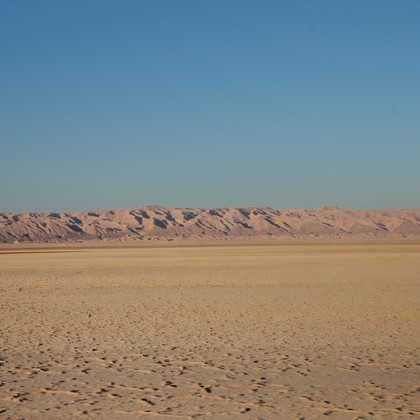
Where the bird is most at home, classified by the habitats of North Africa and the Middle East.


Range and movements
In winter in large numbers in the Arabian Sea and the Gulf of Oman, with flocks of thousands off the coast of Oman and also off the east coast of the Emirates; scarcer in the Red Sea and off Yemen. On passage widespread in the east of the region: in the Emirates a fairly common migrant, mainly in April and September, on inland sewage ponds and at sea, and recorded in every month; also in Kuwait, Qatar, Bahrain, eastern Saudi Arabia and southern Iraq, and in Israel, where small flocks appear on the Eilat salt pans in late summer. Scarcer in Jordan, Syria and Lebanon, and in Egypt mainly along the Red Sea and the Suez Canal. Rare in the Maghreb and Libya: in Morocco a rare visitor with just over a dozen records up to 2006, mainly in winter, including on the Sebkha Bou Areg near Nador. Breeds circumpolar on the tundra, from Iceland and Scotland to Siberia, Alaska and Canada; also winters off Peru and in South-East Asia.
- Resident
- Summer visitor (c. Apr–Sep)
- Winter visitor (c. Oct–Mar)
- Passage (Mar–Apr, Oct–Nov)
- dark = core range, pale = thinly spread
How and when to look
In April and September small flocks can be found on sewage ponds and salt pans in the Emirates and Kuwait, often remarkably tame. On winter boat trips from Muscat or the east coast of the Emirates large flocks are sometimes seen, low over the water like flocks of stints. At Eilat the salt pans north of town are the best site in August and September.
Conservation status
Not globally threatened (LC). At some traditional staging sites outside the region, however, numbers have fallen sharply. At sea the species is vulnerable to oil pollution, a real risk in the Gulf of Oman with its busy tanker lanes; on passage it depends on shallow saline waters that are being lost to coastal development.
Scientific name
Phalaropus lobatus | (Linnaeus, 1758)
Linnaeus described the species in 1758 as Tringa tobata; because it was later moved to another genus, the author and year stand in brackets. The genus Phalaropus was introduced in 1760 by Brisson. Phalaropus comes through French phalarope from Greek phalaris 'coot' and pous 'foot': like coots, phalaropes have lobed toes. lobatus is modern Latin for 'lobed', after the swimming lobes along the toes. The specimen the first description was based on came from Hudson Bay.