All species › Passerines › Crows and jays › Northern Raven
Northern Raven | Corvus corax
Raaf | Cuervo grande
The largest passerine of the region, in the Maghreb and the northern Middle East a bird of mountains, steppes and sea cliffs. Further south it is replaced at the desert edge by Brown-necked Raven, and it is precisely in that transition zone that separating the two is most difficult.

Voice
A deep, sonorous, far-carrying kronk-kronk or prruk, much lower and fuller than Brown-necked Raven; also a clucking klonk, a wooden rattle and soft throaty sounds at the nest.
Recording: Scott Crabtree — CC BY-NC-SA 4.0 · shortened to the first 60 s, mono · xeno-canto
Identification
Large and all black with a blue-purple gloss, with a heavy, deep bill with a strongly curved culmen and thick nasal bristles, and shaggy, projecting throat feathers forming a beard. In flight a long protruding head, long fingered wings and a distinct wedge-shaped tail with a pointed centre; soars and tumbles a lot, even rolling onto its back. The North African form tingitanus is somewhat smaller, with shorter wings and an oily, strongly glossed tone; the form laurencei in the Levant and Iraq has a slightly browner-tinged neck, which can cause confusion with Brown-necked Raven. Juveniles are duller, with a shorter beard.
Confusion species
Brown-necked Raven (Corvus ruficollis) is slimmer, with a longer, more slender and straighter bill, a smooth throat, a brown wash on head and neck, a less pointed wedge-shaped tail and a higher, nasal call. Fan-tailed Raven (Corvus rhipidurus) is smaller and has a very short tail. Carrion Crow (Corvus corone) is smaller and has a rounded tail; moreover in the region it is almost always grey and black. When in doubt the wedge-shaped tail, the beard and the deep voice decide.
Habitat
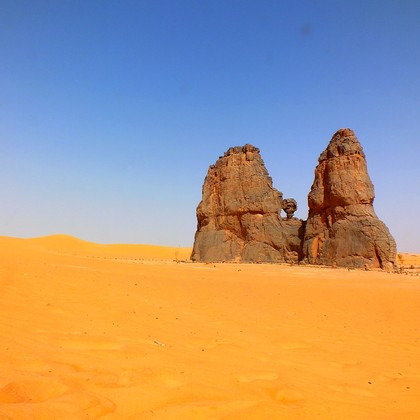
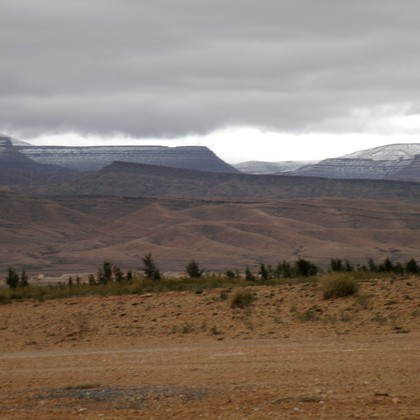
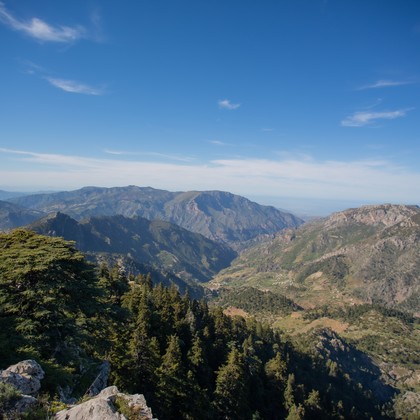
Mountains with cliffs, gorges, the Atlas and the Rif, high plateaux and alfa steppe, cedar forests, sea cliffs and open farmland with scattered trees; in the Levant also hills and steppe on the desert edge. Visits rubbish dumps and slaughter sites. Nests on a rock ledge, in a tall tree or on a pylon.
Where the bird is most at home, classified by the habitats of North Africa and the Middle East.
Range and movements
In Morocco in the Rif, the Middle and High Atlas, on the high plateaux and along the Atlantic coast south to about the Souss; in northern Algeria in the Tell, the Atlas and on the High Plateaux, in northern and central Tunisia and in Libya in the Jebel Nafusa and the Jebel Akhdar in Cyrenaica. In the east in Lebanon, western and northern Syria, northern and central Israel (Galilee, Golan, Carmel, the hill country of Judea and Samaria and the northern Negev), in western Jordan and in northern Iraq (Kurdistan). In Egypt, on the Arabian Peninsula and in the deep desert it is absent and Brown-necked Raven takes its place. Beyond the region over almost the whole northern hemisphere: Europe, Asia and North America, south to the Canary Islands, Iran and the Himalayas.
- Resident
- Summer visitor (c. Oct–Mar)
- Winter visitor (c. Apr–Sep)
- Passage (Mar–Apr, Oct–Nov)
- dark = core range, pale = thinly spread
How and when to look
In the Moroccan interior, on the southern edge of the Atlas and in the Negev highlands, check the bill and the call of every large black bird: here Northern Raven and Brown-necked Raven can both occur on the same day. The cedar forests around Ifrane and the gorges of the Todra and Dadès are good places for the North African form.
Conservation status
Not globally threatened and fairly common in the region in the mountains of the Maghreb and the northern Middle East. Locally declined through poisoning and persecution; elsewhere it benefits from refuse.
Scientific name
Corvus corax | Linnaeus, 1758
Linnaeus described the species in 1758 and placed it straight away in the genus where it still stands. He introduced the genus Corvus in that same work. Corvus is the Latin word for 'raven'. corax is the Latinised form of Greek korax 'raven', so the name says the same thing in both languages. The specimen the first description was based on came from Sweden.