All species › Owls › Typical owls › Omani Owl
Omani Owl | Strix butleri
Omaanse uil | Cárabo de Omán
One of the most enigmatic owls in the world. In 2013 unknown tawny owls were photographed and recorded in the Hajar Mountains of northern Oman and first described as a new species; two years later the old type of Strix butleri, collected in Pakistan in 1878, proved to be the same species. The bird has since been found in Oman, the Emirates and Iran, but is seldom seen.
No photograph of a living wild bird of this species with a suitable Creative Commons licence exists. Do you have one that meets the rules? Send it in.
Voice
A soft, low series of evenly repeated hollow notes, hoo… hoo-hoo… hoo-hoo, more even in rhythm than Desert Owl; mainly in the first hours of the night and often from high cliffs. The first records in Oman and the Emirates were sound recordings.
Recording: Uku Paal — CC BY-NC-SA 4.0 · shortened to the first 60 s, mono · xeno-canto
Identification
A small owl without ear tufts, the size of Desert Owl but clearly darker. The upperparts are grey-brown with fine pale and dark speckling; the underparts pale grey to off-white with fine dark streaks. The facial disc is dark grey-brown with a dark rim, against which the orange eyes stand out; a pale V above the bill. In flight barred flight feathers and tail.
Confusion species
Desert Owl (Strix hadorami) is paler and sandier, with a pale, almost white face, fine bars rather than streaks below and a different call; its occurrence in northern Oman is uncertain. Spotted Eagle-Owl (Bubo africanus) and Pharaoh Eagle-Owl (Bubo ascalaphus) are much larger and have ear tufts. Pallid Scops Owl (Otus brucei) is much smaller and has short ear tufts.
Habitat
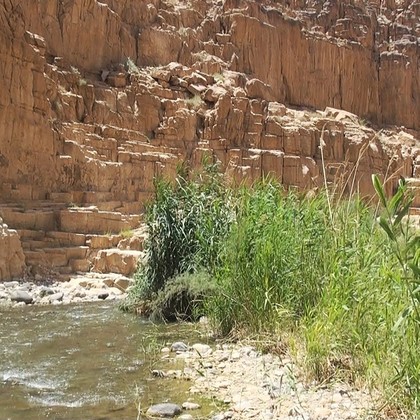
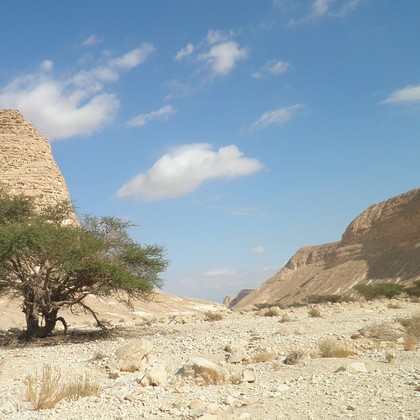
Steep, bare limestone cliffs and deep gorges and wadis in the mountains, often with a spring or permanent pool, at middle altitudes. The nest is unknown but presumably in a crevice or hole in a cliff.
Where the bird is most at home, classified by the habitats of North Africa and the Middle East.

Range and movements
Within the region only in the Hajar Mountains: in northern Oman, where it was discovered in 2013 and has since been found at several sites in the central and eastern parts of the range, and in the Emirates at Wadi Wurayah (Fujairah), where its call was recorded in 2015 and a bird was photographed by a camera trap at a pool in 2020. Beyond the region known from north-eastern and south-western Iran and possibly the Makran coast of Pakistan, where the old type was collected.
- Resident
- dark = core range, pale = thinly spread
How and when to look
Sites are usually kept secret for protection. Anyone staying overnight in the Hajar Mountains can listen in the evening near steep gorges and wadis with water; sound recordings are a valuable contribution to knowledge of the species. Do not use playback.
Conservation status
Too poorly known globally for its status to be properly assessed; the population is presumably small. In the Emirates it is listed as Critically Endangered on the national Red List. Possible threats are disturbance, loss of water sources and development in the mountains.
Scientific name
Strix butleri | (Hume, 1878)
Hume described the species in 1878 as Asio butleri; because it was later moved to another genus, the author and year stand in brackets. The genus Strix was introduced in 1758 by Linnaeus. Strix is the Latin word for 'owl'; in classical lore the strix was a night bird said to suck the blood of infants. butleri honours Edward Arthur Butler (1843–1916), British army officer and ornithologist. The specimen the first description was based on came from Ormara on the Makran coast, Pakistan.