All species › Owls › Typical owls › Tawny Owl
Tawny Owl | Strix aluco
Bosuil | Cárabo común
The familiar owl of European woodland reaches the southern edge of its range in the region. It lives in the forests of the Maghreb and the wooded mountains and hills of the Levant and northern Iraq, and is absent from the deserts, where Desert Owl and Omani Owl take its place.
Voice
The male gives a familiar, quavering hooo… hu-hu-huooo, the female a sharp ke-wick; often interwoven, especially in autumn and winter. Young beg with a hoarse, squeaky psee-ip.
Recording: Mark James Pearson — CC BY-NC-SA 4.0 · converted to mono · xeno-canto
Identification
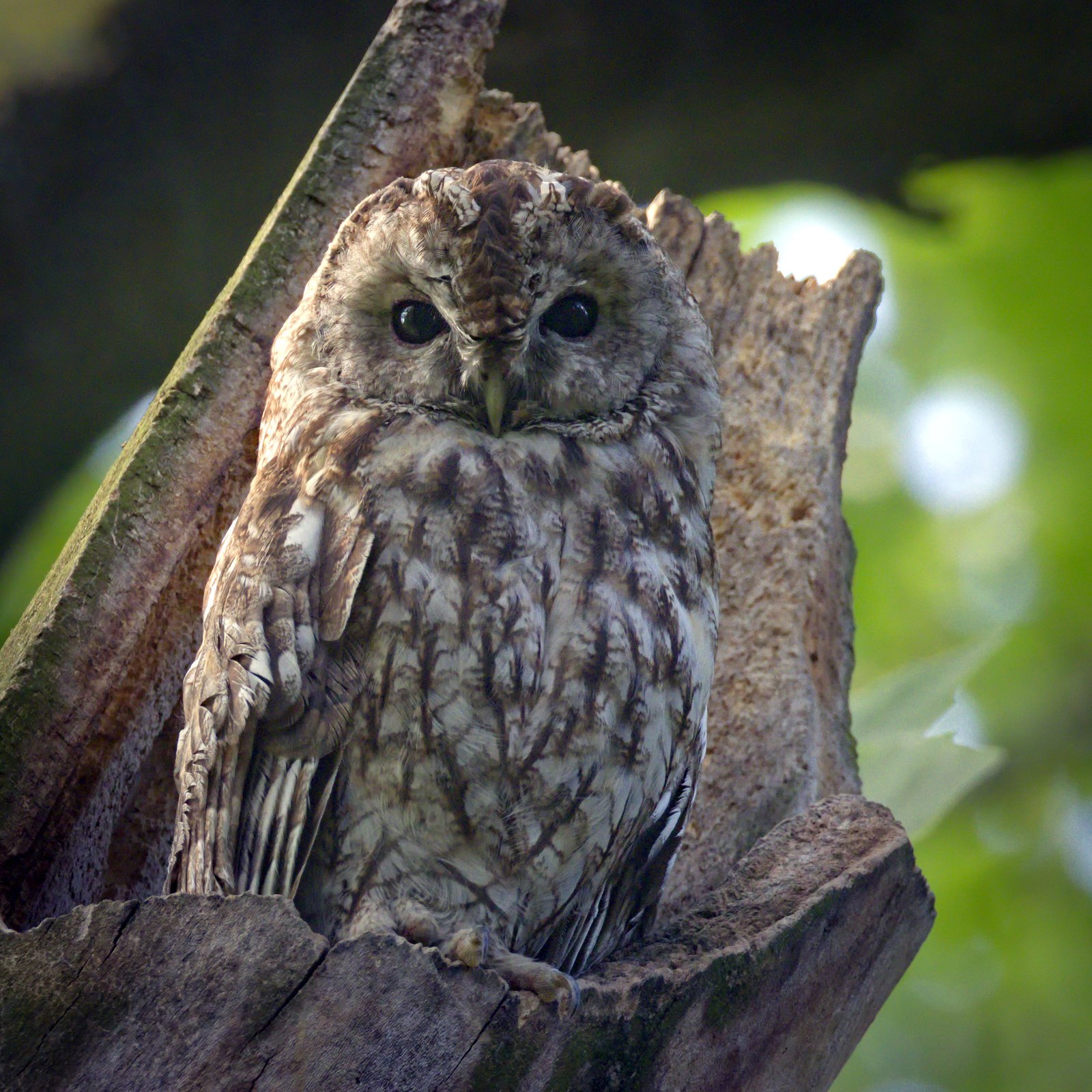
A stocky, medium-sized owl with a large round head without ear tufts and large dark, almost black eyes. The plumage is brown to rufous or grey-brown, with dark streaks and fine bars below and a row of white spots on the scapulars. The face is plain with a dark rim and two pale stripes rising between the eyes like eyebrows. The North African subspecies mauritanica is large and fairly dark and grey-brown. In flight broad-winged and short-tailed, with a big head.
Confusion species
Desert Owl (Strix hadorami) is smaller and much paler and sandier, with orange-yellow eyes and a pale face; it lives in rocky desert, not woodland. Long-eared Owl (Asio otus) is slimmer, with ear tufts and orange eyes. Western Barn Owl (Tyto alba) has a heart-shaped white face and pale underparts.
Habitat
Mature deciduous and coniferous woodland with hollow trees: in the Maghreb oak and cedar forests, cork-oak woodland and mixed forest in the Atlas, the Rif and Kroumirie; in the Levant oak and pine woodland and wooded valleys, but also olive groves, old orchards, parks and cemeteries with large trees. The nest is in a tree hole, sometimes in a rock crevice or building.
Where the bird is most at home, classified by the habitats of North Africa and the Middle East.



Range and movements
In North Africa in the forested areas of Morocco (Rif, Middle and High Atlas, the cork-oak forests of the Atlantic plain), northern Algeria and northern Tunisia. In the east it breeds in Lebanon, western Syria, northern Israel (Galilee, Carmel and the Judean hills to around Jerusalem), the northern highlands of Jordan (Ajloun, Dibbeen) and in the mountains of northern Iraq. Absent from Egypt, Libya and Arabia. Beyond the region it breeds over almost all of Europe, in Turkey and Iran and east to western Siberia, with related forms in Central Asia and China.
- Resident
- Summer visitor (c. Oct–Mar)
- Winter visitor (c. Apr–Sep)
- Passage (Mar–Apr, Oct–Nov)
- dark = core range, pale = thinly spread
How and when to look
In the cedar forests near Ifrane and Azrou in the Middle Atlas it calls shortly after dusk in autumn and early spring. In Israel it can be heard in the woods of Carmel and Galilee and in Jerusalem's parks; in Jordan in the oak woods of Ajloun. Songbirds mobbing noisily around a dense tree sometimes betray a roosting owl.
Conservation status
Not globally threatened. In the region it is sensitive to forest loss, felling of old hollow trees, wildfires and rodent poisoning. At the southern edge of its range in Israel the species appears sensitive to extreme heat and drought.
Scientific name
Strix aluco | Linnaeus, 1758
Linnaeus described the species in 1758 and placed it straight away in the genus where it still stands. He introduced the genus Strix in that same work. Strix is the Latin word for 'owl'; in classical lore the strix was a night bird said to suck the blood of infants. aluco comes from Italian allocco 'tawny owl', which goes back to Latin ulucus 'screech owl'. The specimen the first description was based on came from Sweden.