All species › Owls › Typical owls › Eurasian Eagle-Owl
Eurasian Eagle-Owl | Bubo bubo
Oehoe | Búho real
The largest owl in the region, a mighty nocturnal predator with long ear tufts and fiery orange eyes. Within the region it reaches the southern edge of its enormous Eurasian range only in the north-east: in the mountains of Lebanon, Syria, northern Iraq and the north of Israel and Jordan. Further south and in North Africa its place is taken by Pharaoh Eagle-Owl.

Voice
A deep, dull, far-carrying oo-hu stressed on the first syllable, audible for kilometres on still evenings; the female calls higher and hoarser. Mainly in late autumn and from December to March, shortly after dusk. Alarm a hard, barking kwek-kwek; young beg with a hoarse, plaintive rasp.
Recording: Samuel Persson — CC BY-NC-SA 4.0 · shortened to the first 60 s, mono · xeno-canto
Identification
Very large and heavy, with a broad head, long, obliquely raised ear tufts and large orange eyes. The upperparts are warm brown with black spots and streaks; the underparts tawny-buff with broad black streaks on the breast, merging into fine wavy barring on the belly. The face is brown with a dark rim and a pale throat. Middle Eastern birds are slightly paler and yellower than those of central Europe. In flight huge and buzzard-like, with broad, rounded wings, a short tail and a big head; the wingbeats are shallow and stiff.
Confusion species
Pharaoh Eagle-Owl (Bubo ascalaphus) is clearly smaller and much paler and sandier, with shorter ear tufts and finer breast streaking; in Israel, Jordan and Syria the two meet and intermediates occur. Long-eared Owl (Asio otus) looks like a small eagle-owl, but is much smaller and slimmer. Short-eared Owl (Asio flammeus) hunts in open country, has very short ear tufts and yellow eyes.
Habitat
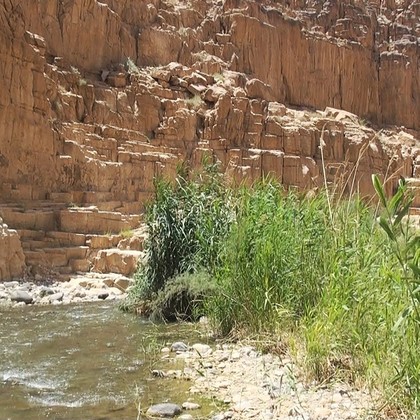
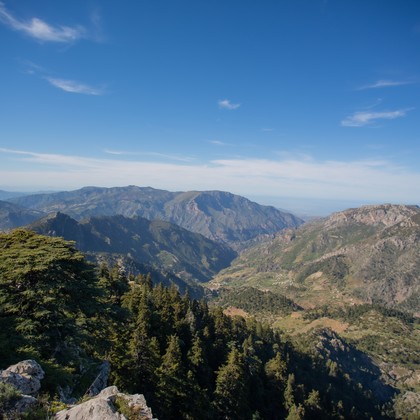
Rugged rocky mountain slopes, gorges and river valleys with cliffs, often mixed with woodland, maquis and open ground; also quarries and ruins. In Iraq also cliffs along rivers in the foothill zone. The nest is on a sheltered ledge or in a hole in a cliff.
Where the bird is most at home, classified by the habitats of North Africa and the Middle East.

Range and movements
Within the region confined to the north-east: in Lebanon in the mountains and the Beqaa Valley, in Syria in the coastal ranges, the Anti-Lebanon and the north and east of the country along the Euphrates, in northern Iraq (Kurdistan and the foothills along the Tigris) and in northern Israel (Golan, Galilee, Carmel) and Jordan (northern highlands). In the south it grades into Pharaoh Eagle-Owl, and the boundary between the two is not sharp. Absent from North Africa and Arabia. Beyond the region it breeds from Iberia and Scandinavia through all of Europe and Asia to Kamchatka, Japan and the Himalayas.
- Resident
- Summer visitor (c. Oct–Mar)
- Winter visitor (c. Apr–Sep)
- Passage (Mar–Apr, Oct–Nov)
- dark = core range, pale = thinly spread
How and when to look
In the Golan and Galilee calling birds can be heard in winter in gorges such as Gamla and Nahal Amud; listen near a cliff shortly after dusk. In Lebanon in the valleys of Mount Lebanon. By day, white droppings and pellets beneath an overhang give away a roost.
Conservation status
Not globally threatened. In the Levant and Iraq scarce and poorly studied; threats include shooting, rodent poisoning, collisions with power lines and traffic, and disturbance of breeding sites by quarries and building.
Scientific name
Bubo bubo | (Linnaeus, 1758)
Linnaeus described the species in 1758 as Strix Bubo; because it was later moved to another genus, the author and year stand in brackets. The genus Bubo was introduced in 1805 by Duméril. Bubo is the Latin word for the eagle-owl. The specific name repeats the genus name. The specimen the first description was based on came from Sweden.