All species › Sandgrouse › Sandgrouse › Pin-Tailed Sandgrouse
Pin-Tailed Sandgrouse | Pterocles alchata
Witbuikzandhoen | Ganga ibérica
The sandgrouse of grassy steppe and high plateaus rather than true desert. With its long pointed tail pins, greenish back and gleaming white belly, it is the most colourful and slender of the region's six sandgrouse. In the morning flocks fly noisily to a drinking place, sometimes dozens of kilometres away.

Voice
In flight a loud, nasal, hoarse katar katar or ga-ga-garr, repeated by every bird in a flock and audible at long range. Rawer and more monotonous than the bubbling kwitoo of Spotted Sandgrouse.
Recording: Esperanza Poveda — CC BY-NC-SA 4.0 · converted to mono · xeno-canto
Identification
Slim, with a long tail whose two central feathers project as thin pins. The male has an olive-green crown and back with yellow and greenish spots, an orange face with a black eye-stripe and a black throat, and a chestnut band across the breast between two narrow black lines. The female is more finely scaled and barred above, with a white throat, two or three thin black breast lines and the same rusty-yellow breast band. Both have a pure white belly. In flight the white underparts and white underwing contrast sharply with the black flight feathers: no other sandgrouse in the region shows such a white underwing.
Confusion species
Spotted Sandgrouse (Pterocles senegallus) also has tail pins, but is plain sandy with a dark central belly stripe, not white. Black-bellied Sandgrouse (Pterocles orientalis) is bulkier, lacks tail pins and has a black belly and dark underwing coverts. Chestnut-bellied Sandgrouse (Pterocles exustus) has a dark chestnut belly and lives further south, in the Arabian lowlands.
Habitat
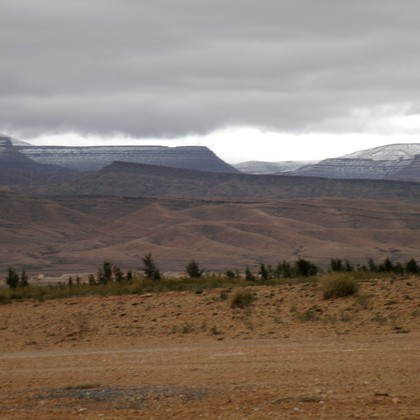
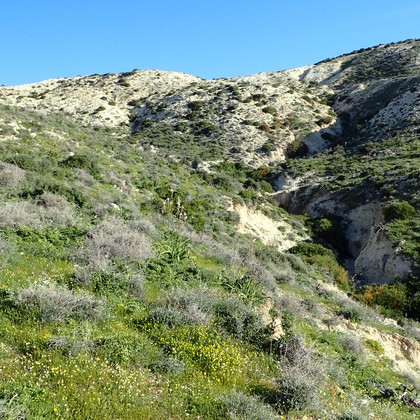
Flat, open steppe with short grass and low shrubs: alfa and herbaceous steppe on the high plateaus, dry grazing land, fallow and stubble, and the margins of chotts and salt flats. Avoids true sand and stone desert, rocky ground and dense vegetation. Eats small seeds, green shoots and buds; drinks mainly in the morning, in winter in flocks of hundreds.
Where the bird is most at home, classified by the habitats of North Africa and the Middle East.

Range and movements
In the Maghreb on the high plateaus and steppes of eastern Morocco (around Missour, Outat el Haj and the Moulouya plain), northern Algeria (the high plateaus from Djelfa to Tébessa) and central Tunisia; scarce in north-western Libya. In the east it breeds on the steppes of Syria and northern Iraq, in eastern Jordan and, much reduced, in the northern Negev in Israel. In winter large flocks appear in Iraq and Kuwait and smaller numbers in northern Saudi Arabia; rare in Egypt and the Gulf states. Beyond the region it breeds in Spain, Portugal and the Crau in southern France, and from Turkey through Iran to Kazakhstan; eastern birds winter as far as Pakistan and north-west India.
- Resident
- Summer visitor (c. Apr–Sep)
- Winter visitor (c. Oct–Mar)
- Passage (Mar–Apr, Oct–Nov)
- dark = core range, pale = thinly spread
How and when to look
In eastern Morocco, head out after sunrise to the plains east of Missour and listen for the hoarse katar of passing flocks; follow them to a pool or trough and wait at a distance. In Tunisia and Algeria the reservoirs on the edge of the high plateaus offer the same chance. In winter in Kuwait and southern Iraq, flocks of hundreds are possible on farmland.
Conservation status
Not globally threatened, but declining across much of its range. In North Africa and the Levant suitable steppe is being lost to ploughing, irrigated farming and overgrazing, and sandgrouse are heavily hunted at drinking places. In Israel the breeding population has dwindled to a small remnant; little is known about numbers in Libya and Iraq.
Scientific name
Pterocles alchata | (Linnaeus, 1766)
Linnaeus described the species in 1766 as Tetrao Alchata; because it was later moved to another genus, the author and year stand in brackets. The genus Pterocles was introduced in 1815 by Temminck. Pterocles is Greek, from pteron 'wing' and -klēs 'notable, splendid'. alchata goes back to Arabic al-qaṭā, the name for sandgrouse, formed from the bird's call. The specimen the first description was based on came from southwestern Europe.