All species › Waders, gulls and terns › Skuas › Pomarine Jaeger
Pomarine Jaeger | Stercorarius pomarinus
Middelste jager | Págalo pomarino
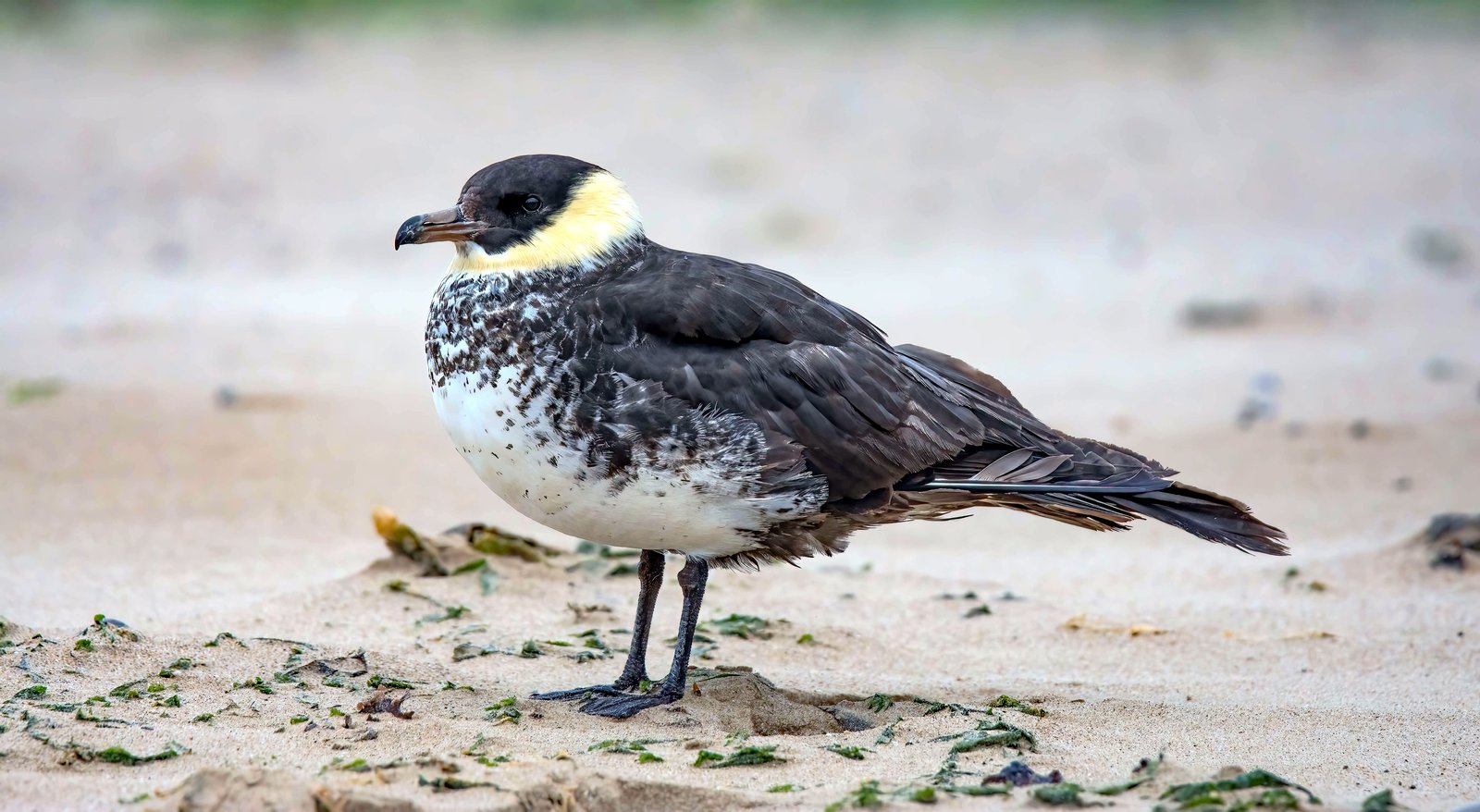
A heavy, barrel-chested skua with spoon-shaped tail feathers, migrating from the Siberian tundra to the tropical oceans. In the region it is seen mainly along the Atlantic coast of Morocco and in the Arabian Sea off Oman; in the Mediterranean and the Gulf it appears chiefly in stormy weather.
Voice
Silent away from the breeding grounds. On the Siberian tundra a hoarse, barking wyek-wyek is given in territorial flights; it is not heard in the region.
Recording: Benjamin Drillat — CC BY-NC-SA 4.0 · converted to mono · xeno-canto
Identification
Bulky and barrel-chested, with a broad wing base, a heavy head and a thick, clearly two-toned bill. The wingbeat is slower and stiffer than in Parasitic Jaeger. Pale-morph adults have a black cap, yellow neck sides, a broad dark breast band and heavily barred flanks and undertail coverts; the elongated central tail feathers are broad, twisted and blunt, like spoons, but often broken or moulted in winter. Dark birds are uniformly blackish brown. Juveniles are cold grey-brown with a plain head, heavily barred tail coverts and a blunt tail projection; on the underwing a double pale patch, at the base of the primaries and of the greater coverts.
Confusion species
Parasitic Jaeger (Stercorarius parasiticus) is slimmer and lighter in flight, with a finer bill and pointed, straight tail feathers. Great Skua (Stercorarius skua) and South Polar Skua (Stercorarius maccormicki) are heavier still, with broader wings, a short tail without projections and a much larger white primary flash. Young gulls such as Lesser Black-backed Gull (Larus fuscus) lack the white primary flash.
Habitat
Open sea and coastal waters over the continental shelf, often near fishing boats and behind flocks of gulls and Northern Gannets. After storms sometimes in harbours and bays. Rests on the sea.
Where the bird is most at home, classified by the habitats of North Africa and the Middle East.

Range and movements
Morocco and Western Sahara: common passage migrant off the Atlantic coast, mainly October – November and April – May, with wintering birds off the southern coast down to Dakhla; also in the Strait of Gibraltar. Algeria, Tunisia and Libya: scarce in winter along the Mediterranean coast. Israel: in winter off the Mediterranean coast, especially during storms, as off Jaffa harbour; in spring a small passage through the Gulf of Aqaba at Eilat. Egypt: scarce on the Mediterranean and in the Gulf of Suez. In Arabia a passage migrant and winter visitor along the Arabian Sea coasts of Oman and Yemen and in the Gulf of Aden, with records off Oman mainly in July – November; rare and not annual in the Gulf of Oman, scarce in the Persian Gulf from Kuwait to the Emirates; scarce along the Red Sea coast of Saudi Arabia. Lebanon and Syria: rare. Breeds on the tundra of northern Russia, Siberia and North America; winters in tropical and subtropical parts of the Atlantic and Indian Oceans.
- Resident
- Summer visitor (c. Apr–Sep)
- Winter visitor (c. Oct–Mar)
- Passage (Mar–Apr, Oct–Nov)
- dark = core range, pale = thinly spread
How and when to look
During Atlantic seawatches at Cap Spartel or Tarfaya, dozens may pass on a good day in May or November, often in small groups with spoon-tails. In Israel it pays to scan the sea off Jaffa or Ashdod during a winter south-westerly gale.
Conservation status
Globally not threatened. Breeding success follows the lemming years on the tundra; the world population is estimated at several hundred thousand. At sea it is at risk from bycatch and oil pollution; no specific threats are known within the region.
Scientific name
Stercorarius pomarinus | (Temminck, 1815)
Temminck described the species in 1815 as Lestris pomarinus; because it was later moved to another genus, the author and year stand in brackets. The genus Stercorarius was introduced in 1760 by Brisson. Stercorarius is Latin for 'of dung', from stercus 'dung': the food disgorged by seabirds when pursued by skuas was once taken for excrement. pomarinus contracts Greek pōma 'lid' and rhis 'nostrils': the nostrils lie beneath the horny cere on the bill. The specimen the first description was based on came from arctic Europe.