All species › Waders, gulls and terns › Skuas › Long-Tailed Jaeger
Long-Tailed Jaeger | Stercorarius longicaudus
Kleinste jager | Págalo rabero
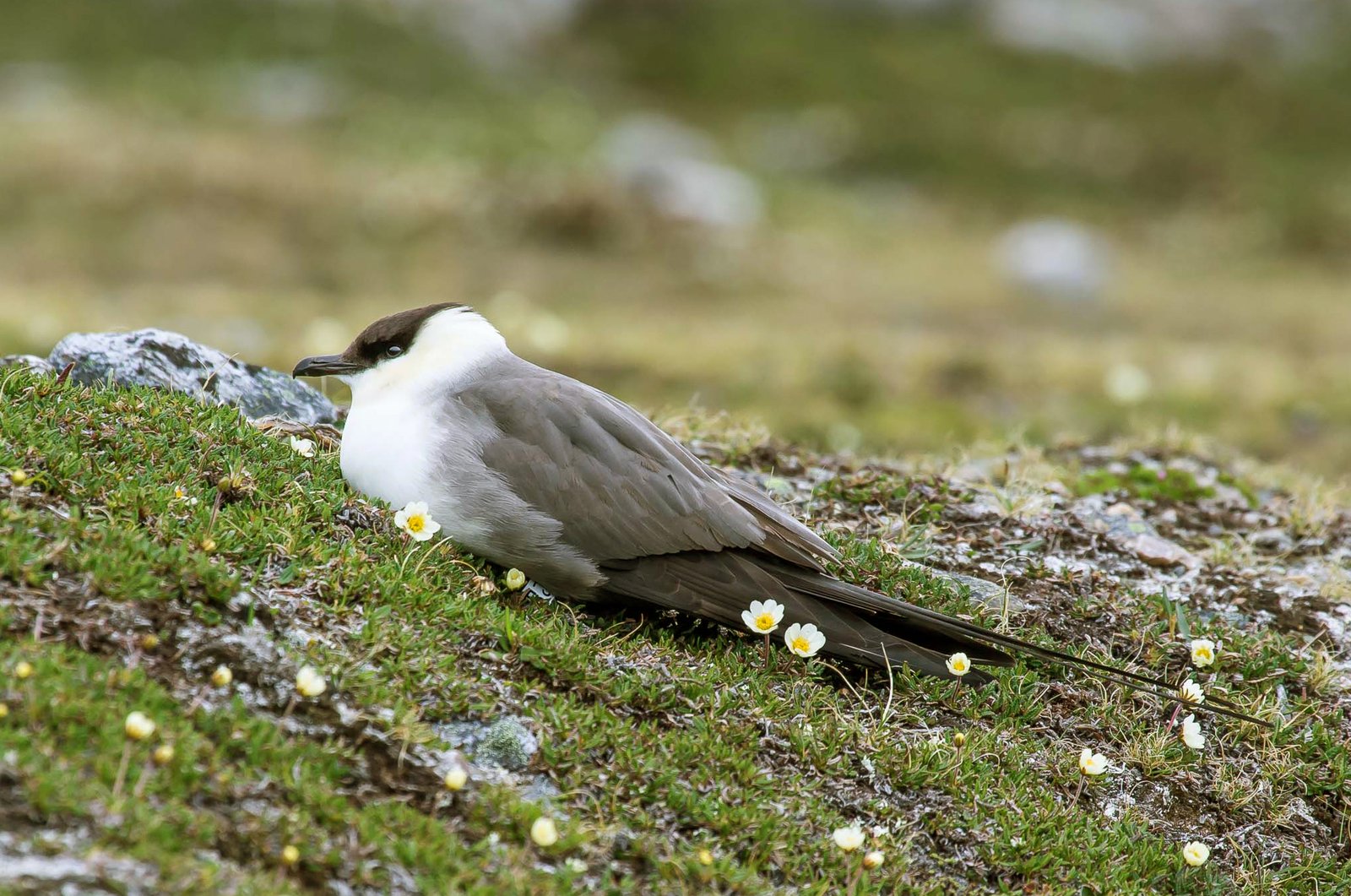
The smallest and slimmest skua, adults with long, whippy tail streamers. It migrates far out at sea and passes the region mainly along the Atlantic coast of Morocco and Western Sahara; in the Mediterranean, the Red Sea and Arabian waters it is a genuine rarity.
Voice
Silent away from the breeding grounds. On the tundra it gives a sharp, nasal kreh-kreh-kreh in display flight; it is not heard in the region.
Recording: Stanislas Wroza — CC BY-NC-SA 4.0 · converted to mono · xeno-canto
Identification
Small and narrow, with a short thick bill, a long pointed hand and a pale grey mantle that contrasts with the black trailing edge of the wing. Adults have a neat black cap, a yellowish-white neck and a white breast without a breast band, grading into a grey belly; the two central tail feathers are thin and flexible and project up to about twenty centimetres. Decisive: only two, sometimes three white shafts in the primaries, so that hardly any pale flash shows from above. Juveniles are cold grey-brown with crisp black-and-white barring on the upper and undertail coverts, often a pale head and a short, blunt tail projection.
Confusion species
Parasitic Jaeger (Stercorarius parasiticus) is bulkier and warmer brown, with a clear white primary flash and shorter, stiff, pointed tail feathers. Juvenile Pomarine Jaegers (Stercorarius pomarinus) are much heavier, with a broad arm and a thick two-toned bill. At a distance the flight can recall a tern, but the dark underwing and the piratical flight rule out terns.
Habitat
Open ocean, usually far offshore over the edge of the continental shelf; it chases other seabirds less than Parasitic Jaeger and catches much of its own food. Only comes closer inshore in strong onshore winds or after storms.
Where the bird is most at home, classified by the habitats of North Africa and the Middle East.

Range and movements
Morocco and Western Sahara: scarce passage migrant off the Atlantic coast, mainly August – October and again in April – May, usually far offshore; from land mostly after westerly gales, for example at Cap Spartel, Essaouira and Tarfaya. Algeria, Tunisia and Libya: rare. Israel: rare visitor, both on the Mediterranean coast (including a juvenile off Jaffa harbour in January 2008) and in the Gulf of Aqaba at Eilat. Egypt, Lebanon and Syria: very rare. Very rare and not annual on the Arabian Peninsula: in the Gulf of Oman ten records off the east coast of the Emirates between 2010 and 2016, mainly in May – August, and only a handful in Oman; isolated records in Saudi Arabia and Kuwait. Breeds on the tundra around the Arctic and on the Scandinavian fells; winters in the South Atlantic off southern Africa and South America.
- Summer visitor (c. Apr–Sep)
- Passage (Mar–Apr, Oct–Nov)
- dark = core range, pale = thinly spread
How and when to look
Your chances are best on a pelagic trip or ferry along the Atlantic coast of Morocco in late August or early September, or during a strong westerly gale from a high seawatching point. Look for a small, grey, tern-like skua without a white wing flash.
Conservation status
Globally not threatened; the population follows the lemming cycles on the tundra and so fluctuates strongly from year to year. Climate change in the Arctic is the main long-term uncertainty. Within the region it is too rare for specific threats to be named.
Scientific name
Stercorarius longicaudus | Vieillot, 1819
Vieillot described the species in 1819 and placed it straight away in the genus where it still stands. The genus Stercorarius was introduced in 1760 by Brisson. Stercorarius is Latin for 'of dung', from stercus 'dung': the food disgorged by seabirds when pursued by skuas was once taken for excrement. longicaudus is Latin, from longus 'long' and cauda 'tail', after the long central tail feathers of the adult. The specimen the first description was based on came from northern Europe.