All species › Waders, gulls and terns › Skuas › Parasitic Jaeger
Parasitic Jaeger | Stercorarius parasiticus
Kleine jager | Págalo parásito
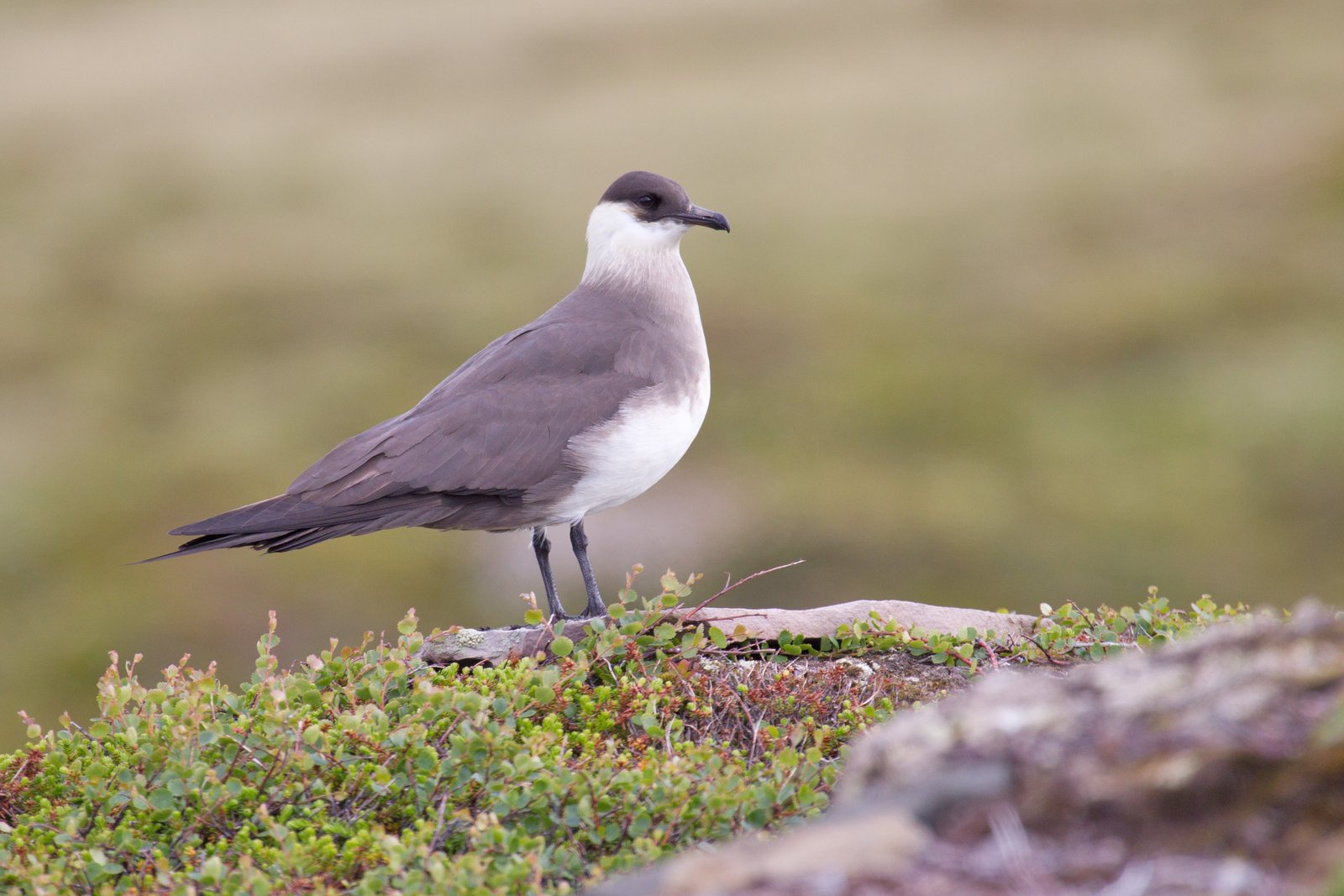
The skua seen most often in the region: a slender, falcon-like pirate that chases terns and gulls until they drop their fish. It migrates in numbers along the Atlantic coast of Morocco and is the commonest skua in the Persian Gulf and the Gulf of Oman, where some birds also stay through the summer.
Voice
Almost always silent at sea and in winter quarters. Only on the breeding grounds in the far north does it give a mewing kee-aaw and a hard tuk-tuk when attacking intruders; in the region you will in practice not hear it.
Recording: Stanislas Wroza — CC BY-NC-SA 4.0 · converted to mono · xeno-canto
Identification
Medium-sized and slim, with a small head, a fine dark bill and a light, agile flight. Adults occur in a pale and a dark morph with every intermediate: pale birds have a black cap, yellowish neck sides, white underparts and often a faint grey-brown breast band; dark birds are uniformly sooty brown. The elongated central tail feathers are straight and sharply pointed and project five to eight centimetres, but are often broken in autumn. In all plumages a clear white primary flash above and below the wing, with four to six white shafts. Juveniles are warm brown to rufous, finely barred, with a short, pointed tail projection.
Confusion species
Pomarine Jaeger (Stercorarius pomarinus) is bulkier and barrel-chested, with a broader arm, a heavy two-toned bill and spoon-shaped tail feathers in adults. Long-tailed Jaeger (Stercorarius longicaudus) is slimmer and greyer above, with only two or three white shafts and no breast band. Young Lesser Black-Backed Gulls (Larus fuscus) and Yellow-Legged Gulls (Larus michahellis) are larger, with a broader wing lacking the white primary flash and a pale tail base.
Habitat
Coastal waters and open sea, often just beyond the surf, in harbours, bays and estuaries where terns and gulls are fishing. Rests on sandbanks and beaches. On migration it sometimes crosses land, and birds then turn up at lagoons, salt pans and reservoirs inland.
Where the bird is most at home, classified by the habitats of North Africa and the Middle East.


Range and movements
Morocco and Western Sahara: common passage migrant along the entire Atlantic coast, mainly August – November and March – May, with wintering birds off Tarfaya, Dakhla and in the Strait of Gibraltar. Algeria, Tunisia and Libya: scarce on passage and in winter along the Mediterranean coast. Egypt and Israel: scarce along the Mediterranean; in spring small numbers move up the Gulf of Suez and the Gulf of Aqaba, at Eilat and Aqaba mainly in April and May. In Arabia a winter visitor and passage migrant along the Red Sea coast of Saudi Arabia and Yemen, in the Gulf of Aden and throughout the Persian Gulf, from Kuwait and Bahrain to Qatar and the Emirates; the commonest skua in the Gulf of Oman, where it occurs all year with a peak in March and April, and along the Arabian Sea coast of Oman. Iraq: rare on the coast at Fao. Lebanon and Syria: scarce. Breeds right around the Arctic, from Scotland and Norway to Siberia and North America; winters mainly off West and southern Africa, South America and Australia.
- Resident
- Summer visitor (c. Apr–Sep)
- Winter visitor (c. Oct–Mar)
- Passage (Mar–Apr, Oct–Nov)
- dark = core range, pale = thinly spread
How and when to look
In autumn, stand with a telescope on an Atlantic headland such as Cap Spartel or the coast at Tarfaya in an onshore wind. Watch the tern flocks: as soon as a bird shoots up in a frantic chase, there is often a Parasitic Jaeger behind it. In the Emirates and Oman, short pelagic trips from Fujairah and Muscat in spring give a good chance.
Conservation status
Globally not threatened and numerous, but the breeding populations in Scotland and Norway have declined sharply in recent decades through food shortage, as sandeels and other prey fish of the seabirds it parasitises disappeared. No specific threats are known within the region.
Scientific name
Stercorarius parasiticus | (Linnaeus, 1758)
Linnaeus described the species in 1758 as Larus parasiticus; because it was later moved to another genus, the author and year stand in brackets. The genus Stercorarius was introduced in 1760 by Brisson. Stercorarius is Latin for 'of dung', from stercus 'dung': the food disgorged by seabirds when pursued by skuas was once taken for excrement. parasiticus is Latin for 'parasitic', after the habit of robbing other seabirds of their catch. The specimen the first description was based on came from the coast of Sweden.