All species › Waders, gulls and terns › Pratincoles and coursers › Oriental Pratincole
Oriental Pratincole | Glareola maldivarum
Oosterse vorkstaartplevier | Canastera oriental
The Asian counterpart of the Collared Pratincole, breeding from India to East Asia and wintering in South-East Asia and Australia. In the region it is a vagrant that turns up with any regularity almost only in the Emirates, usually among flocks of other pratincoles.
Voice
A hard, tern-like chik-chik and a rattling kirri-kirri, mainly in flight; hardly distinguishable from the calls of the other pratincoles.
Recording: 王自堃 — CC BY-NC-SA 4.0 · converted to mono · xeno-canto
Identification
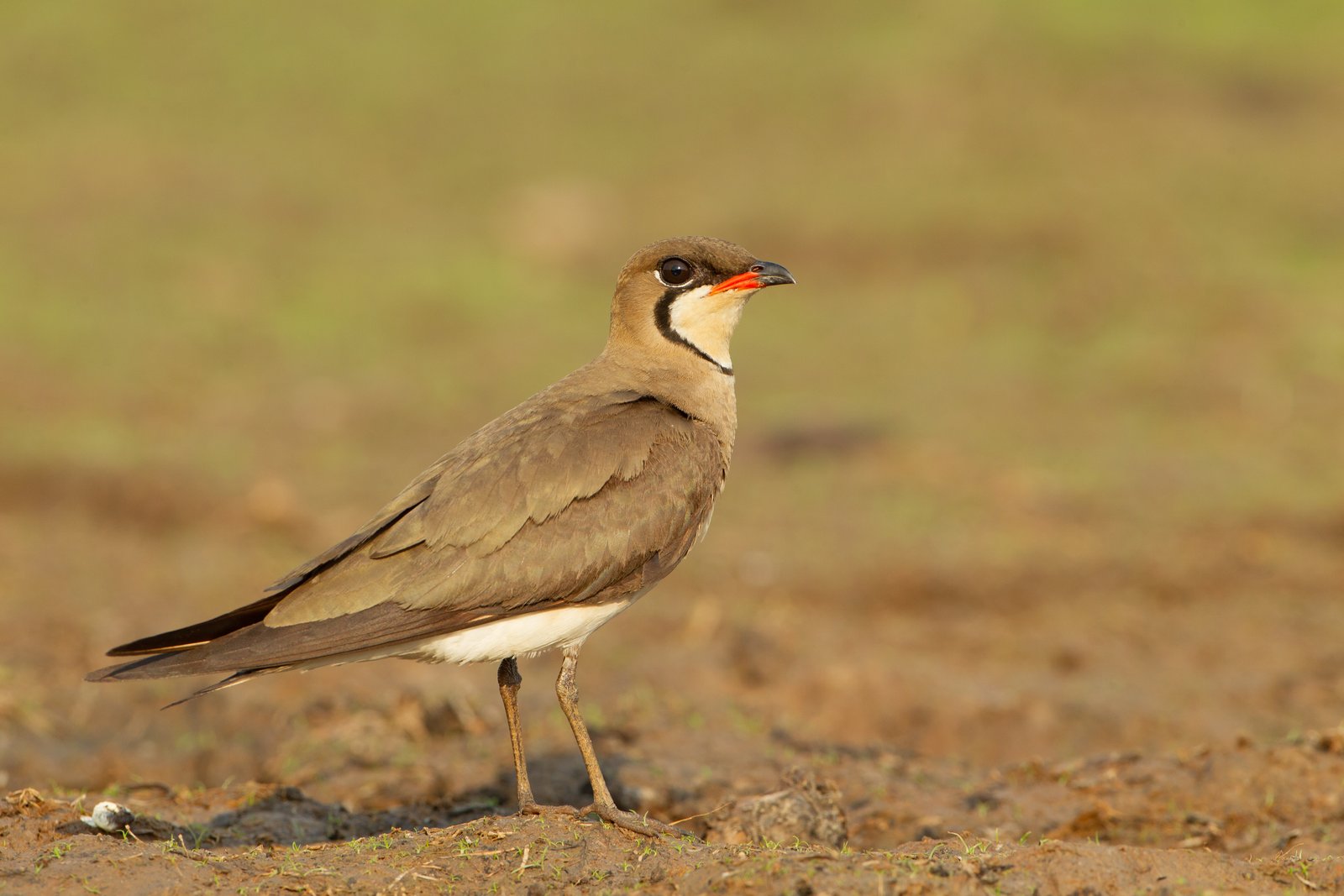
Upperparts olive-brown, belly white, with a warm orange-brown wash on the breast fading towards the flanks. The throat is ochre-buff and outlined by a narrow black border; the bill is black with a red base. Rump white, tail black and only shallowly forked: at rest the wingtips project clearly beyond the tail tip. In flight the underwing is chestnut and there is no white trailing edge to the secondaries. Juveniles are scaled and have a faint throat border.
Confusion species
Collared Pratincole (Glareola pratincola) also has a chestnut underwing, but a narrow white trailing edge to the arm and a longer tail, the tips reaching to or beyond the wingtips at rest. Black-winged Pratincole (Glareola nordmanni) also lacks the white trailing edge, but has a black underwing and is darker above. The short tail and orange breast point to Oriental, but only the combination of underwing, trailing edge and tail length is conclusive.
Habitat
Breeds on bare, drying plains, saline steppe and river banks; outside the breeding season over rice fields, wet grassland and mudflats. Vagrants in the region have mainly been seen on pivot fields, grassland, sewage pools and the edges of salt flats, often with Collared or Black-Winged Pratincoles.
Where the bird is most at home, classified by the habitats of North Africa and the Middle East.



Range and movements
Rare vagrant in the east of the region. Most records come from the Emirates, where about ten birds have been seen since the early 1990s, including around Dubai and Abu Dhabi, some staying for weeks. A handful of records in Oman. In Kuwait one bird at the Sulaibiya pivot fields in March 2008, and probably several birds again in a large flock of Black-Winged Pratincoles in April 2009. In Israel one record: a small group at the Beersheba sewage ponds in October 1999. Not known from North Africa. Beyond the region it breeds from Pakistan and India through East and South-East Asia to Manchuria and the Philippines and winters in South-East Asia, Indonesia and northern Australia.
How and when to look
In the Emirates check every flock of pratincoles on pivot fields and at sewage pools, especially in late summer and autumn: look for a bird with a strikingly short tail and orange breast, and try to get flight photos of the underwing and the trailing edge of the arm. Report a sighting with photos to the national rarities committee.
Conservation status
Vagrant in the region, with an estimated fifteen to twenty records in all, mainly from the Emirates (since 1992); in Kuwait, Oman and Israel only one to a few records. Not globally threatened, with a population of millions, but declining through wetland loss and agricultural intensification in Asia.
Scientific name
Glareola maldivarum | Forster, 1795
Forster described the species in 1795 and placed it straight away in the genus where it still stands. The genus Glareola was introduced in 1760 by Brisson. Glareola is a Latin diminutive of glarea 'gravel', after the bare gravelly ground where pratincoles nest. maldivarum means 'of the Maldives', after the sea off those islands, the type locality. The specimen the first description was based on came from the open sea off the Maldives.