All species › Passerines › Grasshopper warblers › River Warbler
River Warbler | Locustella fluviatilis
Krekelzanger | Buscarla fluvial
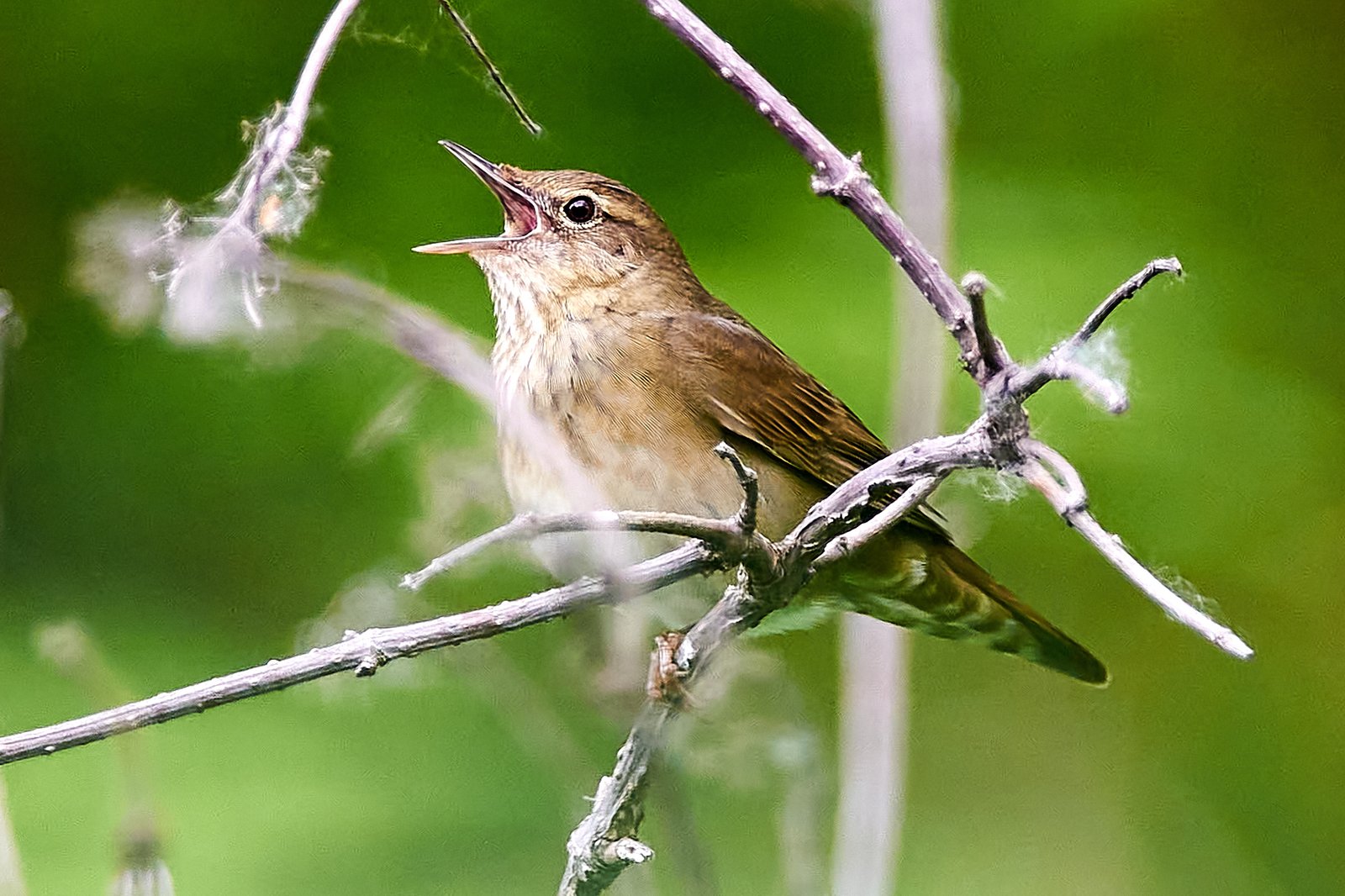
The River Warbler is a shy, plain brown grasshopper warbler from eastern Europe that migrates through the east of the region to and from south-eastern Africa. It is mostly noticed in late spring, when a singing male briefly delivers its slow, ticking rattle in an oasis or garden.
Voice
The song is a slow, hard, segmented rattle on one low pitch: zre-zre-zre-zre or dzhe-dzhe-dzhe, about five to eight strokes per second, slow enough to count; it sounds like an old sewing machine or a steam engine. Savi's Warbler reels faster and fuller, Common Grasshopper-Warbler higher and so fast that nothing can be counted. Migrants regularly sing in spring, also by day. Call: a hard chik.
Recording: Abe Bakker — CC BY-NC-SA 4.0 · shortened to the first 60 s, mono · xeno-canto
Identification
14–16 cm. A fairly large, stocky warbler, plain olive- to coffee-brown above without any streaking. The breast is diagnostic: chin, throat and upper breast carry diffuse grey-brown streaks and spots on an off-white ground, fading towards the flanks. The undertail coverts are long, dark brown with broad off-white tips, giving a scaled look. The tail is long, broad and rounded, the supercilium narrow and faint, the legs flesh-coloured. The primary projection is long. Walks mouse-like on the ground under dense cover.
Confusion species
Savi's Warbler (Locustella luscinioides) is warmer rufous-brown, with an unmarked or only faintly spotted breast and less contrasting tips to the undertail coverts; however, the eastern form fusca that passes through the region is greyer olive-brown and more like River Warbler, so check the breast spotting and the broad white tips under the tail. Common Grasshopper-Warbler (Locustella naevia) is smaller, with streaked upperparts and an unspotted breast. Eurasian Reed Warbler (Acrocephalus scirpaceus) and Blyth's Reed Warbler (Acrocephalus dumetorum) lack the breast spotting and the long, scaled undertail coverts.
Habitat
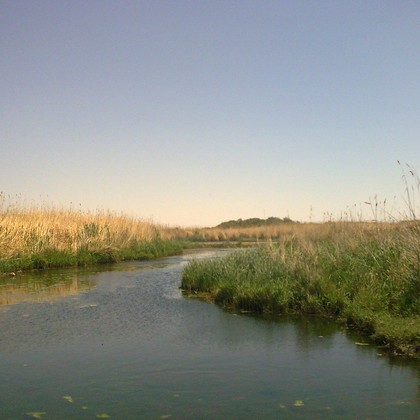
In the breeding season damp, dense undergrowth in riverine woodland, along woodland edges and in tall herbage by rivers. On passage in the region in dense scrub and undergrowth: oases, date-palm gardens, parks, orchards, reed fringes with bushes and wadi vegetation. Eats insects, spiders and small snails, taken on or just above the ground.
Where the bird is most at home, classified by the habitats of North Africa and the Middle East.


Range and movements
Passage migrant in the east of the region, on the route between eastern Europe and south-eastern Africa. In Israel a scarce but regular migrant, most numerous from late April to late May in the Arava and at Eilat, scarcer in autumn; also in Jordan, Lebanon, Syria and Sinai. Scarce in Egypt. In Iraq, Kuwait, eastern Saudi Arabia, Bahrain, Qatar, the United Arab Emirates and Oman a scarce migrant, more often heard than seen; rare in western Saudi Arabia and Yemen. A vagrant to Morocco and Tunisia. Breeds from central Europe and the Balkans east to western Siberia and winters in south-eastern Africa, from Kenya and Tanzania to Zambia and Mozambique.
- Passage (Mar–Apr, Oct–Nov)
- dark = core range, pale = thinly spread
How and when to look
The best chance is in May at Eilat or the kibbutzim of the Arava: listen in the early morning and evening for the slow, countable rattle from a dense bush or reed edge. At ringing stations in Israel and the Gulf states it is caught more often than seen.
Conservation status
Not globally threatened. The breeding population is large and the western edge of the range is expanding. On passage it depends on oases and green stopover sites in the desert.
Scientific name
Locustella fluviatilis | (Wolf, 1810)
Wolf described the species in 1810 as Sylvia fluviatilis; because it was later moved to another genus, the author and year stand in brackets. The genus Locustella was introduced in 1829 by Kaup. Locustella is Latin, a diminutive of locusta 'grasshopper'. fluviatilis is Latin for 'of the river', from fluvius 'river', after the damp riverside woods where it breeds. The specimen the first description was based on came from the Danube, Austria.