All species › Passerines › Grasshopper warblers › Savi's Warbler
Savi's Warbler | Locustella luscinioides
Snor | Buscarla unicolor
Savi's Warbler is an unstreaked, rufous-brown grasshopper warbler of old, wet reeds, best known for its low, even reeling at dusk. In the region it breeds locally in the large marshes of the Maghreb, the Levant and Iraq; elsewhere it passes through unobtrusively on its way to the Sahel and East Africa.
Voice
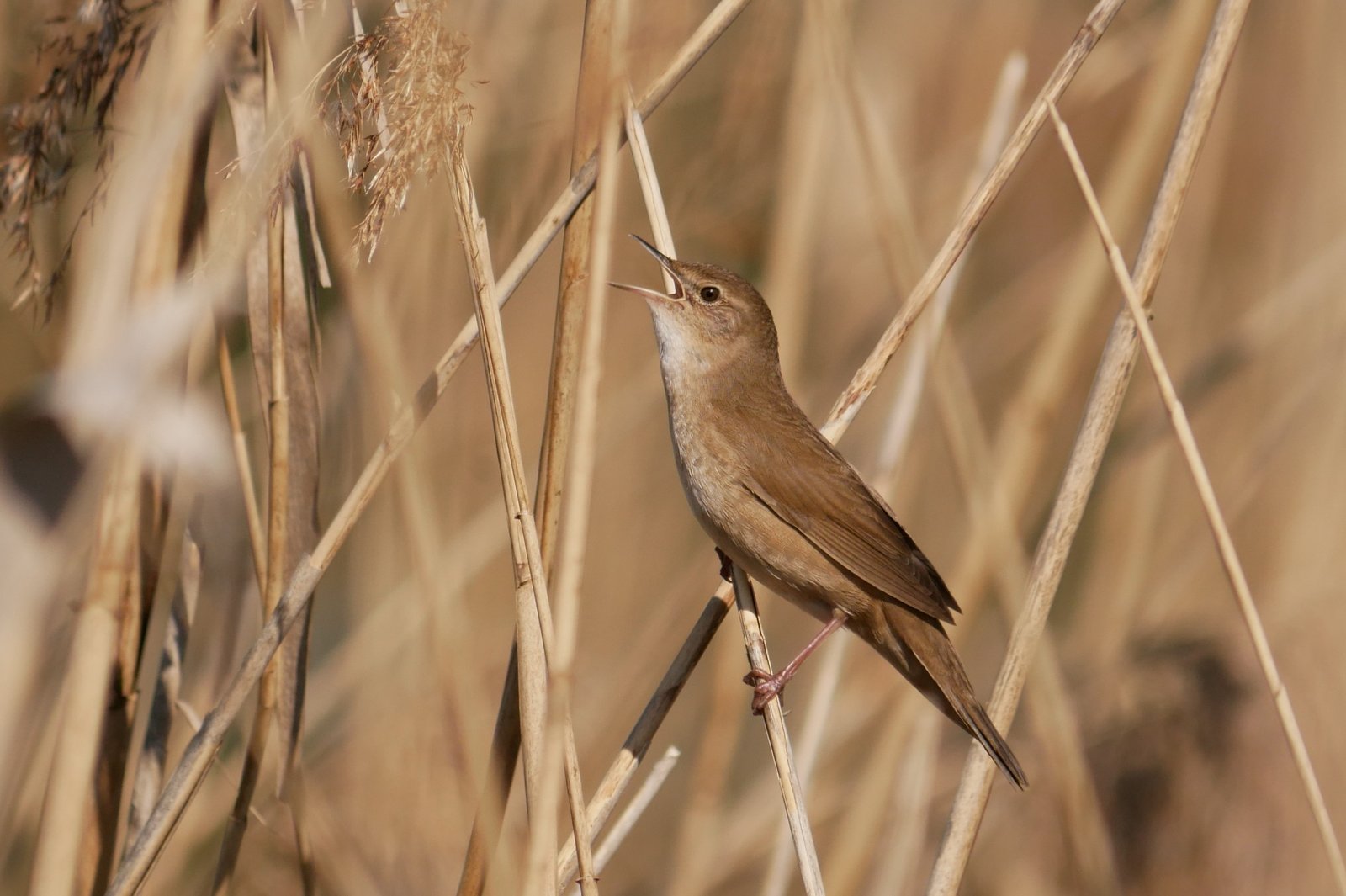
The song is a low, even, mechanical reel on one pitch: a sustained surrrrrrrrr lasting tens of seconds, often preceded by separate ticks that accelerate until they merge: tik … tik … tiktiktik-surrrrr. Lower, fuller and more even than Common Grasshopper-Warbler, faster and smoother than River Warbler. Mainly at dusk and at night, from a reed stem. Call: a short, sharp chik.
Recording: Romuald Mikusek — CC BY-NC-SA 4.0 · shortened to the first 60 s, mono · xeno-canto
Identification
13–15 cm. Plain warm rufous-brown above, without any streaking, with an off-white throat and pale brown breast and flanks. The tail is long, broad and strongly rounded, with long, plain brown undertail coverts with narrow pale tips. Forehead flat, supercilium short and faint, legs pink to flesh-coloured. The eastern form fusca, which breeds in Iraq and the Levant and migrates through Arabia, is colder olive-brown and greyer below, with more obvious white tips to the undertail coverts. Sexes alike.
Confusion species
Common Grasshopper-Warbler (Locustella naevia) is olive-brown with fine dark streaks on crown and mantle and streaked undertail coverts, and reels higher and drier. River Warbler (Locustella fluviatilis) has a spotted breast and long undertail coverts with broad white tips; especially the form fusca can resemble it. Eurasian Reed Warbler (Acrocephalus scirpaceus) has a more pointed bill, a shorter, less rounded tail and short undertail coverts, and sings in repeated phrases.
Habitat
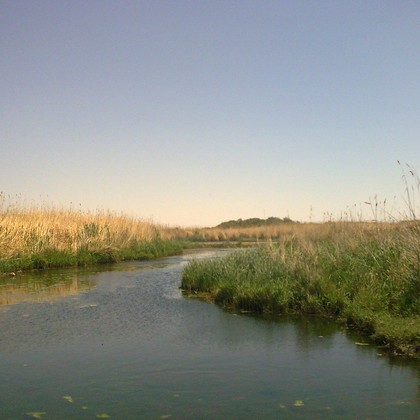
Large, old, permanently wet reedbeds and reedmace with a thick layer of dead reed, sometimes with scattered bushes, along lakes, marshes and riverbanks. On passage also in reed fringes of smaller pools, treatment ponds and irrigation canals, and in dense tall herbage. Eats insects and spiders, gleaned low in the reeds.
Where the bird is most at home, classified by the habitats of North Africa and the Middle East.

Range and movements
Breeds in the north of the Maghreb in large marshes: locally in north-western Morocco (including Merja Zerga and the lower Loukkos), in north-eastern Algeria (the lakes near El Kala) and in northern Tunisia (Ichkeul). In the east the form fusca breeds in the marshes of Iraq, in Syria and in small numbers in the Hula Valley in Israel; breeding has been suspected in Kuwait. As a passage migrant widespread throughout the region, scarce in Libya and Egypt, regular in Israel and the Jordan Valley, and a scarce migrant in Kuwait, eastern Saudi Arabia, Bahrain, Qatar, the United Arab Emirates and Oman. Winters in the Sahel, from Senegal to Sudan and Ethiopia. Beyond the region it breeds from Iberia and central Europe east to Central Asia.
- Summer visitor (c. Oct–Mar)
- Winter visitor (c. Apr–Sep)
- Passage (Mar–Apr, Oct–Nov)
- dark = core range, pale = thinly spread
How and when to look
In the Maghreb in May at sunset on the edge of the reeds of Merja Zerga or Ichkeul; in Israel in the Hula Valley, where migrants also sing in March and April. Stand facing the reeds and wait for the reeling; a singing male often sits halfway up a sturdy reed stem and can be watched for minutes.
Conservation status
Not globally threatened. In North Africa and the Middle East vulnerable to drainage and burning of marshes, reed harvesting and falling water levels; the Mesopotamian marshes and the Maghreb lakes are the main breeding sites in the region.
Scientific name
Locustella luscinioides | (Savi, 1824)
Savi described the species in 1824 as Sylvia Luscinioides; because it was later moved to another genus, the author and year stand in brackets. The genus Locustella was introduced in 1829 by Kaup. Locustella is Latin, a diminutive of locusta 'grasshopper'. luscinioides means 'nightingale-like', from Luscinia, the nightingale, and Greek -oides 'resembling'. The specimen the first description was based on came from Pisa.