All species › Waders, gulls and terns › Gulls and terns › Slender-Billed Gull
Slender-Billed Gull | Chroicocephalus genei
Dunbekmeeuw | Gaviota picofina
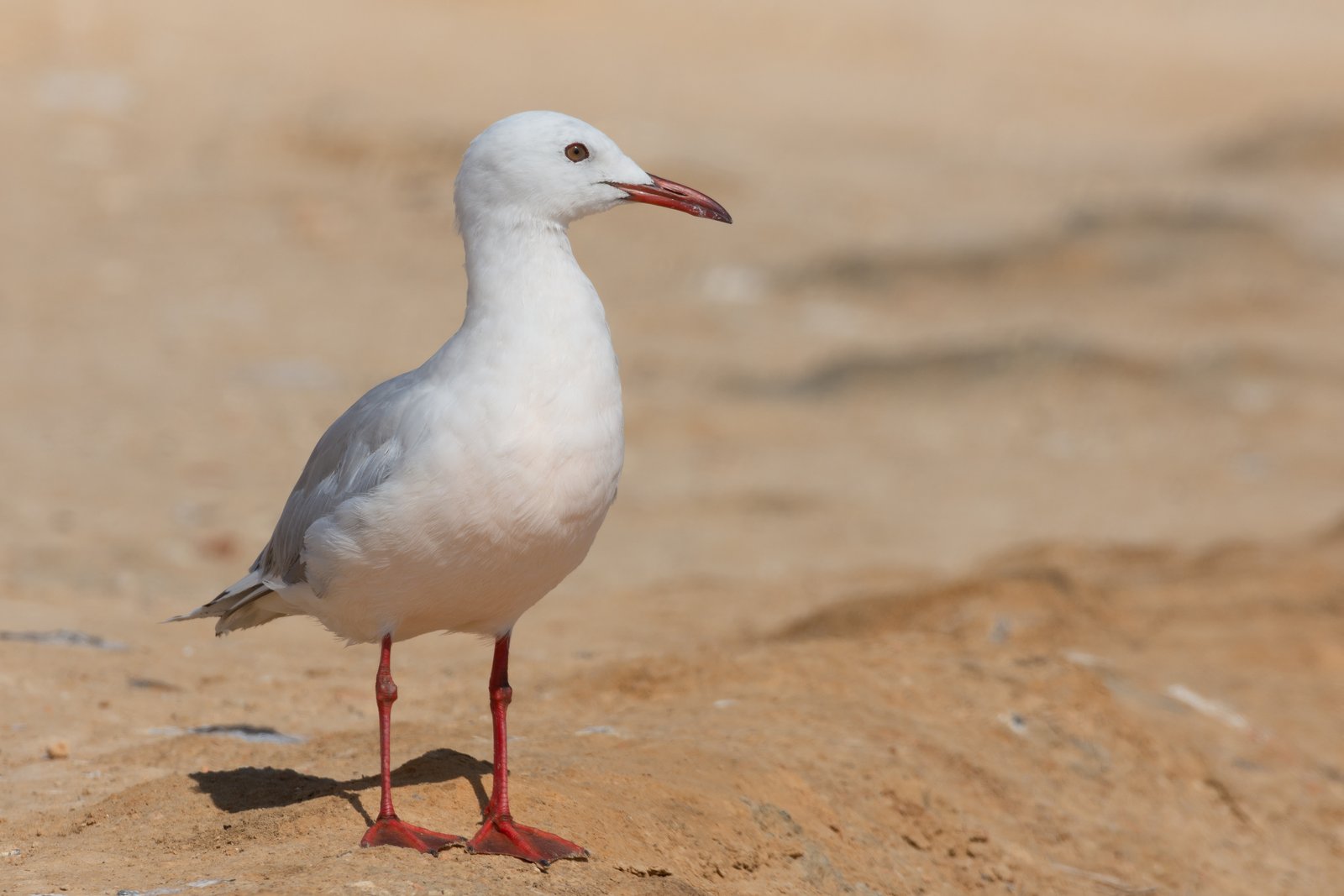
A pale, slim gull with a long, slender head and a white head in all plumages, sharing the habitat of the avocet in the region: salt pans, sebkhas and shallow lagoons. It breeds patchily from Tunisia to the Persian Gulf and is one of the commonest gulls in the Gulf and along the Red Sea in winter.
Voice
Lower, harsher and more nasal than Black-headed Gull: a drawn-out krrair or kaa, and in the colony a humming, grating chatter.
Recording: David Darrell-Lambert — CC BY-NC-SA 4.0 · converted to mono · xeno-canto
Identification
Slightly larger than Black-headed Gull, with an elongated head, a long, slightly drooping bill and a long neck, giving a hunched, 'long-nosed' look at rest and in flight. Adults have a white head without a hood, a pale grey mantle and, in the breeding season, a pink flush on the breast and belly; the bill is dark red and looks black at a distance, the legs are dark red. The eye is pale (pale yellow to whitish), giving a 'staring' expression. The wing pattern is like Black-headed Gull: a white leading edge and black tips to the primaries. In winter there is at most a faint grey spot behind the eye. Juveniles have a pale orange bill and legs, a faint ear spot and a brown wing bar.
Confusion species
Black-headed Gull (Chroicocephalus ridibundus) is very similar in winter plumage, but has a rounder head, a shorter, straighter bill, a dark eye and a distinct dark ear spot; in breeding plumage it has a chocolate-brown hood. In a mixed flock look at the profile: Slender-billed Gull holds its head low and forward and looks longer-necked. Audouin's Gull (Ichthyaetus audouinii) is larger, has a heavy red bill and lacks the white leading edge to the wing.
Habitat
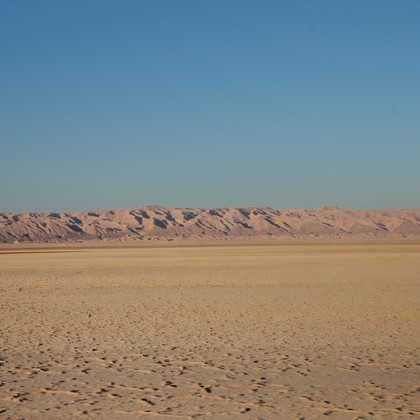
Salt pans, sebkhas, coastal lagoons, tidal flats and sheltered bays; less on fresh water and rarely far inland. It feeds by swimming and picking at the surface, often in dense flocks, and sometimes makes shallow dives. Breeds in dense colonies on bare islets and bunds in salt pans and lagoons, often alongside terns.
Where the bird is most at home, classified by the habitats of North Africa and the Middle East.

Range and movements
In North Africa it breeds mainly in Tunisia (salt pans of Sfax, islets in the Gulf of Gabès), and also irregularly and in small numbers in Morocco and Algeria, and in Egypt on Lake Bardawil and the delta lakes near Port Said. In the east there are large colonies in Kuwait (Bubiyan) and southern Iraq, and smaller ones on the Saudi Gulf coast, in Bahrain, Qatar and the Emirates. In winter it spreads along the entire coast of the region: the Atlantic and Mediterranean coasts of Morocco, Tunisia, Libya and the Nile Delta, the Levant coast, the Gulf of Aqaba (Eilat), the Red Sea coasts of Egypt, Saudi Arabia and Yemen, and above all the Persian Gulf and Oman (including Barr al Hikman and Masirah), where tens of thousands winter. Scarce inland, for example on the Iraqi marshes and reservoirs. Beyond the region it breeds patchily around the Mediterranean and Black Sea, from Mauritania and Senegal to Kazakhstan and Pakistan.
- Resident
- Summer visitor (c. Oct–Mar)
- Winter visitor (c. Apr–Sep)
- Passage (Mar–Apr, Oct–Nov)
- dark = core range, pale = thinly spread
How and when to look
In winter the lagoons and salt pans of the Gulf, such as Al Jahra in Kuwait, Al Wathba and the Abu Dhabi coast, and Barr al Hikman in Oman are the best sites, with flocks of hundreds to thousands. At Eilat it is present year-round on the salt pans and North Beach. The Tunisian salt pans at Sfax combine it with avocets and flamingos.
Conservation status
Not globally threatened. Because the breeding population in the region is concentrated in a handful of colonies, it is vulnerable to disturbance, egg collecting, land reclamation and coastal development; the large colonies in Kuwait and southern Iraq depend on undisturbed islands, and the decline of traditional salt production costs breeding habitat in places.
Scientific name
Chroicocephalus genei | (di Brème, 1839)
Di Brème described the species in 1839 as Larus Genei; because it was later moved to another genus, the author and year stand in brackets. The genus Chroicocephalus was introduced in 1836 by Eyton. Chroicocephalus combines the Ancient Greek khrōikos 'coloured' with -kephalos '-headed'. genei honours the Italian naturalist Giuseppe Gené. The specimen the first description was based on came from Sardinia.