All species › Waders, gulls and terns › Gulls and terns › Sooty Gull
Sooty Gull | Ichthyaetus hemprichii
Hemprichs meeuw | Gaviota cejiblanca
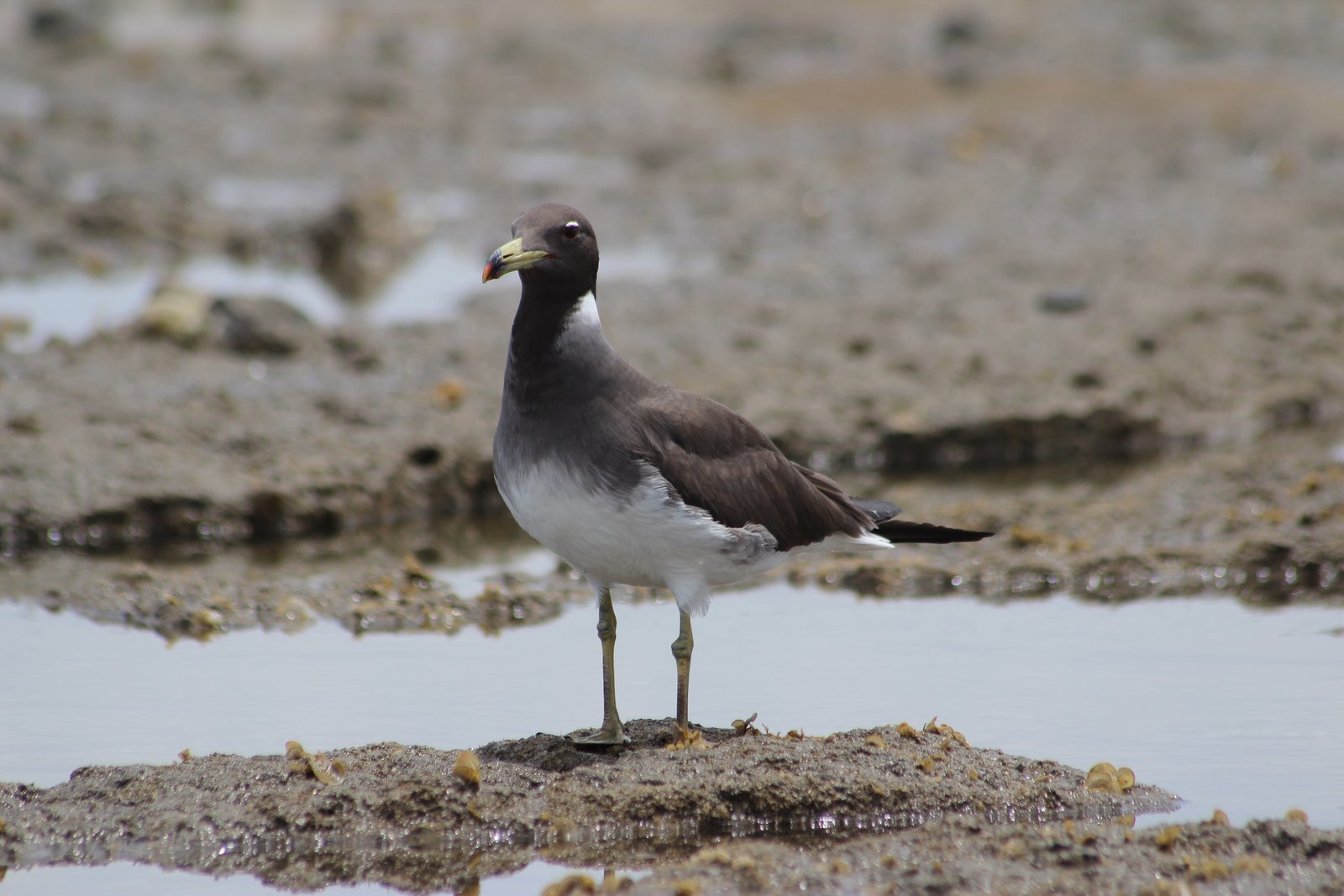
The common dark gull of the Arabian coasts, from Eilat to Socotra and Oman. It is larger and coarser than White-eyed Gull, with a brown hood and a heavy, two-toned bill, and is often remarkably tame in harbours and at fish markets.
Voice
A loud, hoarse, wailing kee-aaa, often in series, and a nasal kek-kek; noisy in harbours and colonies.
Recording: David Darrell-Lambert — CC BY-NC-SA 4.0 · converted to mono · xeno-canto
Identification
Medium-sized and fairly long, with a long, heavy bill and a dark appearance. Adults have a dark chocolate-brown head with a narrow white crescent above the eye, a white collar separating the hood from a brown breast band, a dark grey-brown mantle and blackish wings with a white trailing edge; belly and tail are white. The bill is yellow-green with a black band and a red tip, the legs greenish yellow. In winter the hood is paler and the white collar less distinct. Young birds are grey-brown and scaly, with a pale head, a dark tail band and a pale, blue-grey bill with a black tip.
Confusion species
White-eyed Gull (Ichthyaetus leucophthalmus) is smaller and slimmer, with a black hood, a broader white eye-ring and a thin dark red bill. Young Sooty Gulls can resemble young Lesser Black-Backed Gulls (Larus fuscus), but have a plain brown breast, a white rump with a sharp black tail band and a two-toned bill.
Habitat
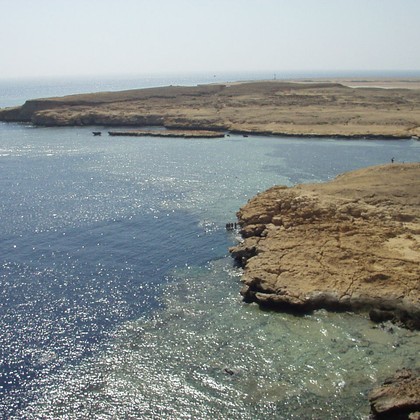
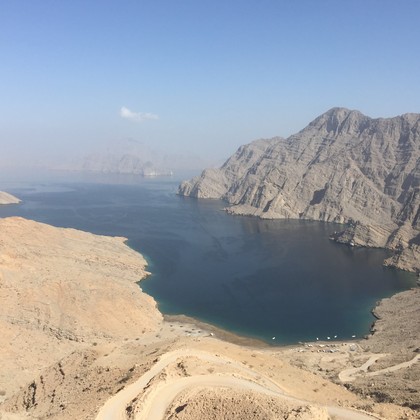
Coasts, harbours, fish markets, beaches and lagoons, also coral reefs and mangroves, and nearby open sea. Breeds in loose colonies on bare islets, rocks and coastal flats. Eats fish, offal and the eggs of other seabirds, and is a regular scavenger behind fishing boats.
Where the bird is most at home, classified by the habitats of North Africa and the Middle East.

Range and movements
Breeds along the Red Sea coast of Egypt, Saudi Arabia and Yemen, in the Gulf of Aden, on Socotra, along the coast of Oman (including the Daymaniyat and Hallaniyat Islands and Masirah) and in smaller numbers in the Emirates and on islets in the southern Persian Gulf. Present year-round along all these coasts, in winter spreading a little further in the Gulf to Qatar, Bahrain and Kuwait, where it is scarce. In the Gulf of Aqaba (Eilat, Aqaba) and the Gulf of Suez scarce but regular; a vagrant on the Mediterranean coasts of Israel and Egypt. Beyond the region it breeds along the coasts of Iran and Pakistan and on the African side of the Red Sea to Somalia and Kenya, and wanders to India and Tanzania.
- Resident
- Summer visitor (c. Oct–Mar)
- Winter visitor (c. Apr–Sep)
- Passage (Mar–Apr, Oct–Nov)
- dark = core range, pale = thinly spread
How and when to look
In Oman it can be seen in every harbour, for example at Mutrah fish market in Muscat and the harbours of Sur and Salalah; on Socotra it frequents the fishing villages along the coast. At Eilat it sometimes stands among the White-Eyed Gulls on North Beach, allowing a direct comparison.
Conservation status
Not globally threatened and numerous in much of the region. Threats are egg collecting and disturbance on breeding islands, oil pollution in the busy Gulf and Red Sea, and coastal development; it actually benefits from fish waste in harbours.
Scientific name
Ichthyaetus hemprichii | (Bruch, 1855)
Bruch described the species in 1855 as Larus (Adelarus) Hemprichii; because it was later moved to another genus, the author and year stand in brackets. The genus Ichthyaetus was introduced in 1829 by Kaup. Ichthyaetus is Greek, from ikhthus 'fish' and aetos 'eagle', hence 'fish eagle'. hemprichii honours the German naturalist Wilhelm Hemprich (1796–1825), who died on an expedition to Egypt and the Middle East. The specimen the first description was based on came from the Red Sea.