All species › Waders, gulls and terns › Gulls and terns › Audouin's Gull
Audouin's Gull | Ichthyaetus audouinii
Audouins meeuw | Gaviota de Audouin
A slender, medium-sized gull that breeds only in the Mediterranean and was once one of the world's rarest gulls. In the region it breeds on rocky islets off the North African coast and in winter moves along Morocco's Atlantic coast to West Africa.

Voice
A hoarse, nasal gyeh and a dry ga-ga-ga, higher and less full than Yellow-legged Gull.
Recording: Sergi Carreras — CC BY-NC-SA 4.0 · converted to mono · xeno-canto
Identification
Slightly smaller and much slimmer than Yellow-legged Gull, with long, pointed wings, a sloping head and a relatively short neck. Adults have a pale grey mantle, a white head and underparts with a greyish wash, and black wingtips with only small white tips; from below the primaries look dark. The bill is striking: deep red with a black band and a yellow tip, simply dark at a distance. The legs are dark grey-green, the eye dark. Juveniles are grey-brown and scaly, with a dark tail and white rump and a black bill; in their second winter they have a grey mantle and a dark bill with a pale base.
Confusion species
Yellow-legged Gull (Larus michahellis) is larger and bulkier, with a heavy yellow bill with a red spot, yellow legs and more white in the wingtip. Slender-billed Gull (Chroicocephalus genei) is smaller, has a white leading edge to the wing and a pale eye. Young birds resemble young Lesser Black-Backed Gulls (Larus fuscus), but are slimmer, with a more uniformly dark tail, a sharply contrasting white rump and a dark, slender bill.
Habitat
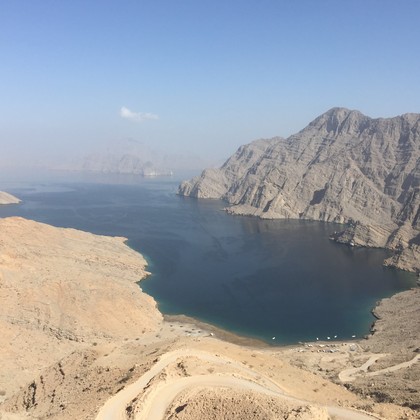
A true seabird of rocky offshore islets, sandbanks and open sea, picking fish from the surface at night, often behind fishing boats. In winter also on beaches, lagoons and in harbours. Breeds in colonies on flat, sparsely vegetated islets and sometimes on salt pans and shingle bars.
Where the bird is most at home, classified by the habitats of North Africa and the Middle East.


Range and movements
Breeds on islets along the Mediterranean coast of North Africa: off Morocco (the Spanish Chafarinas Islands near the Moulouya mouth, holding the largest colony in North Africa, and small colonies on the Moroccan coast), Algeria (including the Habibas Islands), Tunisia (La Galite, Zembra and islets in the Gulf of Gabès) and Libya. In winter most birds move through the Strait of Gibraltar to the Atlantic coast of Morocco and Western Sahara (Khnifiss, Dakhla) and on to Mauritania and Senegal; some remain in the western Mediterranean. Scarce in the east: irregular on the coasts of Egypt, Israel and Lebanon, mostly birds from the Aegean and Cyprus. Beyond the region it breeds around the whole Mediterranean, with its stronghold in Spain, and also on Corsica, Sardinia and in Greece, Turkey and Cyprus.
- Resident
- Summer visitor (c. Apr–Sep)
- Winter visitor (c. Oct–Mar)
- Passage (Mar–Apr, Oct–Nov)
- dark = core range, pale = thinly spread
How and when to look
On Morocco's Atlantic coast it is easy to see in winter at the Oued Massa and the Souss estuary, and in large numbers at Khnifiss lagoon and Dakhla Bay. In the breeding season it is easiest to see from boats to the Tunisian islands and at the Moulouya mouth.
Conservation status
After a recovery from about a thousand pairs in the 1960s to around ten thousand now, it is classed as Vulnerable (VU), because the world population is concentrated in a few large colonies and those in Spain have recently declined sharply. Threats are disturbance and predation on the breeding islands, bycatch in longline fisheries, changes in fishery discards and coastal development.
Scientific name
Ichthyaetus audouinii | (Payraudeau, 1826)
Payraudeau described the species in 1826 as Larus Audouinii; because it was later moved to another genus, the author and year stand in brackets. The genus Ichthyaetus was introduced in 1829 by Kaup. Ichthyaetus is Greek, from ikhthus 'fish' and aetos 'eagle', hence 'fish eagle'. audouinii honours the French naturalist Jean Victoire Audouin (1797–1841). The specimen the first description was based on came from Sardinia and Corsica.