All species › Waders, gulls and terns › Gulls and terns › Pallas's Gull
Pallas's Gull | Ichthyaetus ichthyaetus
Reuzenzwartkopmeeuw | Gavión cabecinegro
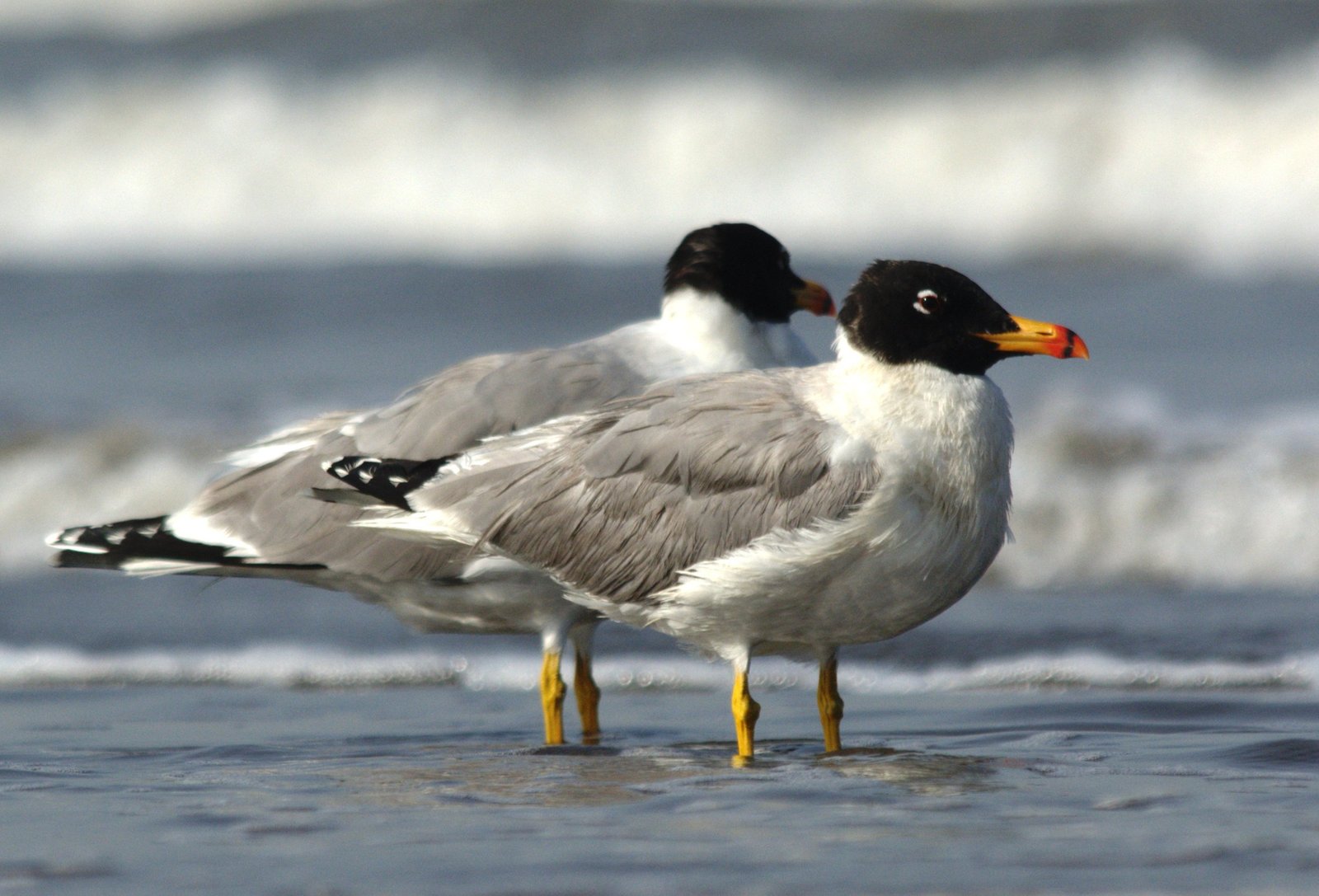
The world's largest black-headed gull, almost as big as a Great Black-backed Gull, with a bulky, elongated profile. It breeds on the steppe lakes of Central Asia and is a regular and conspicuous winter visitor to the eastern part of the region.
Voice
A deep, hoarse, crow-like krau or kra-ah, lower than other gulls; seldom heard away from the breeding grounds.
Recording: Stanislas Wroza — CC BY-NC-SA 4.0 · shortened to the first 60 s, mono · xeno-canto
Identification
Very large, with a long, heavy bill, a low, sloping forehead and a peaked rear crown, long wings and long legs. Adults have a pale grey mantle, white wingtips with a small black subterminal pattern and, in breeding plumage (already from January in many birds), a black hood with striking white eye-crescents. The bill is yellow with a red tip and a black band, the legs are yellow. In winter a white head with a dark mask behind the eye and a dusky rear crown. Young birds have a white body, a grey mantle already in their first winter, a sharp black tail band, dark wingtips and a pale bill with a black tip.
Confusion species
Its size and profile make it hard to confuse. Large gulls such as Armenian Gull (Larus armenicus) and Caspian Gull (Larus cachinnans) lack the black hood or dark mask and have a different wing pattern. Mediterranean Gull (Ichthyaetus melanocephalus) has a similar hood but is half the size. Young birds resemble young large gulls, but soon have a clean grey mantle, a white tail with a sharp black band and a long, pointed bill.
Habitat
Coasts, lagoons, harbours and estuaries, but also large inland waters: lakes, reservoirs, fish ponds and rivers. It hunts fish and rests on sandbanks, breakwaters and bunds, often in loose groups apart from other gulls.
Where the bird is most at home, classified by the habitats of North Africa and the Middle East.


Range and movements
Winters along the entire Persian Gulf (Kuwait, Saudi Arabia, Bahrain, Qatar, the Emirates) and the coast of Oman, along the Red Sea in Egypt, Saudi Arabia and Yemen, and in the Gulf of Aden. Numerous in Iraq on the marshes, rivers and reservoirs. In Israel and Jordan regular in small numbers on the Sea of Galilee, inland and coastal fish ponds and in the Gulf of Aqaba; scarcer in Lebanon and Syria. In Egypt mainly on the Gulf of Suez, the Red Sea coast and Lake Nasser, rare in the Nile Delta. West of Egypt a rare vagrant (Libya, Tunisia, Morocco). Beyond the region it breeds on lakes from the Black Sea steppes to Mongolia and winters from the eastern Mediterranean to India and Myanmar.
- Winter visitor (c. Oct–Mar)
- dark = core range, pale = thinly spread
How and when to look
In winter a regular visitor at Eilat (North Beach and salt pans) and on the Sea of Galilee; in the Gulf easy to see on the beaches of Kuwait, the lagoons of Abu Dhabi and at Khawr Rawri in Oman. Adults acquire their black hood from January and are then recognisable at long range.
Conservation status
Not globally threatened. The breeding population on the steppe lakes is sensitive to changing water levels; in winter it depends on quiet coasts and fish-rich inland waters, and is locally threatened by pollution, disturbance and persecution at fish farms.
Scientific name
Ichthyaetus ichthyaetus | (Pallas, 1773)
Pallas described the species in 1773 as Larus Ichthyaetus; because it was later moved to another genus, the author and year stand in brackets. The genus Ichthyaetus was introduced in 1829 by Kaup. Ichthyaetus is Greek, from ikhthus 'fish' and aetos 'eagle', hence 'fish eagle'. The specific name repeats the genus name. The specimen the first description was based on came from the Caspian Sea.