All species › Waders, gulls and terns › Gulls and terns › White-Eyed Gull
White-Eyed Gull | Ichthyaetus leucophthalmus
Witoogmeeuw | Gaviota ojiblanca
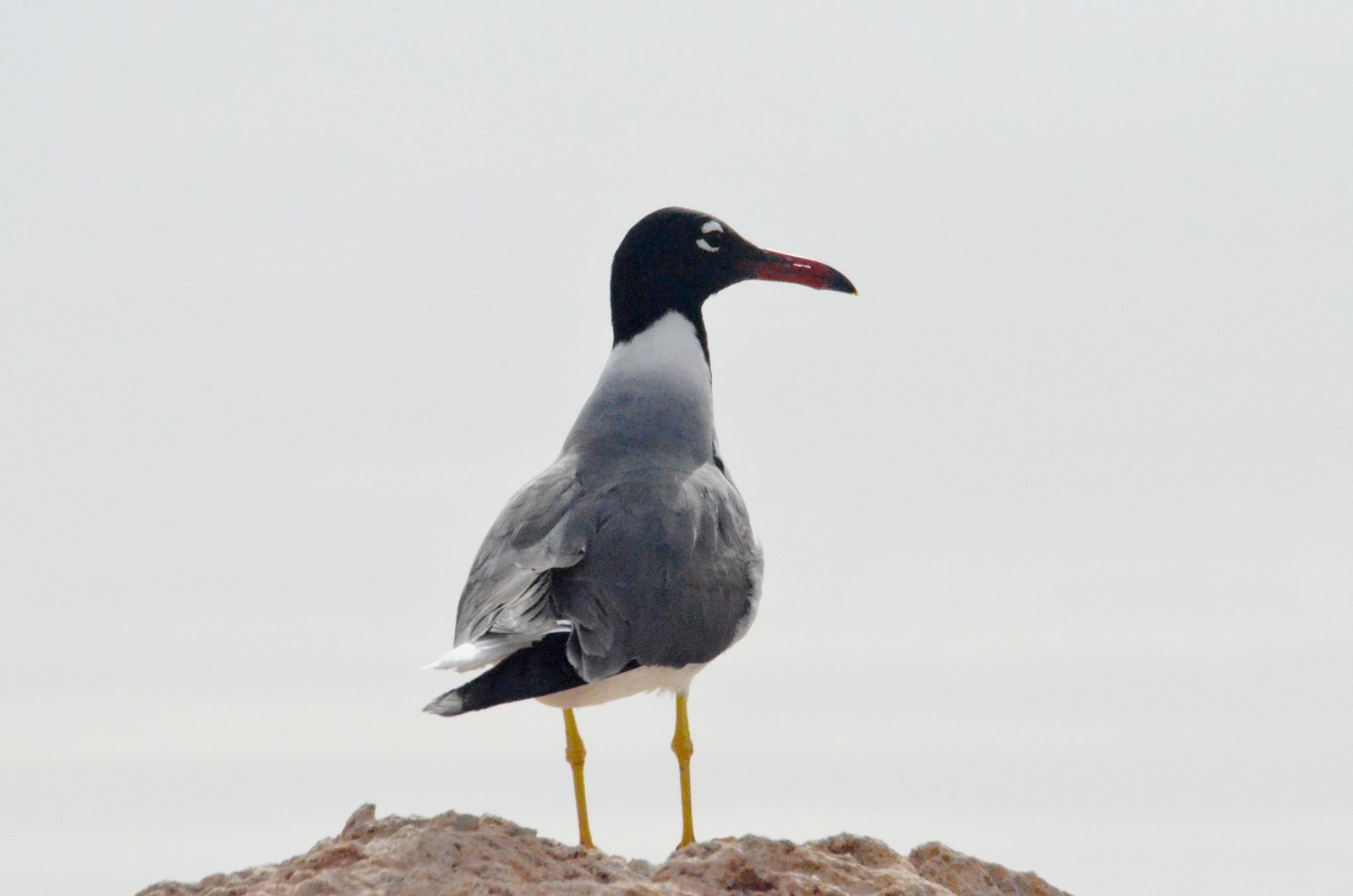
A slender, dark gull that breeds only along the Red Sea and the Gulf of Aden and lives almost entirely within the region. With its jet-black hood, white eye-crescents and long dark red bill it is the slimmer, more sharply marked counterpart of Sooty Gull.
Voice
A high, nasal, plaintive call, a drawn-out kehh and a barking kek-kek-kek in disputes; thinner than Sooty Gull.
Recording: David Darrell-Lambert — CC BY-NC-SA 4.0 · converted to mono · xeno-canto
Identification
Slim and long-winged, with a fine, tern-like head and a long, thin, slightly drooping bill. Adults in breeding plumage have a black hood and throat with striking white crescents above and below the eye, a grey collar and breast, a dark slate-grey mantle and blackish wings with a narrow white trailing edge; the belly and tail are white. The bill is dark red with a black tip and looks black at a distance; the legs are yellow. In winter the hood becomes duller and flecked white. Young birds are grey-brown with pale fringes, a dark head with a white eye-crescent, a black bill and a broad black tail band; adult plumage is reached after three years.
Confusion species
Sooty Gull (Ichthyaetus hemprichii) is larger and bulkier, with a brown rather than black hood, a brown breast band, a thick two-toned bill (yellow-green with a black band and red tip) and a narrower white eye-crescent. In young birds the bill decides: thin and black in White-eyed Gull, heavier with a pale base in Sooty Gull. Other gulls in the region are much paler above.
Habitat
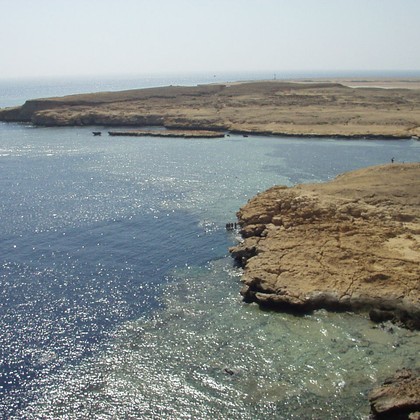
Coral coasts, sandy and rocky beaches, shallow inshore waters, harbours, jetties and fish farms. Breeds in loose colonies on bare coral and sand islets. Feeds just above the water, often with terns, and follows fishing boats.
Where the bird is most at home, classified by the habitats of North Africa and the Middle East.


Range and movements
Breeds on islets along the Egyptian Red Sea coast (including near Hurghada and south of Marsa Alam), along the Saudi coast (Farasan Islands and elsewhere) and the Yemeni Red Sea coast; most pairs breed in the southern part, also on the African side in Sudan and Eritrea. Outside the breeding season it is spread along the entire Red Sea, including the Gulf of Suez and the Gulf of Aqaba (Eilat, Aqaba), and in the Gulf of Aden at Aden. A vagrant on the Arabian Sea coast of Oman and in the Emirates (four records in the Emirates up to 2022, including at Kalba); very rarely in the eastern Mediterranean. Beyond the region only on the African side of the Red Sea and the Gulf of Aden (Djibouti, northern Somalia).
- Resident
- Summer visitor (c. Apr–Sep)
- Passage (Mar–Apr, Oct–Nov)
- dark = core range, pale = thinly spread
How and when to look
Eilat is the best-known site: year-round along North Beach, at the marina and at the fish farms in the Gulf. In Egypt numerous in the harbours of Hurghada and Marsa Alam and on boat trips to the islands. Look at the bill to separate it from Sooty Gull.
Conservation status
Not threatened according to the Red List, but the entire world population, a few tens of thousands of birds, breeds along a single sea. Risks are oil pollution from the busy shipping lanes, disturbance and egg collecting on the breeding islands, and rapid coastal development, such as the large tourism projects on the Egyptian and Saudi Red Sea coasts.
Scientific name
Ichthyaetus leucophthalmus | (Temminck, 1825)
Temminck described the species in 1825 as Larus leucophthalmus; because it was later moved to another genus, the author and year stand in brackets. The genus Ichthyaetus was introduced in 1829 by Kaup. Ichthyaetus is Greek, from ikhthus 'fish' and aetos 'eagle', hence 'fish eagle'. leucophthalmus is Greek, from leukos 'white' and ophthalmos 'eye', meaning 'white-eyed'. The specimen the first description was based on came from the Red Sea coast.