All species › Waders, gulls and terns › Stone-curlews › Spotted Thick-Knee
Spotted Thick-Knee | Burhinus capensis
Kaapse griel | Alcaraván del Cabo
A large, densely spotted thick-knee of the African savannas that, within the region, occurs only in south-west Arabia, from the Tihama to Dhofar. By day it lies invisible in the shade of an acacia; only as night falls does it become active and noisy.

Voice
Mainly in the evening and at night a loud, plaintive series of whistles, ti-ti-ti-tee-tee-teeoo-teeoo, that swells and dies away again; pairs and neighbours answer each other. When alarmed a sharp kwee.
Recording: Campbell Fleming — CC BY-NC-SA 4.0 · converted to mono · xeno-canto
Identification
Large and long-legged, with a round head, a large yellow eye and a short, thick bill that is yellow at the base and black at the tip. The upperparts are sandy-brown and densely covered with black and pale spots and drops, so that the bird looks spotted rather than streaked; the breast is finely streaked, the belly white. Unlike Eurasian and Senegal Thick-Knee there is no black-and-white bar on the folded wing: the wing coverts are as spotted as the back. The face pattern is weaker, with a pale supercilium and cheek stripe. In flight black primaries with small white patches.
Confusion species
Eurasian Thick-Knee (Burhinus oedicnemus), which also occurs in south-west Arabia in winter, is streaked rather than spotted and has a clear black-white-black bar across the folded wing. Senegal Thick-Knee (Burhinus senegalensis) is smaller, has a grey wing panel and a longer, blacker bill, and occurs only in Egypt. Great Stone-curlew (Esacus recurvirostris) is larger, unspotted grey-brown and has a massive, upturned-looking bill.
Habitat
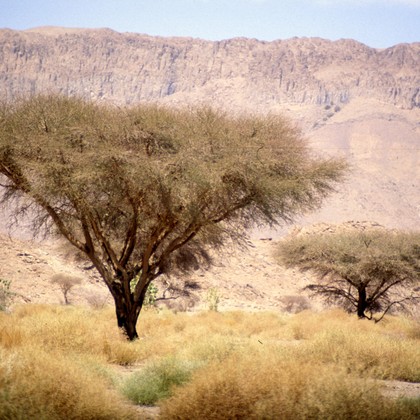
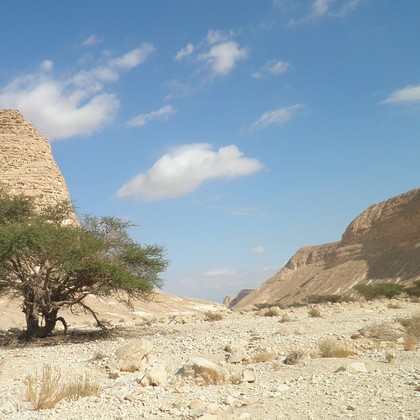
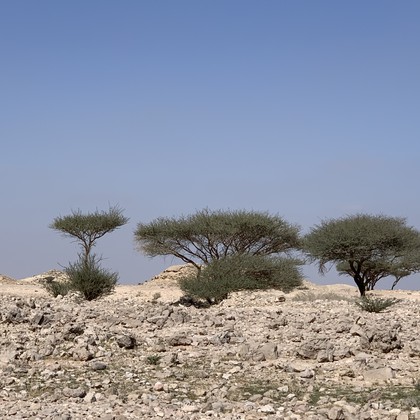
Open, dry country with scattered bushes and trees: acacia savanna, thorn scrub, wadi edges, dry riverbeds, fields and fallow land, usually below 1,000 m, locally up to 2,000 m on the plateaus of Yemen. Also occurs close to villages and feeds at night on roads and open ground.
Where the bird is most at home, classified by the habitats of North Africa and the Middle East.
Range and movements
In the region only in south-west Arabia. Saudi Arabia: a scarce resident of the southern Tihama and the low slopes south of Jeddah to Jizan, with an estimated hundred or so breeding pairs, including at Malaki Lake by the Wadi Jizan dam. Yemen: widespread in the Tihama, the foothills of the highlands and the wadis of the south. Oman: in Dhofar, where flocks of up to about fifty birds gather outside the breeding season. Beyond the region widespread across much of sub-Saharan Africa, from Senegal and Ethiopia to South Africa.
- Resident
- Summer visitor (c. Oct–Mar)
- Winter visitor (c. Apr–Sep)
- Passage (Mar–Apr, Oct–Nov)
- dark = core range, pale = thinly spread
How and when to look
At dusk, drive slowly along the country roads through the acacia savanna and fields of the Tihama in Yemen or Saudi Arabia, or around Salalah in Dhofar, and look for eyeshine in the headlights. By day it pays to check under large acacias in wadis, where birds rest in the shade.
Conservation status
Not globally threatened and fairly common in Africa. In Arabia the population is small and local; it suffers from the loss of acacia savanna to farming and building, overgrazing and night-time traffic on country roads.
Scientific name
Burhinus capensis | (Lichtenstein, 1823)
Lichtenstein described the species in 1823 as Oedicnemus capensis; because it was later moved to another genus, the author and year stand in brackets. The genus Burhinus was introduced in 1811 by Illiger. Burhinus is Greek, from bous 'ox' and rhis 'nose', after the heavy, broad base of the bill. capensis refers to the Cape of Good Hope, where the first specimen came from. The specimen the first description was based on came from Cape of Good Hope.