All species › Passerines › Swallows and martins › Streak-Throated Swallow
Streak-Throated Swallow | Petrochelidon fluvicola
Indische klifzwaluw | Golondrina india
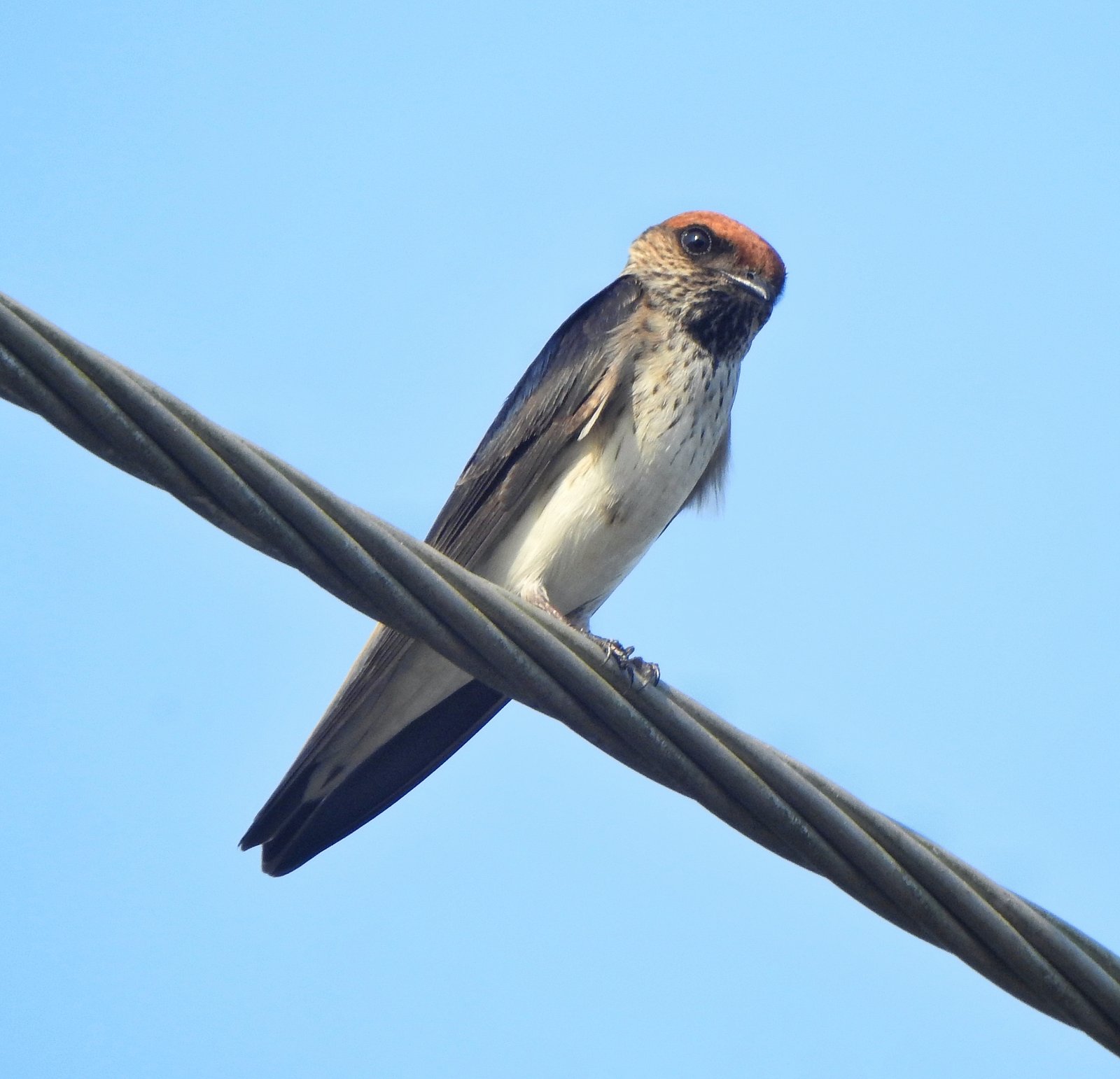
The Streak-throated Swallow is a small, short-tailed swallow of the Indian subcontinent that turns up increasingly often in eastern Arabia in winter. More than fifteen records are now known from the United Arab Emirates, sometimes of small groups; elsewhere in the region it is a true vagrant.
Voice
A soft, dry trr or tret in flight; a colony produces a continuous chirping murmur. Usually silent in Arabia.
Recording: David Darrell-Lambert — CC BY-NC-SA 4.0 · converted to mono · xeno-canto
Identification
11–12 cm. Small and stocky, with broad wings and a short, barely notched tail. The crown is dull chestnut, the mantle blue-black with fine white streaks, wings and tail brownish-black and the rump dull grey-brown. Throat and breast are white with fine dark streaks, the belly off-white. At a distance it looks like a small, brown martin with a dark head. Sexes alike; juveniles are duller, with a browner crown.
Confusion species
Wire-tailed Swallow (Hirundo smithii) also has a rufous crown, but pure white, unstreaked underparts, glossy blue upperparts and thread-like tail streamers. Pale Martin (Riparia diluta) and Bank Swallow (Riparia riparia) lack the chestnut crown and the streaked throat. Pale Crag Martin (Ptyonoprogne obsoleta) is larger and uniformly sandy brown, with white spots in the spread tail. Eastern Red-rumped Swallow (Cecropis daurica) is much larger, with a rusty rump and long tail streamers.
Habitat
Breeds in colonies of tightly packed, bottle-shaped mud nests under bridges, on buildings and on rock faces, always near water. Hunts low over water, damp ground and fields. In Arabia at sewage works, desert lakes and irrigated land, often among other hirundines.
Where the bird is most at home, classified by the habitats of North Africa and the Middle East.


Range and movements
In the region a rare winter visitor in eastern Arabia. In the United Arab Emirates at least sixteen records up to 2021, including at Al Marmoom, Al Maha Forest and the sewage works of Ajman and Mafraq, sometimes groups of up to five birds; also a few records in Oman and one in Kuwait (Jahra, December 2013). Breeds in Afghanistan, Pakistan, northern and central India and Nepal, and partly moves south within the Indian subcontinent in winter.
- Winter visitor (c. Oct–Mar)
- dark = core range, pale = thinly spread
How and when to look
In winter search sewage works and desert lakes around Dubai and Abu Dhabi for a small, short-tailed, brownish swallow with a dark head among the Barn Swallows; the streaked throat is the best feature on photographs.
Conservation status
Not globally threatened. In the region a rare winter visitor with no known breeding; the increasing number of records in the Emirates suggests a westward spread or better coverage.
Scientific name
Petrochelidon fluvicola | (Blyth, 1855)
Blyth described the species in 1855 as Hirundo fluvicola; because it was later moved to another genus, the author and year stand in brackets. The genus Petrochelidon was introduced in 1851 by Cabanis. Petrochelidon comes from the Greek petros, 'rock', and khelidōn, 'swallow' — for the cliff swallows' habit of building their mud nests against rock faces. fluvicola is Latin for 'river-dweller', from fluvius 'river' and -cola 'inhabitant'. The specimen the first description was based on came from Sonar and Ken rivers, Bundelkhand, India.