All species › Passerines › Swallows and martins › Western Red-Rumped Swallow
Western Red-Rumped Swallow | Cecropis rufula
Roodstuitzwaluw | Golondrina dáurica occidental
The Western Red-rumped Swallow is the swallow of gorges, bridges and culverts in the Maghreb and the Levant, recognised by its rusty rump and collar and its flat, gliding flight. Under AviList it is the western half of the former Red-rumped Swallow in the broad sense; the Asian birds now form Eastern Red-rumped Swallow.

Voice
The call is a short, nasal kvitch or djuit, harder and less clear than Barn Swallow's; in alarm a sharp keer. The song is a short, scratchy twitter, slower and lower than that of Barn Swallow.
No recording with a suitable Creative Commons licence is available for this species yet.
Identification
16–18 cm, including the long outer tail feathers. Upperparts glossy blue-black, with a rusty-orange collar separating the head from the mantle and a pale, rufous-tinged rump that shows as a light band in flight. Cheeks and supercilium rusty. Underparts warm ochre-buff with fine, thin dark streaks, visible only at close range. The undertail coverts are jet black, so the tail looks ‘cut off’ from the body; there are no white tail spots. Juveniles are duller, with shorter streamers and a paler rump. Flight slower and more gliding than Barn Swallow, often with the wings held slightly raised.
Confusion species
Barn Swallow (Hirundo rustica) has a dark red throat with a blue-black breast band, white tail spots and a dark rump. Common House-Martin (Delichon urbicum) has a pure white rump and underparts and a short forked tail. Eastern Red-rumped Swallow (Cecropis daurica), a possible vagrant from Asia, is heavily and broadly streaked below, with a streaked rump and often a broken collar; the difference is a matter of degree and needs good photographs.
Habitat
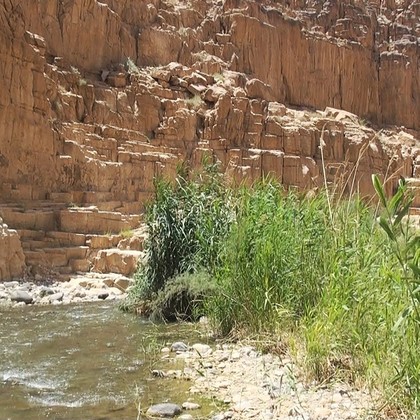
Open, warm and often hilly country with cliffs, gorges and wadis, and also farmland, villages and roads with bridges and culverts. It builds a retort-shaped mud nest with a long entrance tunnel against the ceiling of a cave, an overhang, a bridge or a derelict building. It hunts flying insects, often low over slopes and water.
Where the bird is most at home, classified by the habitats of North Africa and the Middle East.


Range and movements
Breeds in Morocco, widely from the Rif and the Atlantic coastal plain through the Middle and High Atlas to the Anti-Atlas, in northern Algeria and northern Tunisia, and locally in north-west Libya. In the east it breeds in Israel, Samaria and Judea, Lebanon, Syria, Jordan and northern Iraq. On passage, mainly March – April and September – October, it appears in Saharan oases, in Egypt (especially Sinai and the Nile Valley) and sparsely in Saudi Arabia and the Gulf States. Beyond the region it breeds from Iberia and southern Europe through Turkey and the Caucasus to Iran and Central Asia, and winters in sub-Saharan Africa.
- Summer visitor (c. Oct–Mar)
- Winter visitor (c. Apr–Sep)
- Passage (Mar–Apr, Oct–Nov)
- dark = core range, pale = thinly spread
How and when to look
One of the first summer visitors in spring: in Morocco from February at the bridges and gorges of the Atlas, such as the Todra and Dadès gorges. Look under bridges and in culverts for the characteristic tunnel nest.
Conservation status
Not globally threatened; it spread north in southern Europe during the last century. The IUCN assessment still covers Red-rumped Swallow in the broad sense, including the eastern species. The boundary between the two species in Iran and Central Asia is still poorly known.
Scientific name
Cecropis rufula | (Temminck, 1835)
Temminck described the species in 1835 as Hirundo rufula; because it was later moved to another genus, the author and year stand in brackets. The genus Cecropis was introduced in 1826 by Boie. Cecropis is from Ancient Greek Kekropis, 'Athenian woman'. rufula is from Latin rufulus 'reddish', for the bird's rufous colouring. The specimen the first description was based on came from Egypt.