All species › Passerines › Swallows and martins › Common House-Martin
Common House-Martin | Delichon urbicum
Huiszwaluw | Avión común
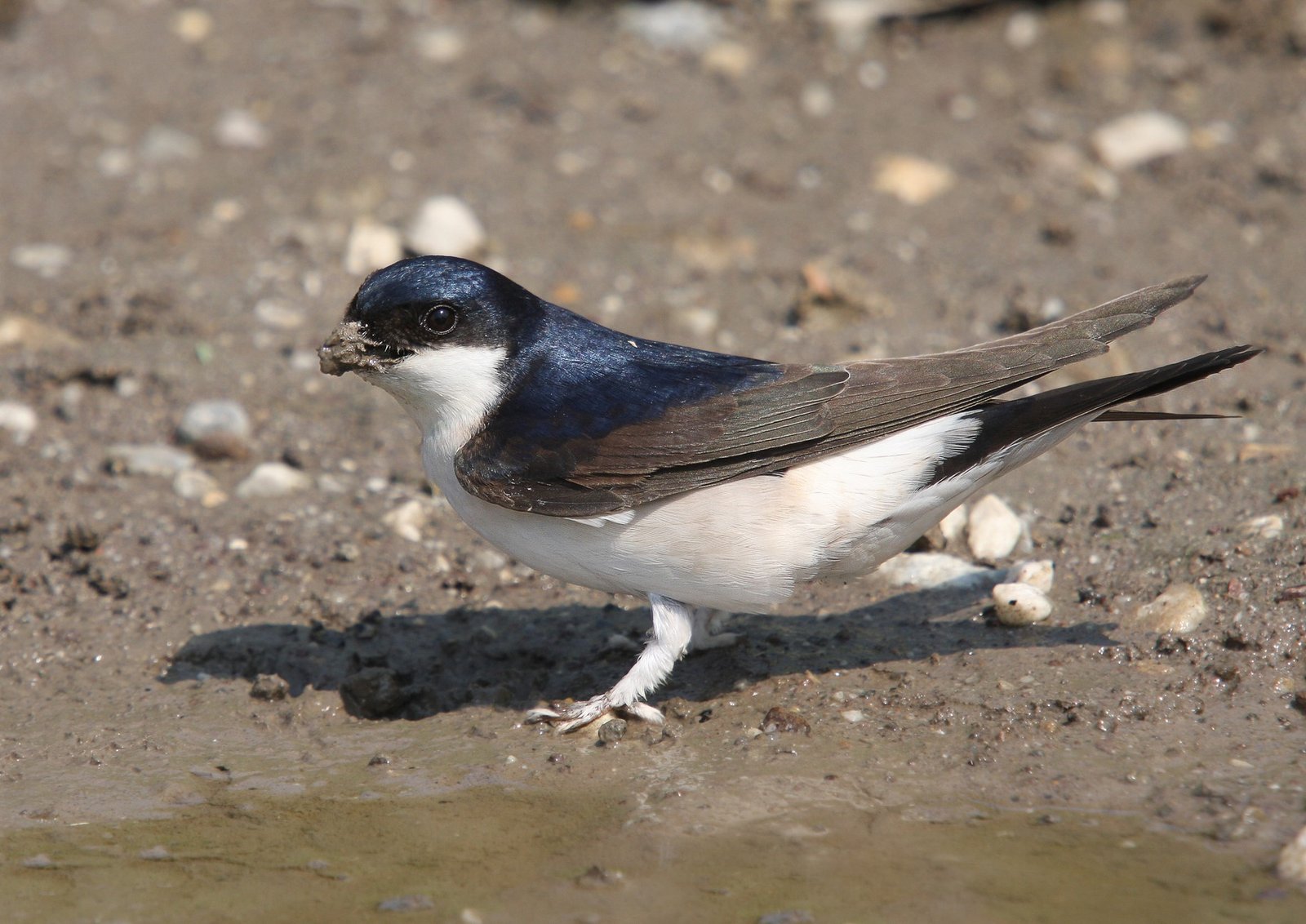
The Common House-Martin is the white-rumped swallow that builds its mud cups under eaves, on bridges and on rock faces in the Maghreb and the Levant. Elsewhere in the region it is a passage migrant moving in flocks over desert, oases and coasts, often together with Barn Swallows.
Voice
A dry, short prrit or chirrp, given constantly in flight; over a colony the calls merge into a continuous murmur. The song is a soft, mumbling twitter without the rattling end of Barn Swallow. Alarm at a falcon: a sharp, high tseer.
Recording: Beatrix Saadi-Varchmin — CC BY-NC-SA 4.0 · converted to mono · xeno-canto
Identification
13.5–15 cm. Compact and rather broad-winged, glossy blue-black on head, mantle and wings, with a large, pure white rump that stands out at long range. Underparts entirely white, including throat and undertail coverts; underwing coverts grey-brown. The tail is short and fairly deeply forked, without streamers. Legs and toes covered in white feathers. Juveniles are duller, with brownish-black upperparts, a dusky wash on breast and flanks and pale fringes to the inner secondaries. The flight is more fluttering and gliding than that of Barn Swallow, often high.
Confusion species
Asian House Martin (Delichon dasypus), a very rare vagrant, is smaller, with a shallowly notched tail, a narrower and often dark-streaked rump, dingy underparts and blackish underwing coverts. Martins of the genera Riparia and Ptyonoprogne never show a white rump. A juvenile with a dusky breast can cause brief confusion, but the white rump is always decisive.
Habitat
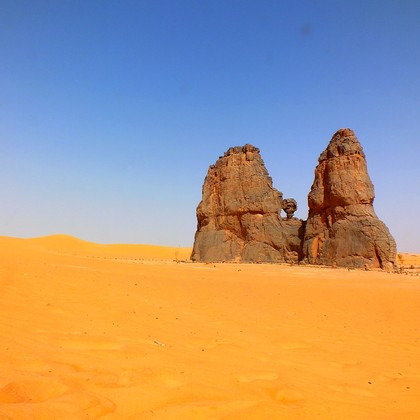
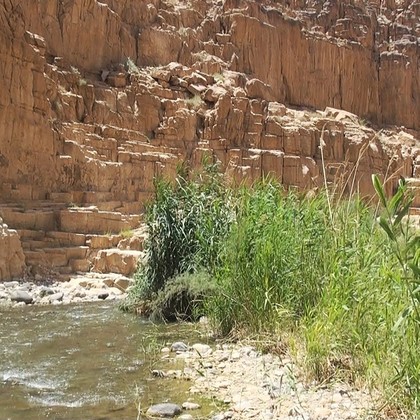
Breeds in colonies on buildings in villages and towns, under bridges and flyovers, and on cliffs and in gorges, in the Atlas up to high altitudes. Hunts high in the air over open country, water and mountains. On passage over any landscape, including desert and sea; prefers to rest on wires and bare trees near water.
Where the bird is most at home, classified by the habitats of North Africa and the Middle East.

Range and movements
Breeds in Morocco (common, from the Rif and the Atlantic plain to high in the High Atlas), in northern Algeria and Tunisia and locally in north-western Libya, in Lebanon, Syria, northern Israel, north-western Jordan and northern Iraq. On passage common throughout the region: Egypt, Sinai, Israel, Jordan, the Arabian Peninsula to Yemen, Oman and the Gulf states; in Saudi Arabia a common passage migrant in February – March and September – early October. Winters in sub-Saharan Africa, high over savanna and rainforest. Beyond the region it breeds throughout Europe and much of western and central Asia.
- Resident
- Summer visitor (c. Apr–Sep)
- Winter visitor (c. Oct–Mar)
- Passage (Mar–Apr, Oct–Nov)
- dark = core range, pale = thinly spread
How and when to look
In Morocco the colonies under balconies and in the Atlas gorges (Todra and Dadès) are easy to watch. On passage in the desert check sewage works and oases, where house martins hunt among Barn Swallows and Bank Swallows; look there for a smaller, dingier bird with a dirty rump.
Conservation status
Not globally threatened, but strongly declined in Europe through lack of mud and insects and the removal of nests. Still locally common in the region; renovation of buildings and insecticide use play a role here too.
Scientific name
Delichon urbicum | (Linnaeus, 1758)
Linnaeus described the species in 1758 as Hirundo urbica; because it was later moved to another genus, the author and year stand in brackets. The genus Delichon was introduced in 1854 by Moore. Delichon is an anagram of Greek chelidon 'swallow'. urbicum is Latin for 'of the town', for the habit of nesting against buildings. The specimen the first description was based on came from Sweden.