All species › Passerines › Swallows and martins › Barn Swallow
Barn Swallow | Hirundo rustica
Boerenzwaluw | Golondrina común
The Barn Swallow can be seen everywhere in the region: as a breeding bird of villages and farms from the Maghreb to Iraq, as a resident along the Nile, and as a passage migrant crossing the Sahara, Sinai and the Arabian Peninsula in their millions in spring and autumn. Three clearly different forms live side by side in the region.
Voice
The song is a busy, twittering warble of chirping and squeaking notes, often ending in a rattling chrrrr, delivered from a wire or inside a stable. The flight call is a clear wit-wit; at a raptor it gives a sharp, repeated siflit.
Recording: João Ferreira Tomás — CC BY-NC-SA 4.0 · shortened to the first 60 s, mono · xeno-canto
Identification
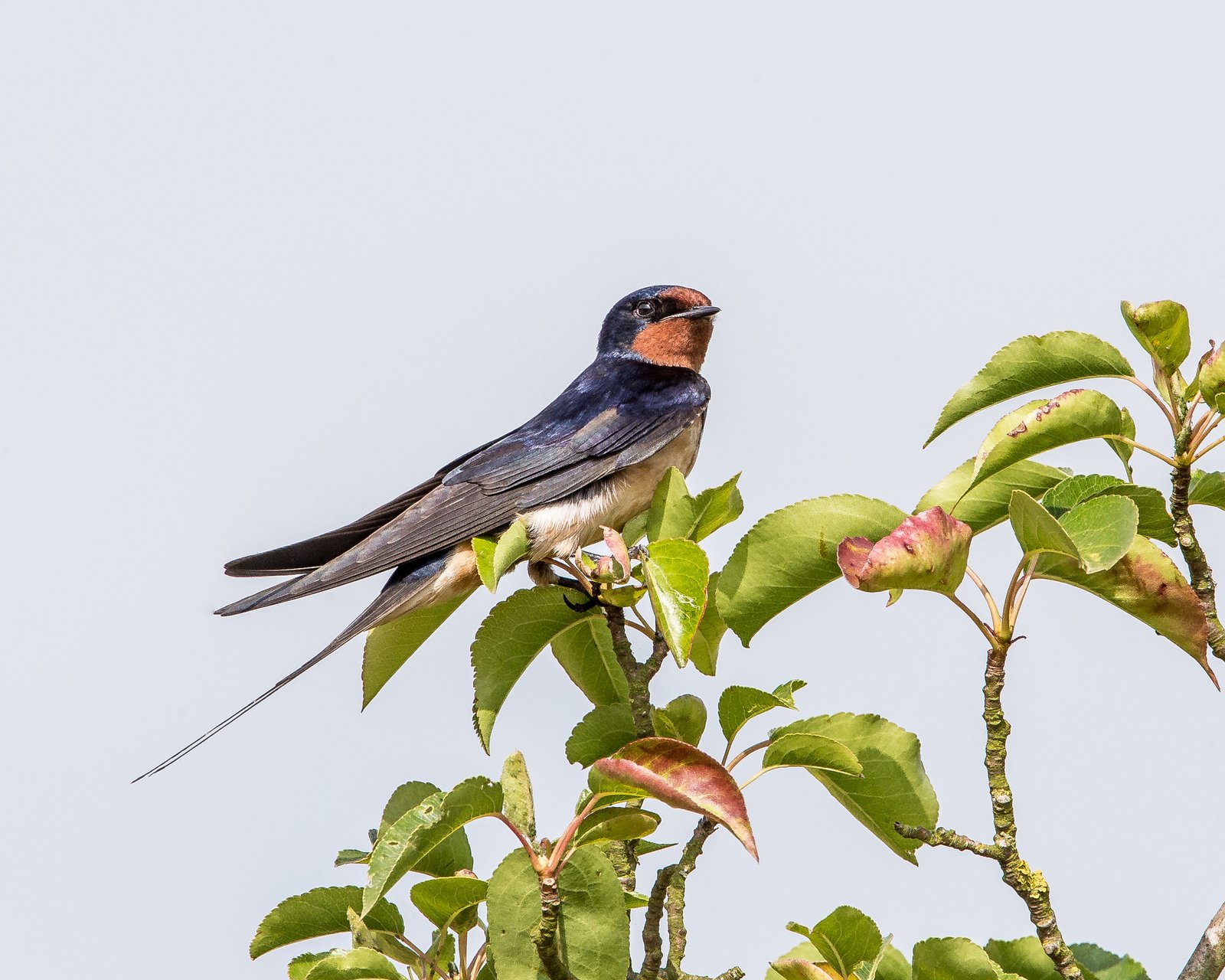
17–19 cm, of which 2–7 cm are the elongated outer tail feathers. Slender, with long pointed wings and a deeply forked tail with a row of white spots that shows when the tail is spread. Upperparts glossy steel-blue, forehead and throat rusty red, with a dark blue breast band. In the European form rustica, which breeds in the Maghreb and passes through everywhere, the underparts are creamy white. The Levant form transitiva (Israel, Lebanon, Syria, Jordan) has warm orange-buff underparts, and the Egyptian form savignii along the Nile is deep chestnut from throat to undertail, with a narrower breast band. Males have longer tail streamers than females; juveniles are shorter-tailed, duller and have a pale rufous-buff throat.
Confusion species
Wire-tailed Swallow (Hirundo smithii) has a rufous crown, pure white underparts without a breast band and thread-like tail streamers. Eastern Red-rumped Swallow (Cecropis daurica) and Western Red-rumped Swallow (Cecropis rufula) have a rusty rump and collar, streaked underparts and black undertail coverts. Common House-Martin (Delichon urbicum) has a white rump and a short tail. Short-tailed juvenile Barn Swallows can recall a Bank Swallow (Riparia riparia) at a distance, but always show the dark throat and the white tail spots.
Habitat
Breeds in and around buildings: stables, barns, bridges, houses in villages and suburbs, usually near water and livestock. Hunts low over fields, irrigated land, pastures, rivers and marshes. On passage over any landscape, including open desert, with large roosts in reedbeds and sugar-cane fields.
Where the bird is most at home, classified by the habitats of North Africa and the Middle East.


Range and movements
Breeds in northern Morocco, Algeria and Tunisia, in north-western Libya and along the Libyan coast, along the whole Nile Valley and in the Nile Delta (savignii, resident), in Israel, Jordan, Lebanon and Syria (transitiva, partly resident) and in Iraq; in Arabia only locally as a breeder. On passage common throughout the region, from the Atlantic coast to the Persian Gulf, Yemen and Oman, with peaks in March – April and September – October along the Red Sea and the Jordan Valley. Small numbers winter in the Gulf states, Oman, Yemen and Egypt. Most birds winter in sub-Saharan Africa. Beyond the region it breeds across Europe, Asia and North America.
- Resident
- Summer visitor (c. Oct–Mar)
- Winter visitor (c. Apr–Sep)
- Passage (Mar–Apr, Oct–Nov)
- dark = core range, pale = thinly spread
How and when to look
Along the Nile, for example at Luxor or Aswan, the deep chestnut savignii birds can be seen all year. In Israel and Jordan you can compare orange-buff transitiva with passing rustica; check the colour of the belly and undertail coverts. In April hundreds per hour sometimes pass over desert oases and sewage works.
Conservation status
Not globally threatened, but declining in parts of Europe through the loss of open stables and insects. In the region breeding birds suffer from insecticide use and the modernisation of buildings; on migration drought in the Sahel is the main risk.
Scientific name
Hirundo rustica | Linnaeus, 1758
Linnaeus described the species in 1758 and placed it straight away in the genus where it still stands. He introduced the genus Hirundo in that same work. Hirundo is the ordinary Latin word for 'swallow'. rustica is Latin for 'of the countryside', after the farms and barns in which the bird nests. The specimen the first description was based on came from Sweden.