All species › Passerines › Swallows and martins › Wire-Tailed Swallow
Wire-Tailed Swallow | Hirundo smithii
Roodkruinzwaluw | Golondrina colilarga
The Wire-tailed Swallow is a slender, steel-blue swallow with a chestnut crown and two thin wires as outer tail feathers. It lives in sub-Saharan Africa and South Asia; in this region it is a rare but, in recent decades, almost annual winter visitor to the east and south-west of the Arabian Peninsula.

Voice
A sharp, repeated chik-chik or chirrik, and a chattering, twittering song, often from a wire over water.
Recording: Bram Piot — CC BY-NC-SA 4.0 · shortened to the first 60 s, mono · xeno-canto
Identification
13–17 cm including the tail wires. Upperparts glossy dark steel blue, crown and forehead bright chestnut. The underparts are gleaming white, including the throat, with a narrow blue-black band across the undertail coverts at the sides of the undertail. The tail is almost square with a row of white spots; the outer feathers end in very thin, long wires, shorter in the female and possibly missing during moult. The underwing coverts are white. Juveniles are duller, with a browner crown and no wires.
Confusion species
Barn Swallow (Hirundo rustica) has a rufous throat and a blue breast band, and long, broader outer tail feathers; short-tailed juvenile Barn Swallows with a pale throat are the main pitfall, but lack the chestnut crown and the pure white underparts. Common House-Martin (Delichon urbicum) has a white rump. Streak-throated Swallow (Petrochelidon fluvicola) has a chestnut crown, but a streaked throat, a brown back and a dull rump.
Habitat
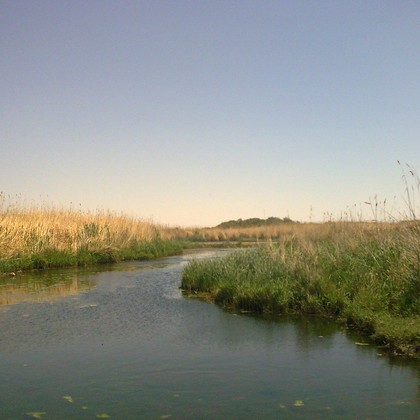
Always near water: in this region at desert lakes, pivot fields and irrigated land, sewage ponds, dams and marshes, where it hunts low over the water and rests on wires or dead branches. In its breeding areas at rivers, lakes and villages, with the nest under bridges, culverts and overhanging rocks.
Where the bird is most at home, classified by the habitats of North Africa and the Middle East.


Range and movements
In the United Arab Emirates a scarce winter visitor, reported increasingly since the 1990s, mainly at the desert lakes and pivot fields of Al Maha and Al Marmoom, at Ajban and at Ajman sewage works; now present almost every winter, usually one to four birds. In Oman rare in the north. In south-west Saudi Arabia recently several birds in winter and spring at Sadd Lake and elsewhere in Jizan province; whether these come from Africa or Asia is unknown. Expected in Yemen, Qatar and Bahrain. Beyond the region the Asian subspecies filifera breeds from Afghanistan and Pakistan to India and South-east Asia, the nominate form across much of sub-Saharan Africa.
- Resident
- Summer visitor (c. Oct–Mar)
- Winter visitor (c. Apr–Sep)
- Passage (Mar–Apr, Oct–Nov)
- dark = core range, pale = thinly spread
How and when to look
From December to March at the desert lakes of Al Maha and Al Marmoom south of Dubai, where it hunts over the water among Barn Swallows. Look for a ‘Barn Swallow’ with a spotless white throat and a chestnut cap; the wires are only visible in flight at close range.
Conservation status
Not globally threatened and common in Africa and South Asia. In this region a scarce winter visitor that is increasing, probably thanks to the growth of irrigation and artificial lakes in the desert.
Scientific name
Hirundo smithii | Leach, 1818
Leach described the species in 1818 and placed it straight away in the genus where it still stands. The genus Hirundo was introduced in 1758 by Linnaeus. Hirundo is the ordinary Latin word for 'swallow'. smithii honours the Norwegian botanist and physician Christen Smith (1785–1816), who died on the British Congo expedition led by James Tuckey. The specimen the first description was based on came from Chisalla Island in the Congo River.