All species › Passerines › Swallows and martins › Eurasian Crag-Martin
Eurasian Crag-Martin | Ptyonoprogne rupestris
Rotszwaluw | Avión roquero
The Eurasian Crag-Martin is a bulky, brown-grey martin of mountain cliffs and gorges, which in this region breeds in the Atlas and the mountains of the Levant. In winter many birds descend to lower, warmer gorges and wadis, as far as Sinai, the Negev and western Arabia, where they hunt alongside the smaller Pale Crag Martin.
Voice
Mostly silent; a short, dry chrrt or prrit, and at the nest a soft, scratchy twitter.
Recording: Thierry THOMAS — CC BY-NC-SA 4.0 · converted to mono · xeno-canto
Identification
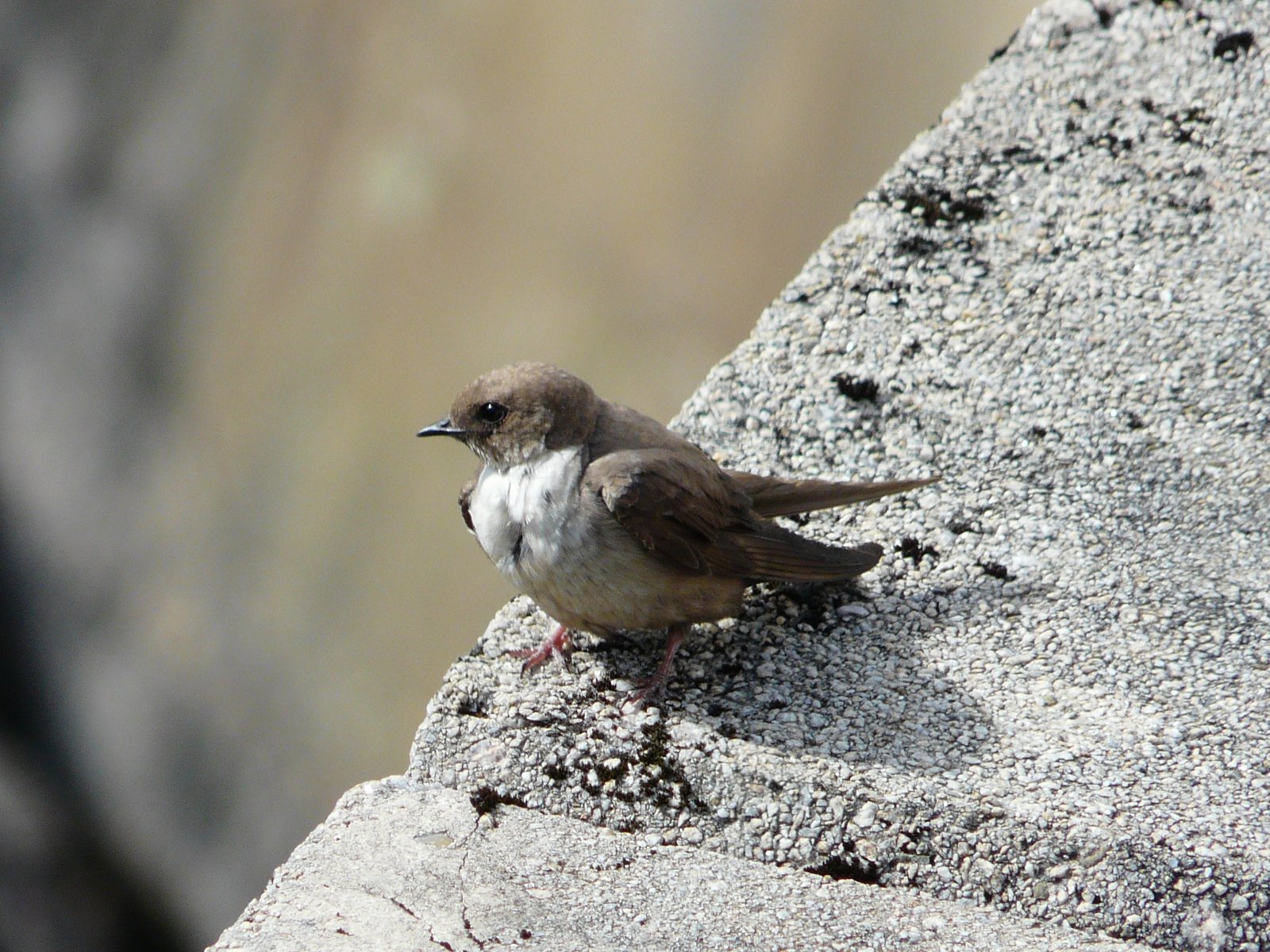
13–15 cm. Broadly built, with a broad wing base, a deep chest and a short, square tail. Upperparts dull ash-brown, underparts off-white to buff, with a finely speckled, dull brown throat merging gradually into the breast; no breast band. The underwing coverts and undertail coverts are dark, so from below the bird looks two-toned with a heavy, dark rear end. In the spread tail a row of conspicuous white spots near the tip. The flight is slow and heavy, with long glides along the cliff face. Sexes alike; juveniles have pale fringes above.
Confusion species
Pale Crag Martin (Ptyonoprogne obsoleta) is smaller and slighter, paler sandy brown, with an unspeckled pale throat and above all pale underwing coverts and undertail coverts: uniformly pale below rather than two-toned. Bank Swallow (Riparia riparia) is smaller, with a sharp brown breast band and a forked tail without spots. Common House-Martin (Delichon urbicum) is blue-black with a white rump. Common Swift (Apus apus) and Pallid Swift (Apus pallidus) are larger, sickle-shaped and without white in the tail.
Habitat
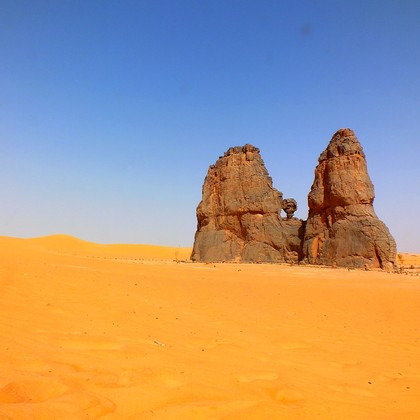
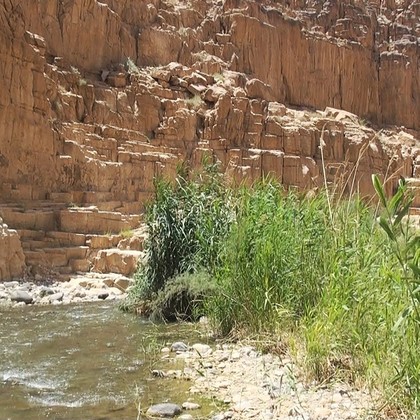
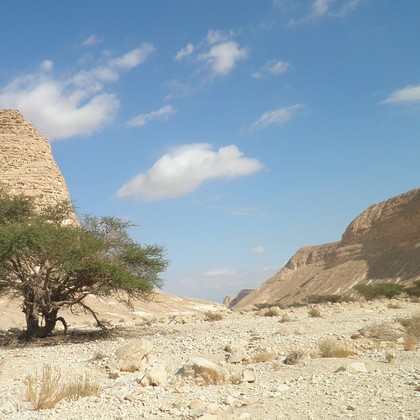
Breeds on steep cliffs, in gorges and cave entrances in the mountains, in the Atlas to above 2000 m, locally also on bridges, dams and buildings; the open, cup-shaped mud nest is placed under an overhang. In winter in lower gorges, wadis, steep coastal cliffs and around rocky sites near water, often with Pale Crag Martins.
Where the bird is most at home, classified by the habitats of North Africa and the Middle East.
Range and movements
Breeds in Morocco in the Rif, the Middle, High and Anti-Atlas, in northern Algeria in the Tell Atlas and the Aurès, in northern Tunisia, and in the Levant in the mountains of Lebanon and Syria, northern Israel (Hermon, Golan, Galilee; scarce) and the Kurdish mountains of northern Iraq. Maghreb birds are largely resident and move down to lower slopes in winter. In winter also in the Jordan Valley and around the Dead Sea, the Negev and the mountains near Eilat, Sinai, the Eastern Desert of Egypt and the Nile Valley, Jordan (Petra, Wadi Rum) and western Saudi Arabia; scarce to rare in the Hajar Mountains of Oman and the Emirates. Beyond the region it breeds in southern Europe, Turkey, the Caucasus and through Central Asia to China.
- Resident
- Summer visitor (c. Apr–Sep)
- Winter visitor (c. Oct–Mar)
- Passage (Mar–Apr, Oct–Nov)
- dark = core range, pale = thinly spread
How and when to look
In winter in the gorges around the Dead Sea, at Ein Gedi and in Wadi Rum, where Eurasian Crag-Martins and Pale Crag Martins hunt side by side: a good opportunity to compare the dark underwing coverts and undertail of the larger species with the uniformly pale underside of its small relative. In summer in the gorges of the High Atlas, such as the Todra and Dadès gorges.
Conservation status
Not globally threatened and stable in the region. Locally benefits from bridges and dams as nest sites.
Scientific name
Ptyonoprogne rupestris | (Scopoli, 1769)
Scopoli described the species in 1769 as Hirundo rupestris; because it was later moved to another genus, the author and year stand in brackets. The genus Ptyonoprogne was introduced in 1850 by Reichenbach. Ptyonoprogne is Greek, from ptuon 'a fan', after the shape of the spread tail, and Procne, the girl of myth who was turned into a swallow. rupestris is Latin for 'of the rocks', from rupes 'rock', after the cliffs where the bird nests. The specimen the first description was based on came from Tyrol.