All species › Passerines › Sylvia warblers › Western Orphean Warbler
Western Orphean Warbler | Curruca hortensis
Westelijke orpheusgrasmus | Curruca mirlona occidental
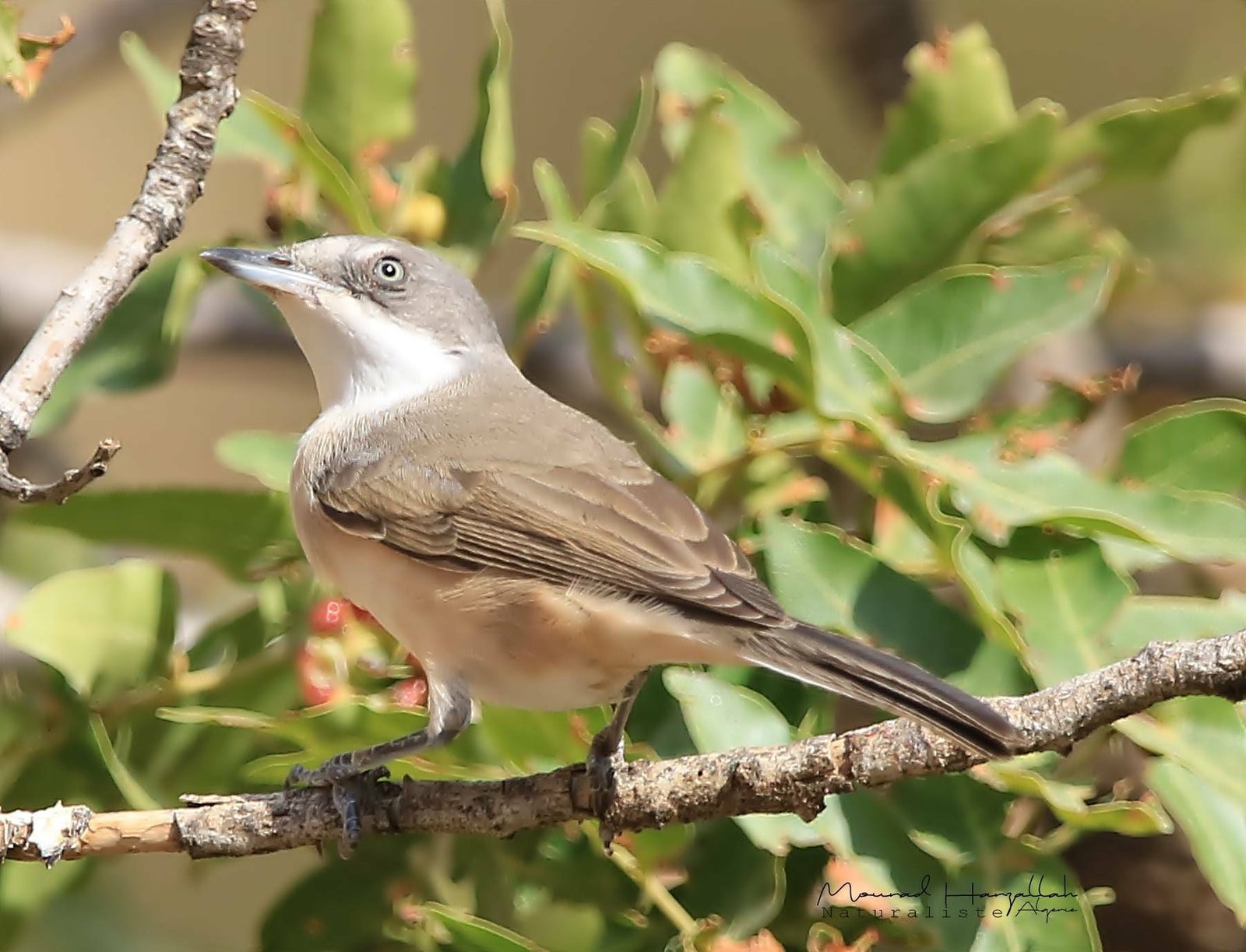
The Western Orphean Warbler is a large, dark-headed warbler of open woodland and orchards in the Maghreb. In the breeding season it is widespread in Morocco, Algeria and Tunisia but surprisingly inconspicuous, and gives itself away mainly by its calm, fluty song. In winter it moves to the Sahel.
Voice
The song consists of short, clear fluty motifs repeated two to four times, separated by distinct pauses, such as tyoo-ree tyoo-ree tyoo-ree: calm and thrush-like. The call is a hard tek, and a rattling trrr when alarmed.
Recording: João Ferreira Tomás — CC BY-NC-SA 4.0 · shortened to the first 60 s, mono · xeno-canto
Identification
15–16 cm. Large, with a long, heavy, pointed bill and a long tail with white outer edges. The male has a dark grey to blackish hood extending below the eye and contrasting with a white throat; the iris is pale yellow to whitish in older birds. Upperparts grey to grey-brown, underparts white with a creamy to dull pink wash on breast and flanks. Females and juveniles have a drab, grey-brown head without sharp contrast and a dark eye. Legs dark.
Confusion species
Eastern Orphean Warbler (Curruca crassirostris) is only to be expected in the east of the region; it has a blacker hood, cleaner white underparts and a longer, more varied song. Sardinian Warbler (Curruca melanocephala) is much smaller, with a red eye-ring, a glossy black hood and a shorter bill. The male Eurasian Blackcap (Sylvia atricapilla) has only a cap above the eye and no white in the tail. Young Barred Warblers (Curruca nisoria) have pale wing fringes and no dark head.
Habitat
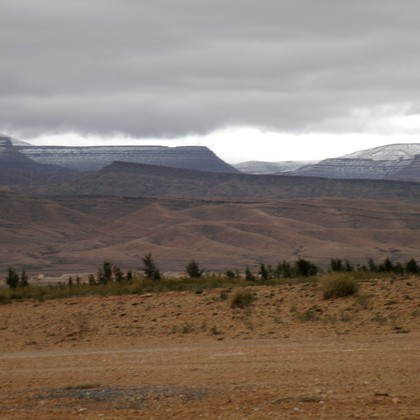
Open, dry woodland and scrub with scattered trees: light oak, thuya and juniper woodland, argan woodland in south-west Morocco, olive groves, almond and other orchards and bushy mountain slopes up to about 2000 m in the Atlas; also wooded parts of the high plateaux. Forages slowly and secretively in the canopy for insects.
Where the bird is most at home, classified by the habitats of North Africa and the Middle East.


Range and movements
Summer visitor in Morocco, from the Rif and the Atlantic lowlands through the Middle and High Atlas and the Anti-Atlas to the argan woodland around Agadir; in northern Algeria, including the Saharan Atlas, and in northern and central Tunisia; in north-west Libya (Jebel Nafusa) possibly a scarce breeder. On passage, in March–April and August–September, across the Sahara and through the oases of the desert edge. Winters in the Sahel, from Senegal and Mali to Chad. Beyond the region it breeds in Iberia, southern France and Italy.
- Summer visitor (c. Apr–Sep)
- Winter visitor (c. Oct–Mar)
- Passage (Mar–Apr, Oct–Nov)
- dark = core range, pale = thinly spread
How and when to look
In May search the olive groves and open oak woodland of the Middle Atlas near Azrou or the argan woodland east of Agadir; the calm, repeated fluty motifs from a treetop are the best clue. It often sits high and still in the canopy, where it is hard to see.
Conservation status
Not globally threatened. Declined in Europe through the loss of traditional orchards and olive groves and through insecticide use; in the Maghreb locally through the conversion of open woodland to farmland and the decline of argan woodland. Western and Eastern Orphean Warblers are now widely treated as separate species.
Scientific name
Curruca hortensis | (Gmelin, 1789) (GBIF: Sylvia hortensis)
Gmelin described the species in 1789 as Motacilla hortensis; because it was later moved to another genus, the author and year stand in brackets. The genus Curruca was introduced in 1802 by Bechstein. Curruca is Latin, the name of an unidentified small bird mentioned by the Roman poet Juvenal. hortensis is Latin for 'of a garden', from hortus 'garden'. The specimen the first description was based on came from France.