All species › Pelicans, herons and ibises › Herons and bitterns › Western Reef Heron
Western Reef Heron | Egretta gularis
Westelijke rifreiger | Garceta dimorfa
A coastal heron with two colour morphs, white and dark slate-grey, which is the commonest small heron along almost all coasts of the Arabian Peninsula, the Red Sea and the Persian Gulf. In the Maghreb it is rare.

Voice
Usually silent; when disturbed and at the colony a hoarse, low kraak or gaark.
Recording: David Darrell-Lambert — CC BY-NC-SA 4.0 · converted to mono · xeno-canto
Identification
A slender heron the size of Little Egret, but with a heavier, slightly drooping bill that is yellowish brown to orange-brown. The dark morph is slate-grey with a white throat, the white morph all white, and there are pied intermediates. The legs are dark to greenish with yellow toes; the yellow often extends some way up the tarsus. In the breeding season it has two long nape plumes and fine back plumes. In the east of the region birds belong to the subspecies schistacea with a pale bill; in Morocco and Tunisia the nominate gularis, with a darker bill closer to that of Little Egret, also occurs.
Confusion species
Little Egret (Egretta garzetta) has a thinner, straighter black bill, black legs with sharply demarcated yellow feet and a slimmer build; in white birds bill colour and shape are decisive, and hybrids occur in Tunisia. Great Egret (Ardea alba) is much larger, with a yellow bill and a long kinked neck. Medium Egret (Ardea intermedia) has a short yellow bill and black legs without yellow toes. Black Heron (Egretta ardesiaca) is smaller and blacker, with a black bill and no white throat.
Habitat
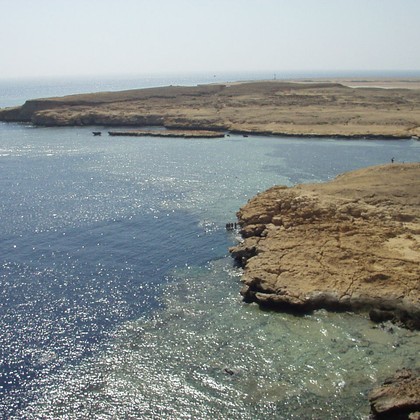
Tidal flats, rocky shores and coral reefs at low tide, mangroves, lagoons, harbours and salt pans; less often on fresh water inland. It hunts actively, often running through shallow water with half-spread wings. Breeds in colonies in mangroves and on islets.
Where the bird is most at home, classified by the habitats of North Africa and the Middle East.


Range and movements
A common resident along the Red Sea coasts of Egypt (including Sinai and the Gulf of Suez), Saudi Arabia and Yemen, around Socotra and along the Gulf of Aden; along the entire coast of Oman (including Barr al Hikman and Masirah) and in the Persian Gulf in the Emirates, Qatar, Bahrain, eastern Saudi Arabia, Kuwait and southern Iraq (Shatt al-Arab). Regular in the Gulf of Aqaba at Eilat and Aqaba; scarcer on Israel's Mediterranean coast and in the Nile Delta. In Tunisia a scarce visitor for decades, with breeding in mixed pairs with Little Egrets at Thyna (Sfax) in 1993, 1996, 1998 and 2002. Rare in Morocco, but reported more often in recent years (including a long-stayer at Essaouira in 2010), and scarce on the coast of Western Sahara; first recorded in Algeria in 2018 (Mekhada marshes, El Tarf). Beyond the region the nominate breeds along the West African coast from Mauritania to Gabon, and schistacea from East Africa to western India and Sri Lanka.
- Resident
- Summer visitor (c. Oct–Mar)
- Winter visitor (c. Apr–Sep)
- Passage (Mar–Apr, Oct–Nov)
- dark = core range, pale = thinly spread
How and when to look
At Eilat and Aqaba both morphs can be seen at close range along the north shore; in the Emirates and Oman they feed on every tidal flat at low tide and even in harbours. At Barr al Hikman and on Socotra they hunt among the Crab-Plovers. In the Maghreb it pays to check every Little Egret with a pale or heavy bill.
Conservation status
Not globally threatened and numerous in the region. Coastal development, marina construction and mangrove clearance reduce breeding sites, but the species adapts well to harbours and artificial shores.
Scientific name
Egretta gularis | (Bosc, 1792)
Bosc described the species in 1792 as Ardea gularis; because it was later moved to another genus, the author and year stand in brackets. The genus Egretta was introduced in 1817 by Forster. Egretta comes from Provençal aigrette, the name for the little egret, a diminutive of aigron 'heron'. gularis is Latin for 'of the throat', from gula 'throat', for the white throat that breaks the dark plumage. The specimen the first description was based on came from the Senegal River.