All species › Waders, gulls and terns › Gulls and terns › White-Cheeked Tern
White-Cheeked Tern | Sterna repressa
Arabische stern | Charrán arábigo
A dark grey tern of the warm coasts around the Arabian Peninsula, whose breeding range lies largely within the region. In summer it is one of the most numerous terns on the coral islands of the Gulf and the Red Sea; in winter most birds move to the coast of East Africa.
Voice
A sharp, high kee-lick, like Common Tern but thinner and faster; when disturbed a rattling kik-kik-kik.
Recording: David Darrell-Lambert — CC BY-NC-SA 4.0 · converted to mono · xeno-canto
Identification
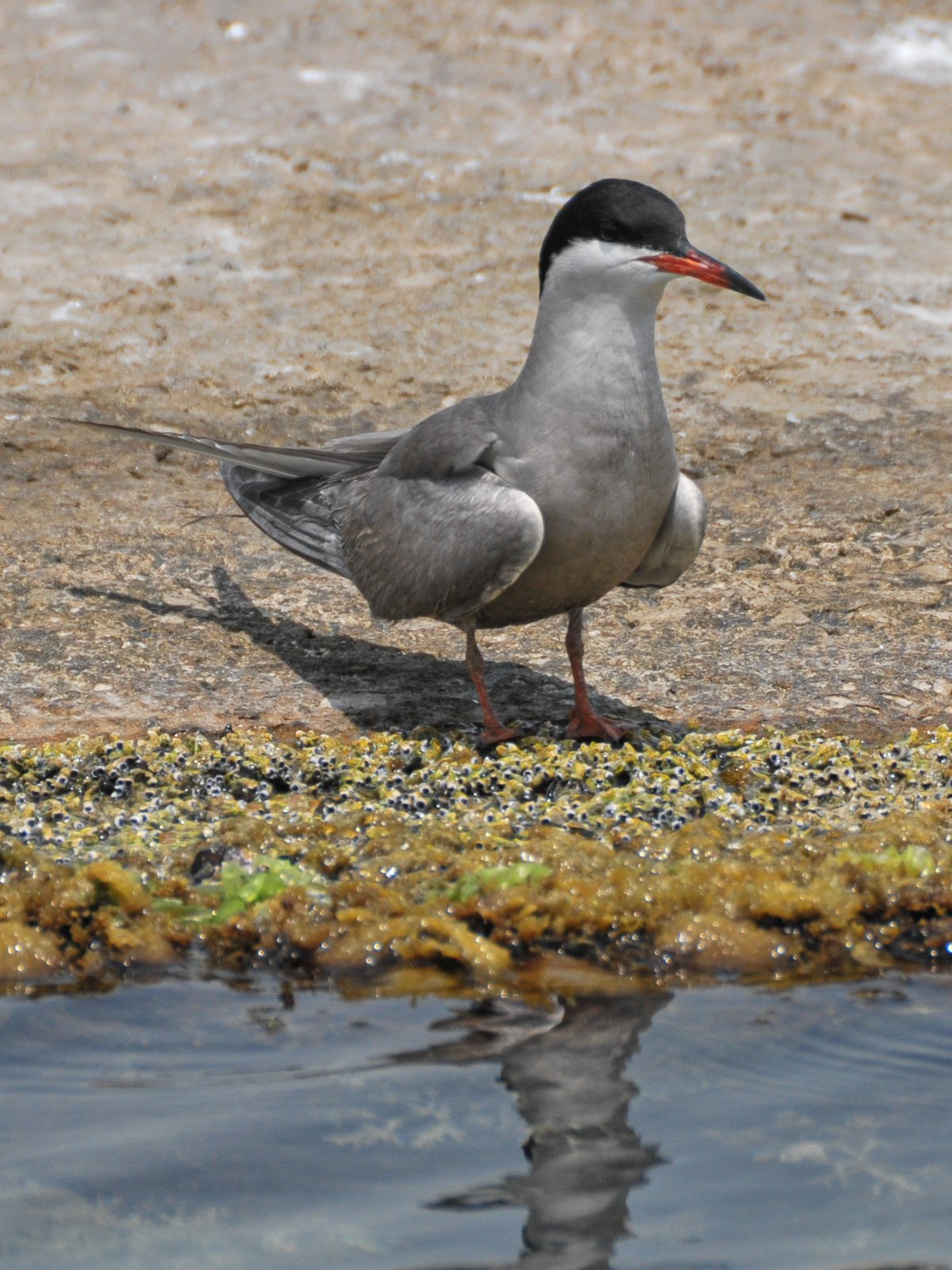
Slightly smaller and finer than Common Tern, with long, narrow wings. In breeding plumage the whole underside is uniform dark slate-grey, with a sharply defined white cheek stripe between the black cap and the grey. Mantle, rump and tail share the same dark grey tone, with no white patch behind. The bill is long and thin, dark red with a blackish tip, the legs red. From below the hand shows a broad, diffuse dark trailing edge and the secondaries are grey. In winter and in juveniles the underparts are white, but rump and tail remain grey.
Confusion species
Common Tern (Sterna hirundo) is pale grey to white below, with a white rump and tail contrasting with the grey mantle. Whiskered Tern (Chlidonias hybrida) also has dark underparts and a white cheek, but is smaller and more compact with a short, barely forked tail and flies low over fresh water. Bridled Tern (Onychoprion anaethetus) is brownish-black above and white below. Roseate Tern (Sterna dougallii) is much paler.
Habitat
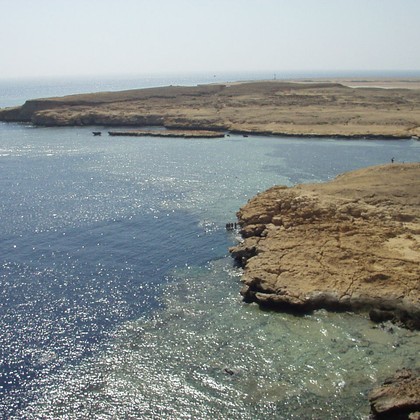
Warm, shallow coastal waters with coral reefs, bays, lagoons and mangrove coasts; feeds with short plunge-dives, also further out at sea. Breeds in colonies on low sand, shell and coral islets, often together with Lesser Crested, Greater Crested and Bridled Terns.
Where the bird is most at home, classified by the habitats of North Africa and the Middle East.


Range and movements
Breeds from April to August on islands in the Red Sea off Egypt (including near Hurghada and in the Gulf of Suez), Saudi Arabia (Farasan Islands) and Yemen, and in the Gulf off Kuwait (Kubbar, Qaru, Umm al Maradim), Saudi Arabia (Juraid, Jana, Karan, together more than 10,000 pairs), Bahrain, Qatar and Abu Dhabi. In Oman it breeds along the whole coast, including on the Daymaniyat Islands, Masirah and the Hallaniyat Islands. After breeding most birds move to East Africa; a few winter off Oman and Yemen. In Israel a scarce summer visitor and migrant at Eilat, not breeding; rare in southern Iraq. Beyond the region it breeds along the Iranian coast, in Eritrea, Djibouti, Somalia and Kenya, and locally in western India.
- Resident
- Summer visitor (c. Apr–Sep)
- Passage (Mar–Apr, Oct–Nov)
- dark = core range, pale = thinly spread
How and when to look
In summer they feed in numbers over the reefs off Hurghada and Marsa Alam, and in Oman along the Muscat coast and at Masirah. At Eilat a bird occasionally turns up among the Common Terns at the northern tip of the Gulf of Aqaba in May – August.
Conservation status
Not globally threatened. Because the world population is concentrated on a limited number of islands, it is vulnerable to disturbance of colonies, egg collecting, oil pollution and coastal development in the Gulf and along the Red Sea.
Scientific name
Sterna repressa | Hartert, 1916
Hartert described the species in 1916 and placed it straight away in the genus where it still stands. The genus Sterna was introduced in 1758 by Linnaeus. Sterna goes back to Old English stearn, which appears in the poem The Seafarer; the Frisians used a related word for terns. repressa is Latin for 'held back, restrained', from reprimere 'to press back'; why the name was chosen is unclear. The specimen the first description was based on came from Fao, Persian Gulf.