All species › Birds of prey › Hawks, eagles and kites › White-Tailed Eagle
White-Tailed Eagle | Haliaeetus albicilla
Zeearend | Pigargo europeo
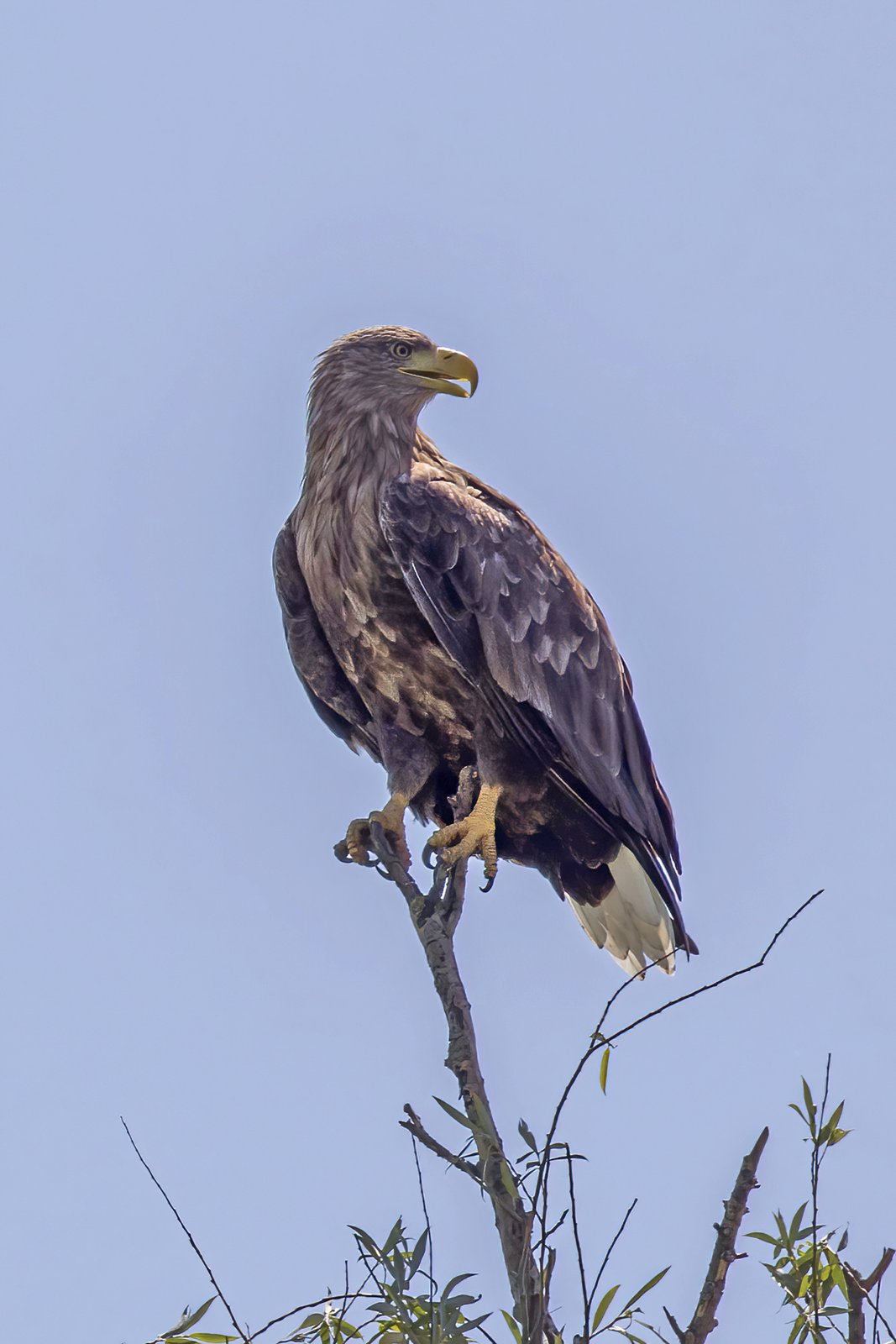
The White-tailed Eagle is the largest eagle in Europe: a huge, brown raptor with plank-like wings, a massive yellow bill and, in adults, a short white wedge-shaped tail. In the region it is a rare winter visitor to large lakes, fish ponds and coastal lagoons; as a breeding bird it disappeared from North Africa long ago.
Voice
Usually silent in winter. At the nest a barking, high klee-klee-klee-klee, often in duet.
Recording: Esperanza Poveda — CC BY-NC-SA 4.0 · shortened to the first 60 s, mono · xeno-canto
Identification
76–92 cm, wingspan 190–240 cm. The adult is dark earth-brown with a pale, buffish head and neck, a massive all-yellow bill and a short, pure white wedge-shaped tail. In flight huge, broad, rectangular wings with deeply fingered primaries, held flat; the head with its large bill projects almost as far forward as the tail does behind. The juvenile is darker and mottled, with a dark bill and head and a dark tail with white inner webs; the white tail and yellow bill are acquired in five to six years.
Confusion species
Golden Eagle (Aquila chrysaetos) is slimmer, soars with the wings in a shallow V, and has a smaller head and a longer, rounded tail. Griffon Vulture (Gyps fulvus) and Cinereous Vulture (Aegypius monachus) have a small, retracted head. Pallas's Fish Eagle (Haliaeetus leucoryphus) is smaller and slimmer, with a longer black tail with a white central band; the juvenile has a pale band under the wing. Young Greater Spotted Eagles (Clanga clanga) at fish ponds are much smaller, with a shorter neck.
Habitat
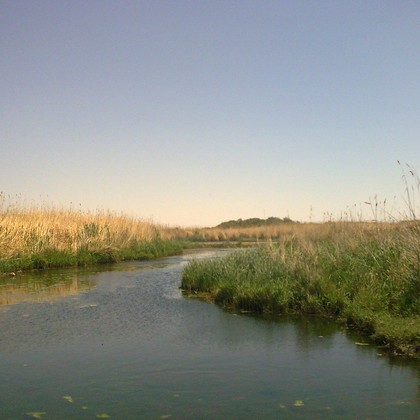
In winter large lakes, river deltas, marshes, fish ponds and coastal lagoons rich in fish and waterbirds, with a roost in tall trees or on open shores. Eats fish, waterbirds and carrion, and readily steals prey from other raptors.
Where the bird is most at home, classified by the habitats of North Africa and the Middle East.


Range and movements
Bred in the Nile Delta of Egypt until the early twentieth century, but has long since disappeared there. Now a rare winter visitor: in Israel a few birds each winter, mainly at the fish ponds of the Hula and Jezreel valleys; also in Syria and in the marshes and large lakes of Iraq. In Kuwait one record (winter 2009, Kuwait Bay and Jahra), and rare to vagrant in Egypt, Lebanon, Jordan and Saudi Arabia. In the Maghreb formerly a winter visitor to Lake Ichkeul in Tunisia, now exceptional. Beyond the region from Iceland, Norway and central Europe across Siberia to Kamchatka and Japan; winters south to Turkey, Iran and China.
- Resident
- Summer visitor (c. Oct–Mar)
- Winter visitor (c. Apr–Sep)
- Passage (Mar–Apr, Oct–Nov)
- dark = core range, pale = thinly spread
How and when to look
The best chance is in December and January in the Hula Valley, where an adult or immature White-tailed Eagle sometimes sits among the cranes and cormorants at the fish ponds. Look for the huge, plank-like wings and the short tail.
Conservation status
Not threatened; in Europe strongly recovered after the ban on DDT and thanks to protection and reintroductions. In the region it remains rare: drainage of marshes, shooting and poisoned bait also affect wintering birds.
Scientific name
Haliaeetus albicilla | (Linnaeus, 1758)
Linnaeus described the species in 1758 as Falco Albicilla; because it was later moved to another genus, the author and year stand in brackets. The genus Haliaeetus was introduced in 1809 by De Savigny. Haliaeetus is Greek in origin, from hals 'sea' and aetos 'eagle': sea eagle. albicilla is New Latin, from albus 'white' and cilla 'tail', after the white tail of the adult. The specimen the first description was based on came from Sweden.