All species › Birds of prey › Hawks, eagles and kites › Common Buzzard
Common Buzzard | Buteo buteo
Buizerd | Busardo ratonero
In the region the Common Buzzard is known mainly as the Steppe Buzzard (B. b. vulpinus), the small, often rufous eastern form that passes north in spring in hundreds of thousands through the Rift Valley at Eilat and the Jordan Valley. As a breeding bird it is scarce in the region; in the Maghreb its place is taken by the Long-legged Buzzard.

Voice
A far-carrying, plaintive mewing, peeeee-yoo, falling at the end; mainly near the nest. Migrants are usually silent.
Recording: Olivier SWIFT — CC BY-NC-SA 4.0 · shortened to the first 60 s, mono · xeno-canto
Identification
46–58 cm, wingspan 110–132 cm; the Steppe Buzzard averages smaller and slimmer than European birds. Compact, with broad, rounded wings, a short, broad tail and a head that projects little; soars with the wings in a shallow V. Plumage varies greatly, but usually there are dark carpal patches, a pale band across the breast, a dark trailing edge to the wing and a finely barred tail with a dark terminal band. Steppe Buzzards are often warm rufous-brown, with a rufous, barely barred tail; there are also dark and grey-brown birds. The juvenile lacks the broad terminal band and is streaked rather than barred below.
Confusion species
Long-legged Buzzard (Buteo rufinus) is larger and longer-winged, with a longer head and a plain pale orange-brown tail without a terminal band; rufous Steppe Buzzards look very similar, so check structure, arm length and carpal patch. European Honey-Buzzard (Pernis apivorus) has a small, cuckoo-like head on a long neck, a longer tail with two narrow basal bands, and soars on flat or drooping wings. Rough-legged Hawk (Buteo lagopus) has a white tail with a sharp black terminal band. Pale Booted Eagle (Hieraaetus pennatus) has black flight feathers and white underwing coverts.
Habitat
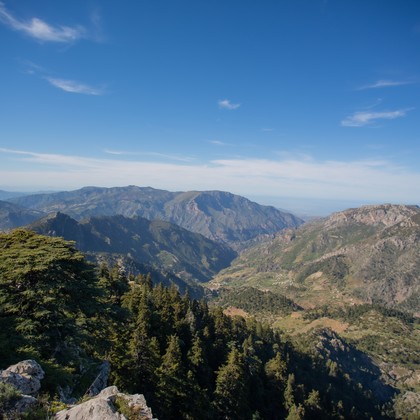
Woodland edges and copses alternating with open country and farmland. Migrants follow ridges, valleys and coastlines and roost in woods, orchards and date palm groves; in the Arava and the Negev in large numbers in the acacias at dusk. Wintering birds hunt over farmland and open woodland.
Where the bird is most at home, classified by the habitats of North Africa and the Middle East.


Range and movements
The Levant lies on one of the greatest raptor flyways in the world: in spring tens of thousands to over two hundred thousand Steppe Buzzards pass Eilat each year, in some years far more, mainly from late February to early May. In autumn they pass on a broader front, through Sinai, the Gulf of Suez and northern Israel and Jordan; some cross to Africa at Bab el-Mandeb in Yemen. A regular passage migrant in Egypt, Saudi Arabia, Yemen and Oman, scarce also in the Gulf states and Iraq. Scarce in winter in the Levant, Egypt and Arabia. In the Maghreb a scarce passage migrant and winter visitor via the Strait of Gibraltar; breeding records in northern Tunisia and Algeria and in the northern Levant are few and partly uncertain, partly through confusion and hybridisation with Long-legged Buzzard. Beyond the region it breeds over almost all of Europe and far into Siberia; the Steppe Buzzard winters in eastern and southern Africa.
- Resident
- Summer visitor (c. Oct–Mar)
- Winter visitor (c. Apr–Sep)
- Passage (Mar–Apr, Oct–Nov)
- dark = core range, pale = thinly spread
How and when to look
Go to the mountains north of Eilat in late March or early April: on a good day with southerly winds thousands of Steppe Buzzards pass in long, swirling streams. In autumn the Suez coast and the Jordan Valley are good places.
Conservation status
Not threatened. Migrants are shot in parts of the region and die on power lines and at wind farms along the Gulf of Suez; poisoned bait also plays a part.
Scientific name
Buteo buteo | (Linnaeus, 1758)
Linnaeus described the species in 1758 as Falco Buteo; because it was later moved to another genus, the author and year stand in brackets. The genus Buteo was introduced in 1799 by De Lacépède. Buteo is the Latin word for a buzzard. The specific name repeats the genus name: the genus was established by tautonymy with this species. The specimen the first description was based on came from Sweden.