All species › Waders, gulls and terns › Gulls and terns › White-Winged Tern
White-Winged Tern | Chlidonias leucopterus
Witvleugelstern | Fumarel aliblanco
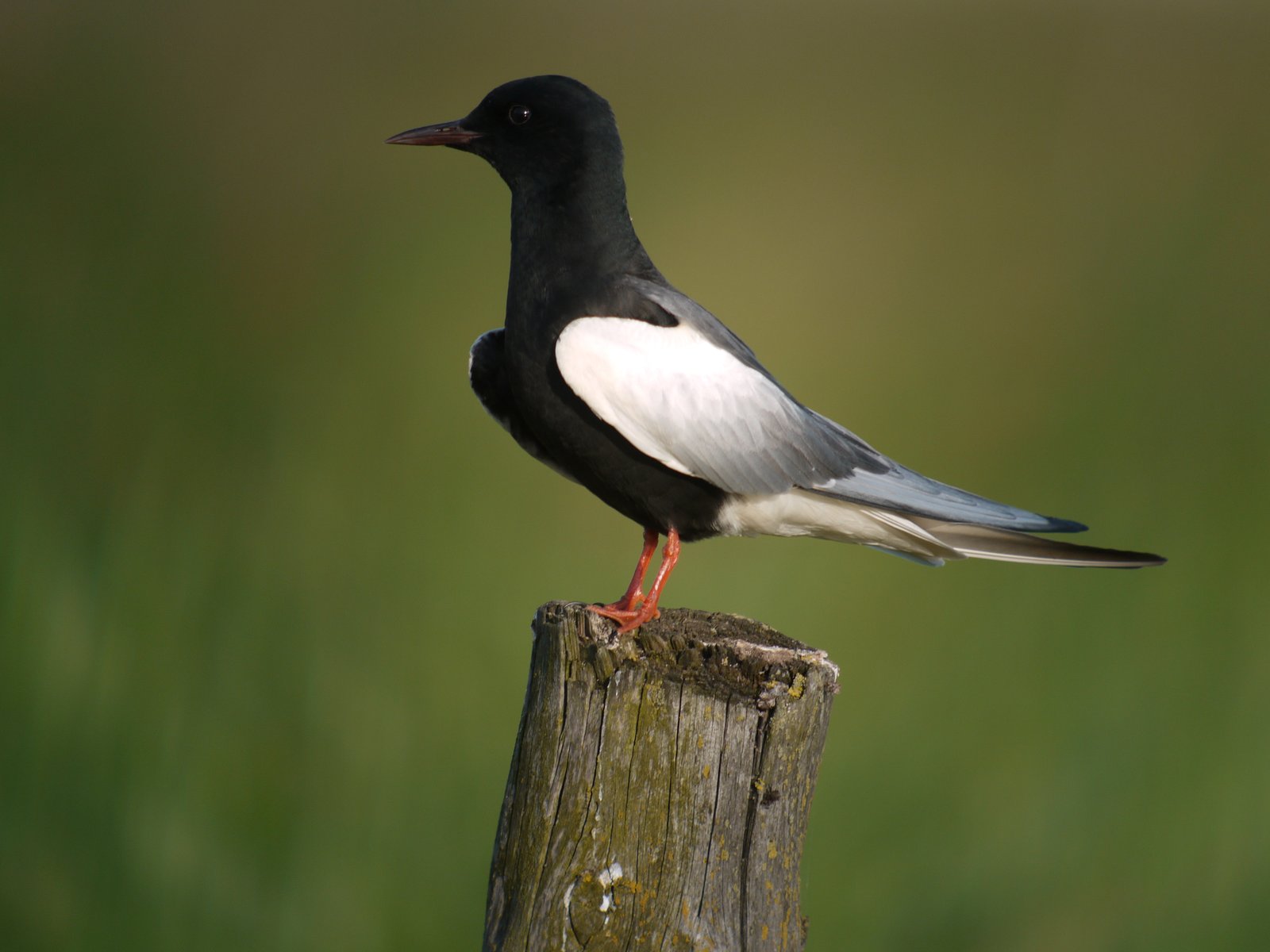
The smallest marsh tern and the most striking in summer plumage: jet black with gleaming white forewings, rump and tail. For the region it is mainly a passage migrant on the route between eastern Europe and Africa, passing through the Levant, Egypt and Arabia in large flocks in April and May.
Voice
A short, hoarse kesch or krek, harsher than Black Tern; flocks give a dry chatter.
Recording: Paul Kelly — CC BY-NC-SA 4.0 · converted to mono · xeno-canto
Identification
Small and compact, with a short, almost square tail, a short, fine bill and red legs. In summer plumage head, body and underwing coverts are black, the upperwing pale grey with a gleaming white forewing, and rump and tail white; the contrast is visible at long range. In winter plumage it is pale grey and white, with a white rump, a small dark ear spot separate from the lightly streaked crown and no breast-side patch. Juveniles have a dark brown saddle contrasting with the pale wings. Moulting birds are blotched black and white.
Confusion species
Black Tern (Chlidonias niger) is dark slate in summer plumage with grey wings and rump and grey underwings, and in winter plumage has a dark breast patch and a grey rump. Whiskered Tern (Chlidonias hybrida) is larger, with a heavier bill, grey underparts and a white cheek in summer plumage and a grey rump in winter plumage.
Habitat
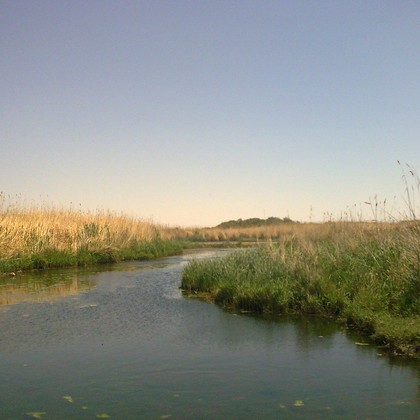
Shallow, vegetated freshwater lakes, flooded grasslands, rice fields, fish ponds and reservoirs; on migration also rivers, canals, sewage ponds and lagoons. Hunts low over water and wet fields for insects, which it picks from the surface.
Where the bird is most at home, classified by the habitats of North Africa and the Middle East.


Range and movements
In the region it breeds only locally in the marshes of Iraq; summer records are also known from other countries. In April and May a common, sometimes abundant migrant through Israel and the Jordan Valley, Egypt (Nile and Sinai), Jordan, Syria, Iraq and western and eastern Arabia; less conspicuous in autumn. In the Maghreb and Libya a scarce to fairly scarce migrant. Winters in small numbers in the Nile Valley, on the Gulf and in Yemen and Oman; since the winter of 2014/15 up to 100–200 birds in full breeding plumage have also spent each winter in the Middle East, suggesting an unknown population breeding somewhere in the region in winter. Beyond the region it breeds from eastern Europe to Mongolia and northeast China and winters in sub-Saharan Africa, Southeast Asia and Australia.
- Resident
- Summer visitor (c. Oct–Mar)
- Winter visitor (c. Apr–Sep)
- Passage (Mar–Apr, Oct–Nov)
- dark = core range, pale = thinly spread
How and when to look
In early May hundreds of birds in breeding plumage can hunt over the fish ponds of the Bet She'an Valley and the Hula, along the Nile and at sewage ponds in the Gulf states. In winter look out for birds in breeding plumage: such records are of scientific interest.
Conservation status
Not globally threatened, with a large population. On migration it depends on shallow wetlands and fish ponds along the route; the size and possible breeding of the wintering group in the Middle East are unknown.
Scientific name
Chlidonias leucopterus | (Temminck, 1815)
Temminck described the species in 1815 as Sterna leucoptera; because it was later moved to another genus, the author and year stand in brackets. The genus Chlidonias was introduced in 1822 by Rafinesque. Chlidonias is from Ancient Greek khelidonios 'swallow-like', from khelidon 'swallow'. leucopterus is Greek, from leukos 'white' and -pteros '-winged'. The specimen the first description was based on came from the Mediterranean coast.