All species › Waders, gulls and terns › Gulls and terns › Whiskered Tern
Whiskered Tern | Chlidonias hybrida
Witwangstern | Fumarel cariblanco
The largest and most silver-grey of the three marsh terns, which builds its floating nest on aquatic plants in shallow, vegetated lakes. In the region it breeds along the wet northern fringe of the Maghreb and in the marshes of Syria and Iraq, and in winter it stays in numbers in the Nile Valley and the Levant.
Voice
A dry, rasping kerch or krrek, like a Corn Crake; at the colony a raucous chattering chorus.
Recording: Indra Kusuma — CC BY-NC-SA 4.0 · converted to mono · xeno-canto
Identification
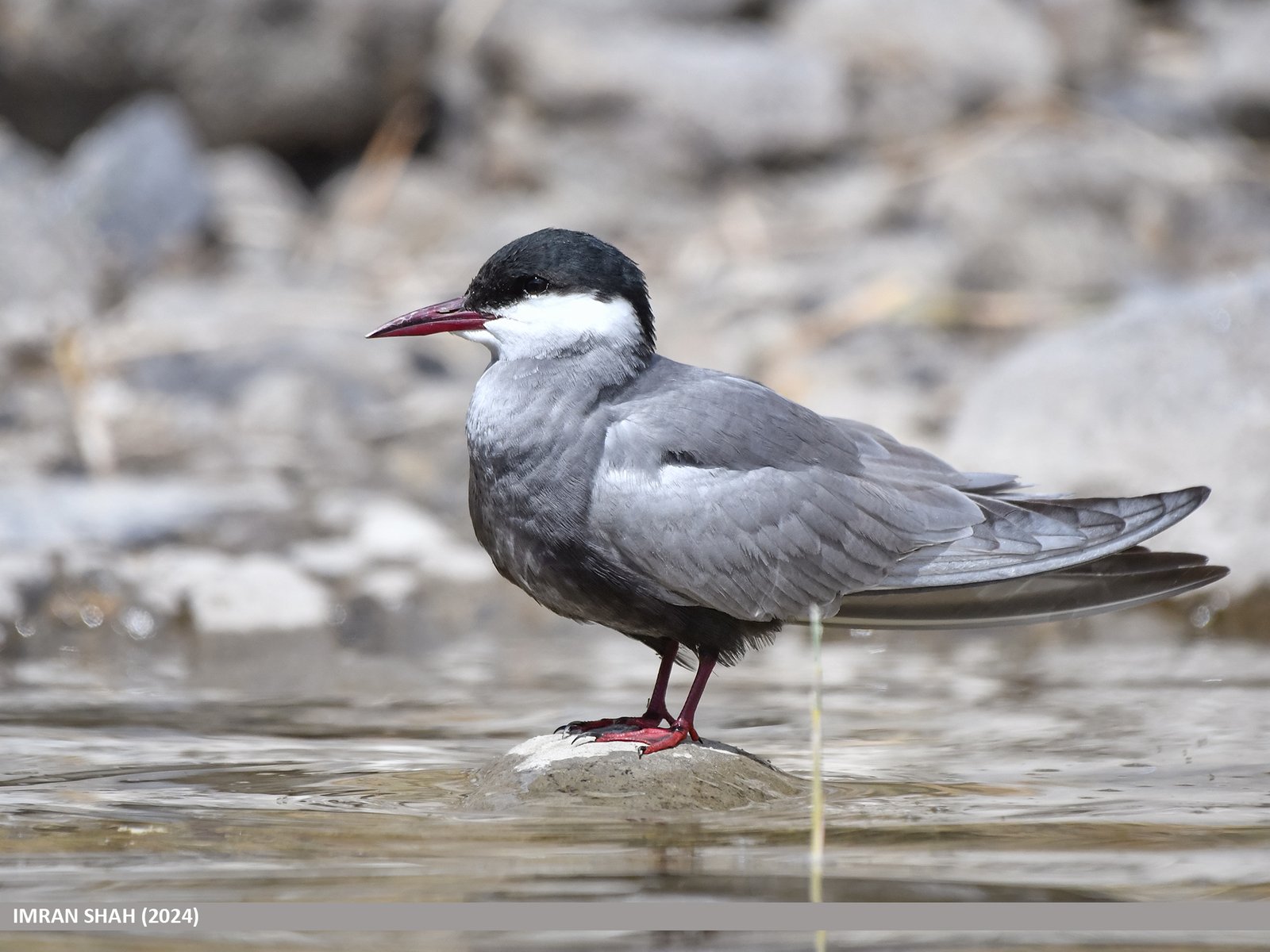
A small, compact tern with a fairly short, barely forked tail and dark red bill and legs. In summer plumage it is dark slate-grey below with a black cap and a striking white cheek forming a white band between cap and grey neck; the undertail coverts are white. In winter plumage it is pale silver-grey above and white below, with a grey-streaked rear crown extending behind the eye. Juveniles have a brown-and-black scaled mantle. The flight is steadier and less fluttering than in the other marsh terns; it picks prey from the water but also makes short plunges.
Confusion species
Black Tern (Chlidonias niger) and White-winged Tern (Chlidonias leucopterus) are smaller and slimmer and have black underparts in summer plumage. In winter plumage Whiskered is told by its heavier bill, pale grey rump and tail and lack of a dark breast patch; White-Winged has a white rump, Black a dark patch on the breast side. Common Tern (Sterna hirundo) is larger, with a longer, deeply forked tail.
Habitat
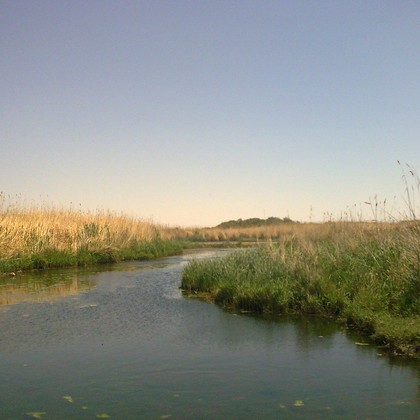
Shallow fresh or slightly brackish lakes, marshes and flooded grasslands with floating plants and reeds; also reservoirs, rice fields, fish ponds and irrigation canals. Breeds in colonies on floating vegetation. Outside the breeding season also on lagoons, salt pans and along rivers.
Where the bird is most at home, classified by the habitats of North Africa and the Middle East.


Range and movements
Breeds in northern Morocco (merjas along the Atlantic coast and small lakes in the Middle Atlas), in northeastern Algeria (the lakes around El Kala are among the most important breeding sites in the Mediterranean) and in northern Tunisia (Ichkeul). In the east it breeds in Syria and commonly in the marshes of southern Iraq; in Israel and Egypt it breeds irregularly and in small numbers. A common migrant in the Maghreb, along the Nile and in the Levant, scarcer in Arabia. In winter common in the Nile Delta and Nile Valley and at fish ponds in Israel, locally in the Maghreb and along the Gulf; scarce in Oman and Yemen. Beyond the region it breeds in southern and eastern Europe, Central and East Asia, sub-Saharan Africa and Australia.
- Resident
- Summer visitor (c. Apr–Sep)
- Winter visitor (c. Oct–Mar)
- Passage (Mar–Apr, Oct–Nov)
- dark = core range, pale = thinly spread
How and when to look
Lake Ichkeul in Tunisia and the lakes near El Kala in Algeria are the best places to see colonies in spring and summer. In winter flocks hunt over the fish ponds of the Bet She'an Valley and the Hula in Israel and over the canals and lakes of the Nile Delta.
Conservation status
Not globally threatened. In North Africa and the Middle East it depends on a limited number of freshwater marshes, which are being lost to drainage, water abstraction and drying out; in dry years whole colonies fail. The restoration of the Iraqi marshes has been beneficial.
Scientific name
Chlidonias hybrida | (Pallas, 1811)
Pallas described the species in 1811 as Sterna hybrida; because it was later moved to another genus, the author and year stand in brackets. The genus Chlidonias was introduced in 1822 by Rafinesque. Chlidonias is from Ancient Greek khelidonios 'swallow-like', from khelidon 'swallow'. hybrida is Latin for 'hybrid': the describer took the bird for a cross between the white-winged tern and the common tern. The specimen the first description was based on came from the lower Volga, Russia.