All species › Waders, gulls and terns › Gulls and terns › Gull-Billed Tern
Gull-Billed Tern | Gelochelidon nilotica
Lachstern | Pagaza piconegra
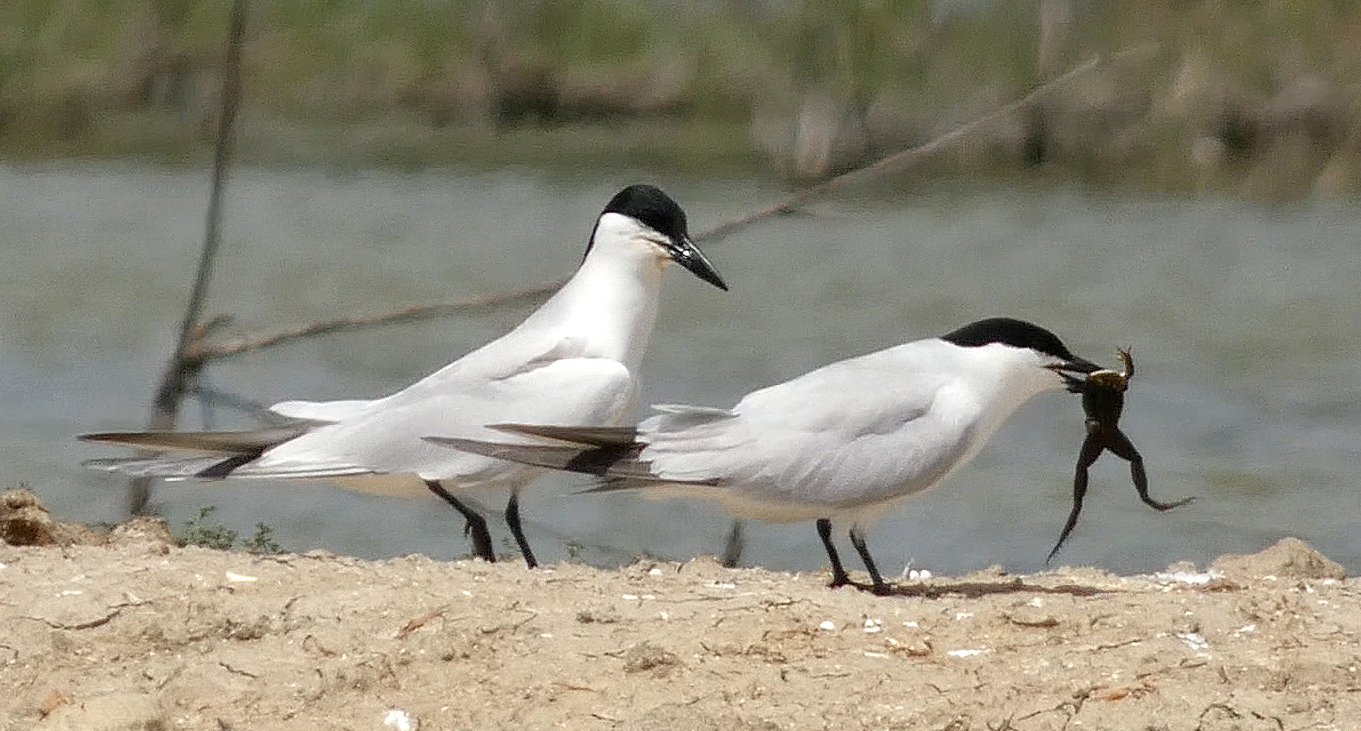
A large, pale tern with a short, thick black bill that hunts over land more than other terns: over salt flats, marshes and fields it picks insects, lizards and small crabs from the ground. In the region it breeds patchily from the Maghreb to the marshes of southern Iraq; in winter it is mainly on the Gulf, the Red Sea and in the Nile Delta.
Voice
A nasal, laughing ke-wek or gerr-vek, often repeated; at the colony a harsh, grating kaak-kaak.
Recording: Walter Wallner — CC BY-NC-SA 4.0 · converted to mono · xeno-canto
Identification
Almost as large as Sandwich Tern, but with broader wings, a shorter, only slightly forked tail and a short, thick, all-black bill with a distinct gonys angle. In summer plumage a neat black cap without a crest; the upperparts are pale silver-grey, the underparts white, the fairly long legs black. In winter plumage the head is white with a small dark patch behind the eye. In flight it shows a dark trailing edge to the primaries, and the flight is calm and gull-like, with little diving: it snatches prey from the ground or the water surface.
Confusion species
Sandwich Tern (Thalasseus sandvicensis) is slimmer, with a longer, thin, yellow-tipped bill, a shaggy crest and narrower wings, and plunge-dives steeply. Caspian Tern (Hydroprogne caspia) is much larger with a heavy red bill. In winter plumage it recalls Whiskered Tern (Chlidonias hybrida), which is much smaller with a thin bill.
Habitat
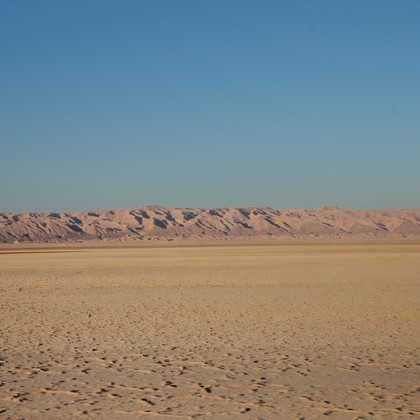
Salt pans, sebkhas, lagoons and marshes with bare, dry margins, and the surrounding steppes, fields and wet meadows over which it hunts; in winter also tidal flats and fish ponds. Breeds in small colonies on bare islets and bunds, often with other terns and avocets.
Where the bird is most at home, classified by the habitats of North Africa and the Middle East.


Range and movements
In the northwest it breeds at a few sites in Morocco (mainly the Atlantic lagoons and the Loukkos area), Algeria (chotts and the lakes around El Kala) and Tunisia (Gulf of Gabès, sebkhas of the Sahel); in Libya and Egypt (Nile Delta) it breeds at most locally and in small numbers. In the east it breeds in Syria, along the Euphrates and Tigris and in large numbers in the marshes of southern Iraq, and further on islands and coasts of Kuwait, Saudi Arabia and Bahrain. As a migrant it can be seen everywhere, including along the Jordan Valley and at Eilat. In winter common along the Persian Gulf, the Gulf of Oman and the Red Sea, in the Nile Delta and Nile Valley, and in smaller numbers on the Atlantic coast of Morocco and Western Sahara. Beyond the region it breeds patchily in southern Europe and from Turkey and the Caspian to Central Asia and China, and in other forms in the Americas and Australia; Eurasian birds winter in the Sahel, East Africa and South Asia.
- Resident
- Summer visitor (c. Oct–Mar)
- Winter visitor (c. Apr–Sep)
- Passage (Mar–Apr, Oct–Nov)
- dark = core range, pale = thinly spread
How and when to look
Watch for a tern quartering low over a salt flat or field and dropping to the ground instead of diving: that is almost always a Gull-billed Tern. In winter the lagoons and tidal flats of Kuwait, Bahrain and Abu Dhabi and the delta lakes of Egypt are the best sites; in spring and summer the salt pans of Tunisia.
Conservation status
Not globally threatened, but the European and North African breeding populations are small and fluctuating. In the region colonies are vulnerable to drainage, disturbance, egg collecting and coastal development; the restoration of the Iraqi marshes after 2003 has given the species room there again.
Scientific name
Gelochelidon nilotica | (Gmelin, 1789)
Gmelin described the species in 1789 as Sterna nilotica; because it was later moved to another genus, the author and year stand in brackets. The genus Gelochelidon was introduced in 1830 by Brehm. Gelochelidon is Greek, from gelaō 'to laugh' and khelidōn 'swallow'. nilotica is Latin for 'of the River Nile', after the region the described bird came from. The specimen the first description was based on came from Egypt.