All species › Passerines › Sparrows › Yellow-Throated Sparrow
Yellow-Throated Sparrow | Gymnoris xanthocollis
Indische rotsmus | Gorrión cuelligualdo
The Yellow-throated Sparrow is a small, plain sparrow of open woodland, palm groves and riverine forest, reaching the western edge of its range in Mesopotamia. It is a summer visitor that winters in India; in the rest of the region it is a rarity.
Voice
A monotonous, regular series of clear chirps, cheep … cheep … chilup, delivered for hours from a treetop, like a House Sparrow set to a metronome. The call is a dry chilp.
Recording: Omar Alshaheen — CC BY-NC-SA 4.0 · shortened to the first 60 s, mono · xeno-canto
Identification
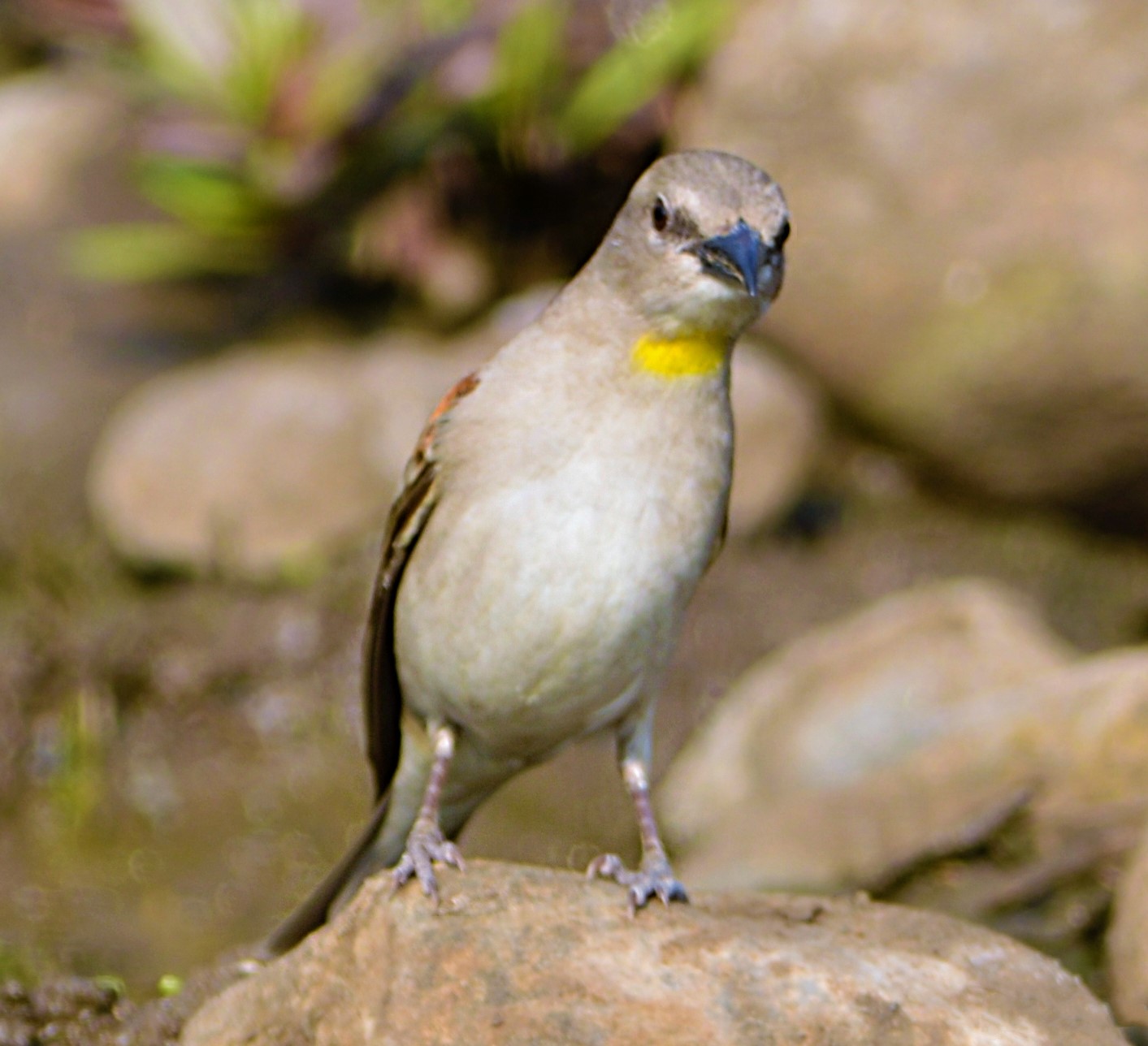
12.5–14 cm. Smaller and slimmer than a House Sparrow, with a neat head and a rather long, pointed bill. Upperparts plain grey-brown, underparts off-white, the head completely unmarked. The breeding male has a black bill, a bright lemon-yellow throat spot, a chestnut shoulder patch and two crisp white wing bars. The female is duller, with a pinkish bill, little chestnut and a small or absent yellow spot. Juveniles resemble the female with buff wing bars.
Confusion species
Female House Sparrow (Passer domesticus) has a pale supercilium and a streaked back. Pale Rockfinch (Carpospiza brachydactyla) is larger, with a heavy blunt bill, long wings and faint wing bars. Dead Sea Sparrow (Passer moabiticus) is smaller; the male has a grey head, a small black bib and a yellow neck patch.
Habitat
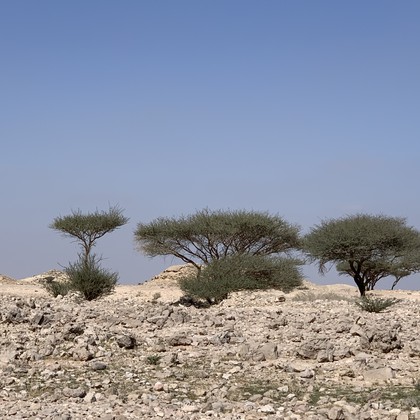
Open woodland, riverine forest with poplars and tamarisks, date-palm groves, orchards, field edges with trees and light acacia scrub. Nests in tree holes and old woodpecker holes. Feeds both in trees and on the ground.
Where the bird is most at home, classified by the habitats of North Africa and the Middle East.


Range and movements
Summer visitor from April to September to Iraq, especially in the palm groves and riverine woods of Mesopotamia along the Euphrates and Tigris, and since 2003 breeding along the Euphrates in eastern Syria. A vagrant or rare migrant in Kuwait, Qatar and the United Arab Emirates; a few records in Israel, and in Jordan first trapped near Azraq in June 2011, where a small breeding population may exist. Beyond the region it breeds from south-east Turkey and Iran to Pakistan and India and winters in India.
- Summer visitor (c. Apr–Sep)
- Passage (Mar–Apr, Oct–Nov)
- dark = core range, pale = thinly spread
How and when to look
Look for it in the date-palm groves of southern Iraq or along the Euphrates in the early morning and listen for the regular, metronomic song from a treetop. In the Gulf states it pays to check spring parks and gardens for a plain sparrow with white wing bars.
Conservation status
Not globally threatened. The recent records in Syria and Jordan may point to a westward expansion.
Scientific name
Gymnoris xanthocollis | (Burton, 1838)
Burton described the species in 1838 as Fringilla xanthocollis; because it was later moved to another genus, the author and year stand in brackets. The genus Gymnoris was introduced in 1845 by Blyth. Gymnoris is Greek, from gumnos 'bare' and rhinos 'nostrils', after the unfeathered nostrils. xanthocollis means 'yellow-necked', from Greek xanthos 'yellow' and Latin collum 'neck', after the yellow throat patch. The specimen the first description was based on came from the Ganges between Calcutta and Varanasi.