All species › Passerines › Sparrows › House Sparrow
House Sparrow | Passer domesticus
Huismus | Gorrión común
The familiar sparrow of houses and yards, in the region as much at home in the medina of Marrakech as in the Gulf cities, the Nile Delta and oases deep in the Sahara. Wherever people live and grain is to be found, it follows; along roads and new settlements it spread far into the desert during the last century.
Voice
The well-known chilp or cheep, repeated in series as a simple song from a roof; also a nasal, rattling chrr-r-r-r in alarm and quarrels, and a continuous hubbub from flocks at the roost in a dense tree.
Recording: Uku Paal — CC BY-NC-SA 4.0 · shortened to the first 60 s, mono · xeno-canto
Identification
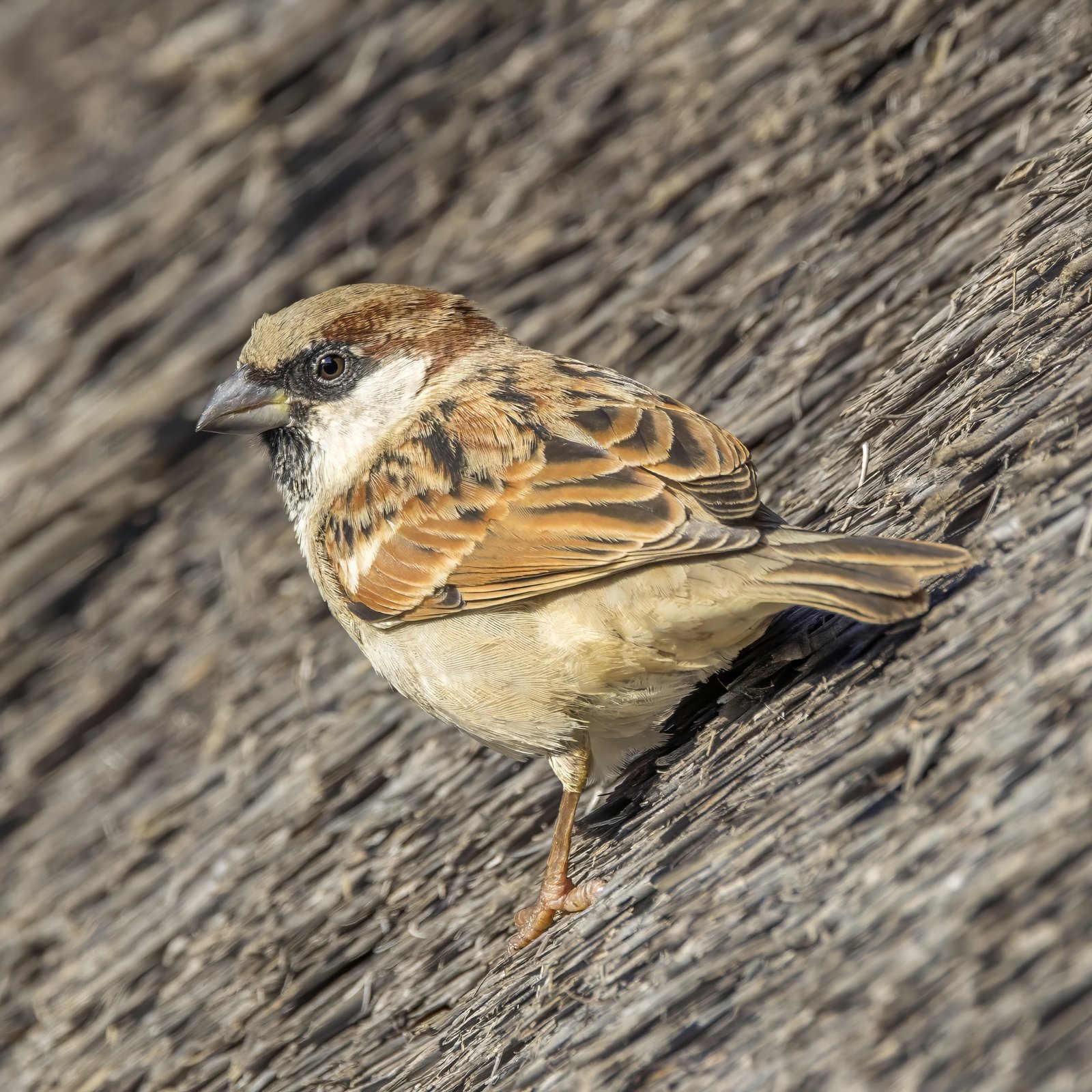
About 14–16 cm, stocky, with a short, heavy conical bill. The male has a grey crown, a chestnut band from behind the eye to the nape, a greyish white cheek, black lores and a black bib on throat and upper breast. The mantle is warm brown with black streaks, the rump grey, the underparts dirty greyish white and the wing has one white bar; the bill is black when breeding and horn-coloured otherwise. In winter the pattern is subdued by pale fringes. The female is plain grey-brown with a pale supercilium behind the eye, a streaked back and unstreaked dirty white underparts. Birds in Egypt and on the Arabian Peninsula are smaller and paler, with a whiter cheek, than those of the Maghreb and the Levant.
Confusion species
Spanish Sparrow (Passer hispaniolensis) has a chestnut crown, white cheek, a much larger bib and black-streaked flanks. The Italian-looking hybrids of Algeria and Tunisia (Passer italiae) have a chestnut crown. Desert Sparrow (Passer simplex) is pale sandy, the male with a grey head and black throat and lores. Dead Sea Sparrow (Passer moabiticus) is smaller, with a yellow spot on the side of the neck. Eurasian Tree Sparrow (Passer montanus) has an all-chestnut crown and a black cheek spot, and the sexes are alike.
Habitat
Towns, villages, farms, ports, markets, filling stations and oases, and the fields, gardens and date-palm groves around them; from sea level to the mountain villages of the Atlas and Yemen. It nests in holes and crevices in buildings, in mud walls, palm crowns, lamp posts and nest boxes, and sometimes free in trees. It feeds on seed, grain, kitchen scraps and insects, the latter mainly for the young.
Where the bird is most at home, classified by the habitats of North Africa and the Middle East.


Range and movements
Throughout the region wherever people live: in all countries from Morocco to Egypt, including the Saharan oases, through the Levant, Syria and Iraq, and across the whole Arabian Peninsula from Kuwait and the Gulf states to Oman and Yemen. Absent only from uninhabited desert and high mountains. Beyond the region native over almost all of Europe and Asia to the Himalaya, and spread by people to the Americas, southern Africa, Australia and many islands.
- Resident
- Summer visitor (c. Oct–Mar)
- Winter visitor (c. Apr–Sep)
- Passage (Mar–Apr, Oct–Nov)
- dark = core range, pale = thinly spread
How and when to look
It needs no searching but repays a look: in the Maghreb compare males on a roof with Spanish and Italian-looking sparrows, and in Arabia note the small, pale, white-cheeked birds. In oases flocks at the water troughs are easiest to watch.
Conservation status
Not threatened and one of the most widespread birds in the world. It has declined sharply in parts of Europe; in the region it is numerous and follows the growth of towns and irrigated farming.
Scientific name
Passer domesticus | (Linnaeus, 1758)
Linnaeus described the species in 1758 as Fringilla domestica; because it was later moved to another genus, the author and year stand in brackets. The genus Passer was introduced in 1760 by Brisson. Passer is the Latin word for 'sparrow'. domesticus is Latin for 'belonging to the house', for the bird's life close to people. The specimen the first description was based on came from Sweden.