All species › Passerines › Sparrows › Arabian Golden Sparrow
Arabian Golden Sparrow | Passer euchlorus
Arabische goudmus | Gorrión dorado árabe
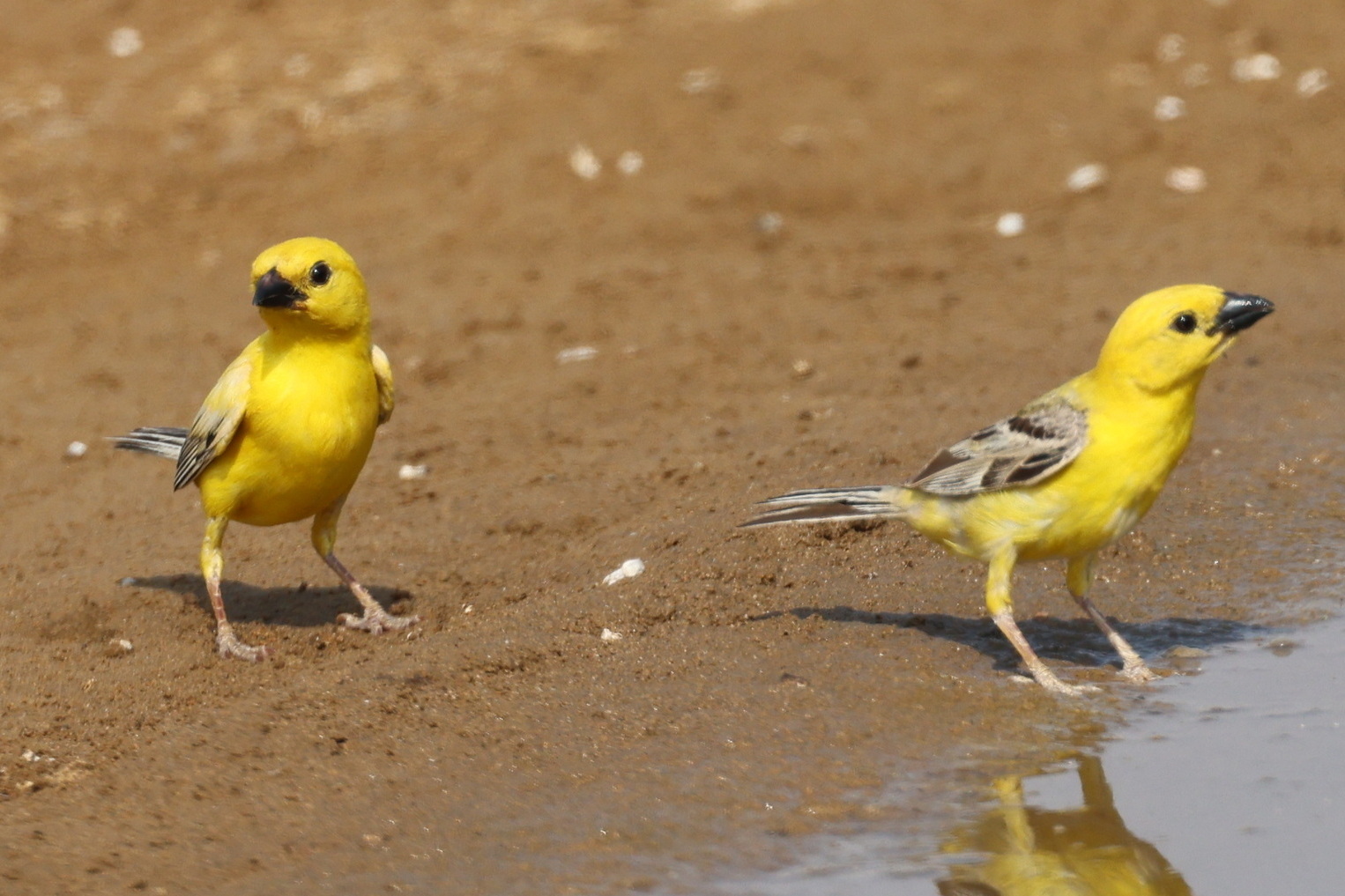
A small, short-tailed sparrow in which the male is almost entirely lemon-yellow, one of the most striking birds of the Tihama in south-western Arabia. It lives in flocks, sometimes of many thousands, breeds colonially in acacias and wanders in search of seed, so that it can be abundant one year and absent the next.
Voice
A dry, sparrow-like chilp and a soft chirping, higher and thinner than in House Sparrow; flocks keep up a continuous twittering and chirping, and a breeding colony produces a deafening clamour.
Recording: Gregory Askew — CC BY-NC-SA 4.0 · converted to mono · xeno-canto
Identification
About 13 cm, smaller and more compact than a House Sparrow, with a short conical bill. The male is bright lemon-yellow on head, back and underparts, without any chestnut; the wings and tail are blackish brown with pale edges and two narrow white wingbars. The bill is black in the breeding season and pinkish horn outside it. The female is much duller: sandy grey-brown above, pale yellowish white below, with a yellow-green wash on head and breast, a pale bill and light brown wings with pale bars. Juveniles resemble the female but are duller still.
Confusion species
The Sudan Golden Sparrow (Passer luteus), on the African side of the Red Sea, is closely related and sometimes treated as the same species; the male has a chestnut back and scapulars. The female resembles a female House Sparrow (Passer domesticus) but is smaller, yellower and has a shorter, pale bill. Rüppell's Weaver (Ploceus galbula) is also yellow but larger, with a longer pointed bill, a red eye and, in the male, a chestnut mask. Yellow canaries and serins are streaked and have a yellow rump.
Habitat
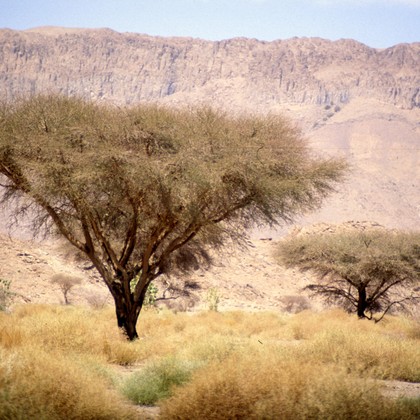
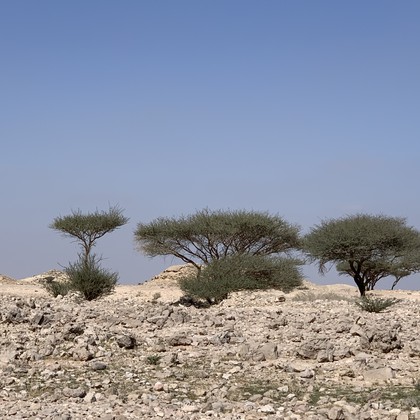
Dry acacia savanna and thorn scrub of the coastal plain and lower slopes, to about 1000 m, often near fields of sorghum and millet, irrigation channels and livestock troughs. It feeds in large, dense flocks on the ground on grass seed and grain and drinks regularly. It nests colonially, with many nests close together in one or a few acacias; the nest is a loose ball of grass with a side entrance.
Where the bird is most at home, classified by the habitats of North Africa and the Middle East.

Range and movements
South-western Arabia: in Saudi Arabia in the Tihama and the lower foothills of the Asir, from around Jeddah south to the Yemen border; in Yemen throughout the Tihama, the western foothills and along the south coast to around Aden and Lahij. Elsewhere in the region exceptional at most. Outside the region only in Djibouti and north-western Somalia.
- Summer visitor (c. Oct–Mar)
- Passage (Mar–Apr, Oct–Nov)
- dark = core range, pale = thinly spread
How and when to look
After rain, drive the Tihama roads between Jizan and Al Hudaydah and watch for moving yellow clouds over the fields and acacias. A colony betrays itself by an acacia full of grass nests and the twittering around it; keep your distance, as the birds readily abandon nests when disturbed.
Conservation status
Not threatened. Locally very numerous, but because of its nomadic habits numbers fluctuate strongly. In some farming areas it is regarded as a pest of grain crops and is controlled.
Scientific name
Passer euchlorus | (Bonaparte, 1850)
Bonaparte described the species in 1850 as Auripasser euchlorus; because it was later moved to another genus, the author and year stand in brackets. The genus Passer was introduced in 1760 by Brisson. Passer is the Latin word for 'sparrow'. euchlorus is Greek for 'bright yellow-green', from eu 'well' and khlōros 'green, yellowish green'. The specimen the first description was based on came from Al Qunfudhah, Saudi Arabia.