All species › Passerines › Thrushes › Yemen Thrush
Yemen Thrush | Turdus menachensis
Jemenlijster | Zorzal yemení
The Yemen Thrush is a thrush endemic to the mountains of south-west Arabia, from Taif in Saudi Arabia to the western highlands of Yemen. An inconspicuous, olive-brown inhabitant of juniper woodland and mountain gardens, it often sits motionless for long periods in dense scrub and mostly betrays itself by its explosive call.

Voice
The call is an explosive chuck-chuck, the easiest way to find the bird. The song, mainly at dawn, is a fluty series of high, varied phrases, less rich than that of Common Blackbird.
Recording: bert de bruin — CC BY-NC-SA 4.0 · converted to mono · xeno-canto
Identification
23 cm. A medium-sized, rather long-tailed and plain thrush. The male is olive-brown above and paler, greyer below; chin and throat are buff-grey with narrow dark streaks continuing onto the breast. The belly is dull and almost unmarked. The stout bill is orange-yellow, the legs flesh-coloured to yellowish. In flight the orange underwing-coverts stand out. The female is paler and buffer below, often with dark shaft streaks on the belly and flanks, and has a duller bill. Juveniles are pale-spotted above and more densely spotted below.
Confusion species
Song Thrush (Turdus philomelos), a rare winter visitor as far as south-west Arabia, has clear drop-shaped spots on a white belly, a shorter tail and a dark bill. A female Common Blackbird (Turdus merula) is darker brown and hardly occurs in the mountains of south-west Arabia. Tristram's Starling (Onychognathus tristramii) also shows orange in the wing in flight, but is glossy black (male) or grey-headed (female) and gives loud whistles.
Habitat
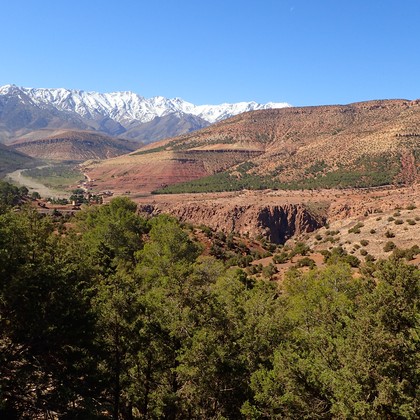
Montane woodland with dense native trees and shrubs: juniper and wild-olive woodland, thickets, copses, orchards and large terraced gardens, often with open ground nearby. From 1,200 to 3,100 m, mainly above 1,700 m; at lower altitudes only in dense vegetation along streams. Forages on the ground among dead leaves and rotting plant material, and also eats berries and figs.
Where the bird is most at home, classified by the habitats of North Africa and the Middle East.

Range and movements
Endemic to the mountains of south-west Arabia. In Saudi Arabia a fairly common resident of the Asir and Hejaz from Taif south through Al Baha, Tanoumah and Abha (Al Soudah, Raydah) to the Yemen border, and on isolated mountains above the Tihama such as Jebel Aswad. In Yemen local in the western highlands. Occurs nowhere else in the world.
- Resident
- Summer visitor (c. Oct–Mar)
- Passage (Mar–Apr, Oct–Nov)
- dark = core range, pale = thinly spread
How and when to look
In the juniper woodland of Al Soudah and the Raydah reserve near Abha, or around Tanoumah and Al Baha: go out early and listen for the hard chuck-chuck from dense scrub. A bird rummaging among leaves on the ground often stands still for a long time and is then easily missed.
Conservation status
Near Threatened. The world population is small and declining through logging, grazing and loss of montane juniper woodland, partly due to climate change and building. In Saudi Arabia part of its habitat is protected in the Raydah reserve and Asir National Park; there the population appears stable since the 1980s.
Scientific name
Turdus menachensis | Ogilvie-Grant, 1913
Ogilvie-Grant described the species in 1913 and placed it straight away in the genus where it still stands. The genus Turdus was introduced in 1758 by Linnaeus. Turdus is the ordinary Latin word for 'thrush'. menachensis refers to Manakhah (Menacha), Yemen. The specimen the first description was based on came from Manakhah, Yemen.