All species › Passerines › Thrushes › Common Blackbird
Common Blackbird | Turdus merula
Merel | Mirlo común
The Common Blackbird is a common breeding bird of gardens, olive groves and woodland in the north of the region, from Morocco to the Levant and northern Iraq. The dark form mauritanicus lives in the Maghreb, syriacus in the Levant; in winter northern birds join them and penetrate further south to the Nile Delta and scarcely to the Arabian Peninsula.

Voice
The song is a slow, mellow and melodious whistle with long, varied phrases and a softer, scratchy ending, from a roof, aerial or treetop, especially at dusk. The alarm is a loud, rattling chak-chak-chak and a thin sreeh; at roosting time a repeated pink-pink.
Recording: Mark James Pearson — CC BY-NC-SA 4.0 · converted to mono · xeno-canto
Identification
23.5–29 cm. The male is all black with an orange-yellow bill and yellow eye-ring; in the first winter the bill is darker and the wings brownish-black. The female is dark brown with a paler, faintly streaked throat and a rusty-brown, indistinctly spotted breast, and a brownish bill. Juveniles are spotted rusty-brown. The North African mauritanicus is small and very dark: the male glossy black, the female almost blackish-brown. Often raises its tail after landing.
Confusion species
Ring Ouzel (Turdus torquatus) has a white or off-white breast band and pale fringes to the wing feathers that make the wing look silvery. Blue Rock-Thrush (Monticola solitarius) also looks dark in poor light, but the male is slate-blue with a long, dark bill, and it lives on rocks and buildings. The male Tristram's Starling (Onychognathus tristramii) is glossy black with orange primaries that flash in flight.
Habitat
Woodland with undergrowth, maquis, riverine woodland, olive groves, orchards, oases with date palms, parks and gardens into the centre of cities. In the Atlas up to about 2,300 m in cedar and oak forest. In winter also in scrub along wadis, irrigated farmland and city parks. Eats worms, insects, snails and much fruit and berries.
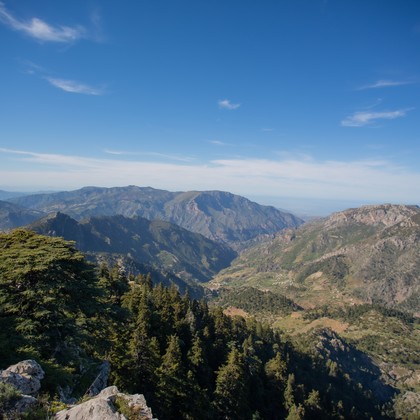
Where the bird is most at home, classified by the habitats of North Africa and the Middle East.


Range and movements
Resident in Morocco (south to the Anti-Atlas and locally the oases of the desert edge), northern Algeria and Tunisia, north-west Libya (Tripolitania) and the Jebel Akhdar in Cyrenaica, with a small population in the Nile Valley and Delta. In the Levant it breeds in Lebanon, Syria, Israel, Palestine, north-west Jordan and northern Sinai, and further in northern Iraq. In winter birds from Europe and Turkey join them in the Maghreb, the Nile Delta to about Cairo, the Jordan Valley and Iraq; on the Arabian Peninsula a scarce winter visitor to Kuwait, northern and eastern Saudi Arabia and the Gulf states, rare in Oman and Yemen. Beyond the region it breeds throughout Europe and east to Iran and Central Asia.
- Resident
- Summer visitor (c. Oct–Mar)
- Winter visitor (c. Apr–Sep)
- Passage (Mar–Apr, Oct–Nov)
- dark = core range, pale = thinly spread
How and when to look
In any town garden or olive grove in the Maghreb or the Levant: listen for the song at dusk. In Morocco compare the jet-black mauritanicus with European Blackbirds, and in winter look for a Blackbird among the Song Thrushes in Arabian parks.
Conservation status
Not globally threatened. Common in the north of the region and well adapted to gardens and towns; in the Maghreb and the Levant it is trapped and shot like other thrushes.
Scientific name
Turdus merula | Linnaeus, 1758
Linnaeus described the species in 1758 and placed it straight away in the genus where it still stands. He introduced the genus Turdus in that same work. Turdus is the ordinary Latin word for 'thrush'. merula is the Latin word for the blackbird; it survives in French merle and Dutch 'merel'. The specimen the first description was based on came from Sweden.