All species › Swifts › Swifts › African Black Swift
African Black Swift | Apus barbatus
Kaapse gierzwaluw | Vencejo del Cabo
The African Black Swift is the large, almost black swift of the mountains of southern Africa. It breeds in crevices in high cliffs and hunts in fast parties over mountains, gorges and open country, often ahead of approaching thunderstorms.

Voice
A high screaming run, tsreeeeee, often given by several birds at once at the breeding cliffs, and a soft chirping in the nest crevices.
Recording: Walter Wallner — CC BY-NC-SA 4.0 · converted to mono · xeno-canto
Identification
17–18 cm, wingspan 40–44 cm. Very dark blackish-brown, with a small greyish-white throat. From above the paler inner secondaries and tertials contrast clearly with the black back and outer wing; in good light this is the best feature. The underparts are uniformly dark, sometimes with faint pale fringes. The tail is moderately forked. The sexes are alike; juveniles have paler feather edges. The flight is powerful and fast, on stiff sickle-shaped wings.
Confusion species
The Common Swift Apus apus is slightly smaller, browner and more uniform above, without the clear contrast in the inner wing, and has a slightly larger white throat patch; it is present only from October to March. Bradfield's Swift Apus bradfieldi is clearly paler and more grey-brown. The Alpine Swift Tachymarptis melba is much larger and has a white belly.
Habitat
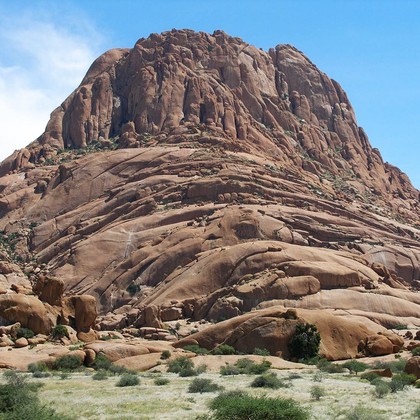
Mountains, gorges, cliffs and rock faces, from sea level to high in the Drakensberg; it hunts over fynbos, grassland, woodland and farmland, often far from the breeding site. It breeds in deep crevices in cliffs, sometimes behind waterfalls or in tall buildings. Parties follow storm fronts and hunt insects carried up by rising air.
Where the bird is most at home, classified by the vegetation units of southern Africa.


Range and movements
Breeds in the mountains of South Africa (from the Cape Fold ranges to the Drakensberg and Limpopo), Lesotho, Eswatini and eastern Zimbabwe, and locally in Mozambique, Malawi, Zambia, Namibia and Angola. In the southern winter most birds leave the interior; some remain in the south-west. Beyond the region in the mountains of eastern and central Africa, Cameroon and Madagascar.
- Resident
- Summer visitor (c. Oct–Mar)
- Passage (Mar–Apr, Oct–Nov)
- dark = core range, pale = thinly spread
How and when to look
Look for parties over high cliffs in the Drakensberg, the Cape mountains or the Magaliesberg, especially in the afternoon as a storm approaches. In side light check the upperwing: the pale panel in the inner wing against the black back separates it from Common Swift.
Conservation status
Not threatened and locally common in the mountains of the region. Breeding sites on high cliffs are hardly threatened; declines in flying insects through agricultural chemicals may play a role.
Scientific name
Apus barbatus | (Sclater, 1866)
Sclater described the species in 1866 as Cypselus barbatus; because it was later moved to another genus, the author and year stand in brackets. The genus Apus was introduced in 1777 by Scopoli. Apus is Latin for a swift, from Greek a- 'without' and pous 'foot', the ancients taking it for a kind of swallow without feet. barbatus is Latin for 'bearded', probably for the pale chin and throat patch. The specimen the first description was based on came from Cape Province, South Africa.