All species › Cuckoos › Cuckoos › African Emerald Cuckoo
African Emerald Cuckoo | Chrysococcyx cupreus
Smaragdkoekoek | Cuclillo Esmeralda Africano
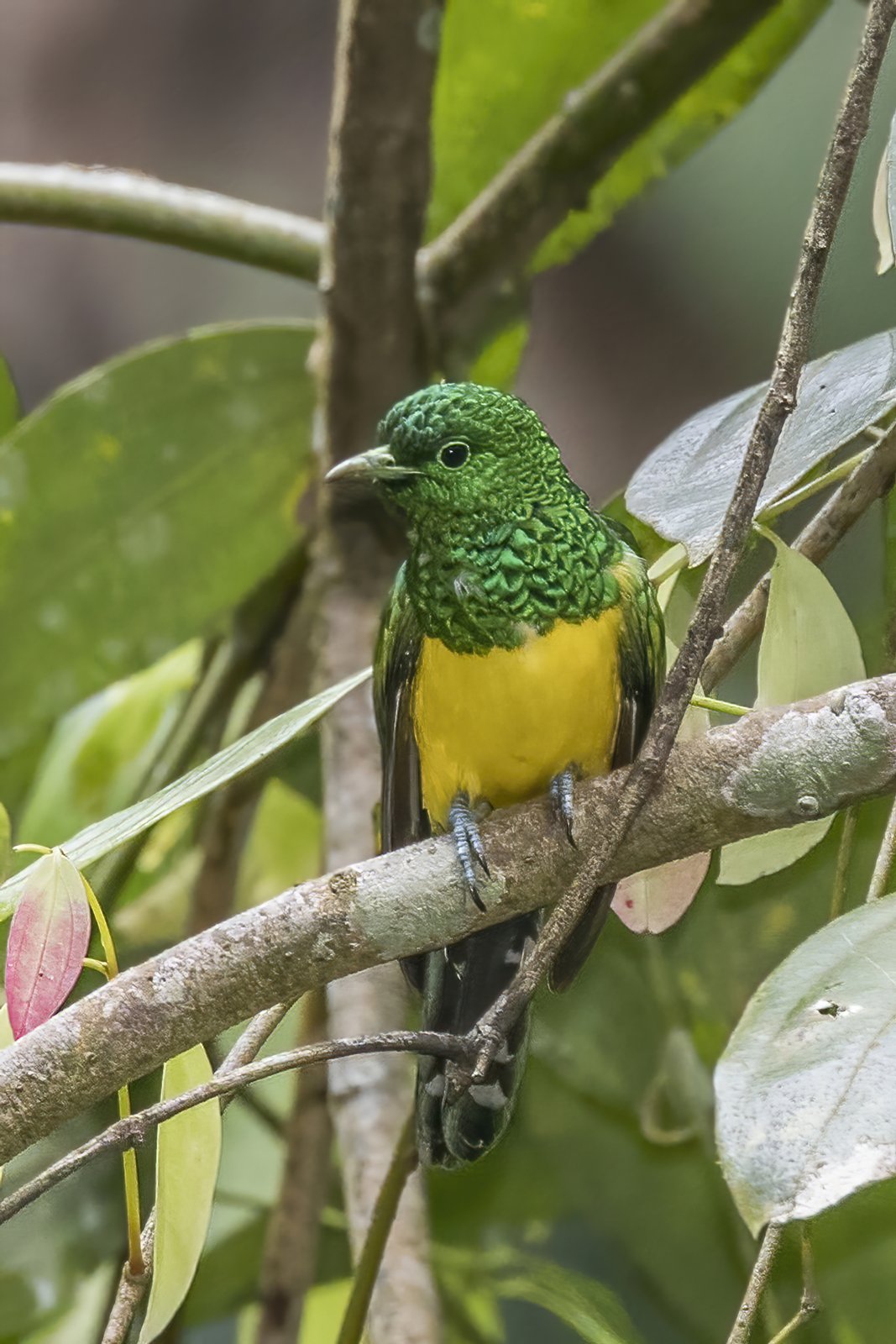
The African Emerald Cuckoo is a bird of the African forest: the male is sparkling emerald green with a bright yellow belly. It is nonetheless rarely seen, keeping high in the canopy of evergreen forest. Its whistled call is one of the characteristic summer sounds of the eastern forests.
Voice
A clear, whistled four-note phrase, often rendered pretty geor-gie or hello ju-dy, with the second note highest and the last two falling; it is repeated monotonously for long periods from the canopy. The female is almost silent.
Recording: Jonathan Onongo — CC BY-NC-SA 4.0 · converted to mono · xeno-canto
Identification
20–22 cm, with a fairly long, rounded tail. The male is glossy emerald green on the head, throat, breast, back and wings, with a golden to blue sheen, and has a bright yellow belly and undertail; the outer tail feathers are barred white. The eye is dark with a blue-green eye-ring and the bill blue-green. The female is bronze-green above with fine rufous and green barring, the crown barred rusty brown, and white below with dense glossy green bars. Juveniles resemble the female but are duller.
Confusion species
The yellow-bellied male is unmistakable. The male Klaas's Cuckoo (Chrysococcyx klaas) is smaller and white below; Diederik Cuckoo (Chrysococcyx caprius) has a white supercilium and white wing spots. The female resembles females of those two but is larger and longer-tailed, more densely and greener barred across the whole underparts, and lacks both the white supercilium and the white spot behind the eye.
Habitat
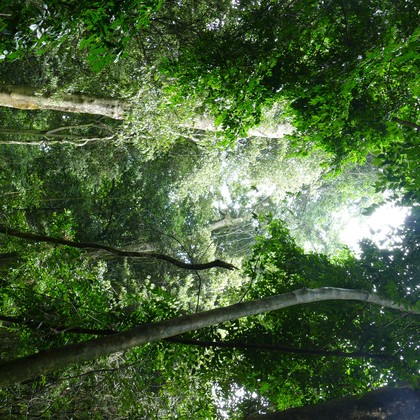
Evergreen lowland, coastal and montane forest, gallery forest along rivers and dense thickets with tall trees. It stays in the middle and upper canopy, searching for caterpillars, moths and other insects. As a brood parasite it mainly uses forest passerines such as greenbuls, puffbacks, batises and warblers.
Where the bird is most at home, classified by the vegetation units of southern Africa.

Range and movements
An eastern forest belt: from the forests of the Eastern Cape and Pondoland north through KwaZulu-Natal, Eswatini and the Mpumalanga and Limpopo escarpment, on through eastern Zimbabwe, Mozambique, Malawi and Zambia to northern and western Angola. Scarce and irregular in the Caprivi and northern Botswana; absent from the arid west. Beyond the region it occurs across the forested parts of Africa south of the Sahara, from Senegal to Ethiopia.
- Resident
- Summer visitor (c. Oct–Mar)
- Winter visitor (c. Apr–Sep)
- Passage (Mar–Apr, Oct–Nov)
- dark = core range, pale = thinly spread
How and when to look
October to January, in the morning, follow the call in a large forest block. The male often sits for a long time on a single high branch in the canopy; scan with a telescope from a viewpoint or forest edge rather than from beneath the tree. In sunlight the green glows, and the yellow belly gives the bird away when it leans forward.
Conservation status
Not threatened and widely distributed. In the south it depends on indigenous forest and is therefore sensitive to deforestation and fragmentation; small forest remnants are abandoned. Elsewhere common in suitable forest.
Scientific name
Chrysococcyx cupreus | (Shaw, 1792)
Shaw described the species in 1792 as Cuculus cupreus; because it was later moved to another genus, the author and year stand in brackets. The genus Chrysococcyx was introduced in 1826 by Boie. Chrysococcyx comes from the Greek chrysos, 'gold', and kokkyx, 'cuckoo' — for the metallic green-and-gold upperparts. cupreus is Latin for 'coppery' — for the metallic upperparts. The specimen the first description was based on came from Gambia.