All species › Cuckoos › Cuckoos › Klaas's Cuckoo
Klaas's Cuckoo | Chrysococcyx klaas
Klaas' koekoek | Cuclillo de Klaas
Klaas's Cuckoo is a small glossy cuckoo, metallic green above and white below, that is heard far more often than seen. It lays its eggs mainly in the nests of sunbirds, batises and small warblers, and is as much at home in gardens with indigenous trees as along forest edges and in woodland.

Voice
A soft, plaintive, repeated may-kie, may-kie or huee-jee, given from a fixed song post and often kept up for long periods; the Afrikaans name Meitjie derives from it. Also a fast descending series of the same notes.
Recording: Nick Schaller — CC BY-NC-SA 4.0 · converted to mono · xeno-canto
Identification
17–18 cm. The male is glossy emerald to bronze-green above, with white underparts and a green patch on the side of the breast that looks like a partial breast band. There is a small white spot behind the eye; a white supercilium is absent or at most a faint line behind the eye. The wings are plain green without white spots, and the outer tail feathers are white with green bars. The eye is dark brown and the bill greenish. The female is bronze-brown above with fine green and rufous barring, white below with fine brown bars, and also shows the white spot behind the eye. Juveniles resemble the female but are duller and more densely barred.
Confusion species
Diederik Cuckoo (Chrysococcyx caprius) is slightly larger, has a bold white supercilium in front of and behind the eye, clear white spots on the wings and, in the male, a red eye; its flanks are also more coarsely barred green. African Emerald Cuckoo (Chrysococcyx cupreus) is larger, and the male has a bright yellow belly. Females of Klaas's and Diederik Cuckoo are the hardest pair: look for the lack of white wing spots and the fairly plain side of the head in Klaas's.
Habitat
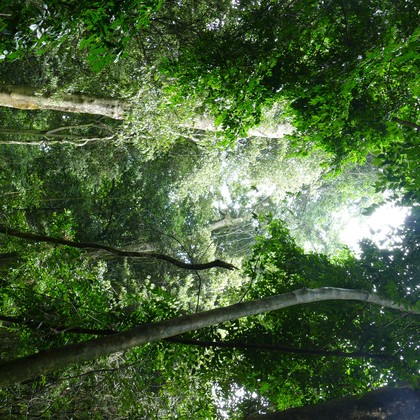
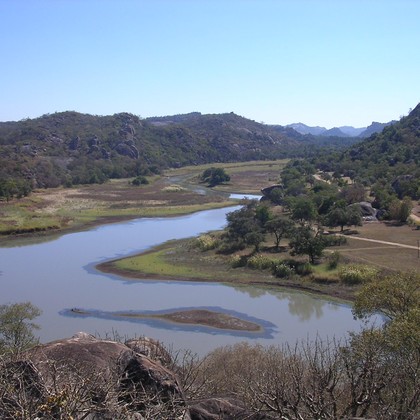
Forest edges, riverine forest, open evergreen forest, moist woodland and miombo, as well as parks, plantations and gardens with trees. It forages in the canopy, mainly on caterpillars, including hairy ones. As a brood parasite it uses a wide range of small passerines, particularly batises, sunbirds, apalises, eremomelas and prinias.
Where the bird is most at home, classified by the vegetation units of southern Africa.

Range and movements
Across most of the region, from the south coast and the Eastern Cape through KwaZulu-Natal, Eswatini and the east and north of South Africa to Zimbabwe, Mozambique, Malawi, Zambia, northern Botswana, northern and central Namibia and Angola; absent from the driest parts of the Karoo, the Kalahari and the Namib. Partly resident in the east and along the south coast, elsewhere mainly present in the wet summer. Beyond the region it occurs across almost all of Africa south of the Sahara and in south-western Arabia.
- Resident
- Summer visitor (c. Oct–Mar)
- Winter visitor (c. Apr–Sep)
- Passage (Mar–Apr, Oct–Nov)
- dark = core range, pale = thinly spread
How and when to look
Follow the call from October to January, when the male calls for hours from a fixed branch. Search the canopy of a forest-edge or garden tree; the male often sits upright on a bare twig, where the white breast makes it easy to see. With a female-type bird, always check the wings for white spots to rule out Diederik Cuckoo.
Conservation status
Not threatened and common across most of the region. It benefits from gardens and plantings with indigenous trees and shrubs. There is no evidence of large declines; it disappears locally where forest edges and riverine woodland are cleared.
Scientific name
Chrysococcyx klaas | (Stephens, 1815)
Stephens described the species in 1815 as Cuculus Klaas; because it was later moved to another genus, the author and year stand in brackets. The genus Chrysococcyx was introduced in 1826 by Boie. Chrysococcyx comes from the Greek chrysos, 'gold', and kokkyx, 'cuckoo' — for the metallic green-and-gold upperparts. klaas honours Klaas, the Khoikhoi servant and hunting companion of François Levaillant on his travels in southern Africa. The specimen the first description was based on came from Cape Colony, South Africa.