All species › Cuckoos › Cuckoos › Diederik Cuckoo
Diederik Cuckoo | Chrysococcyx caprius
Diederikkoekoek | Cuclillo Didric
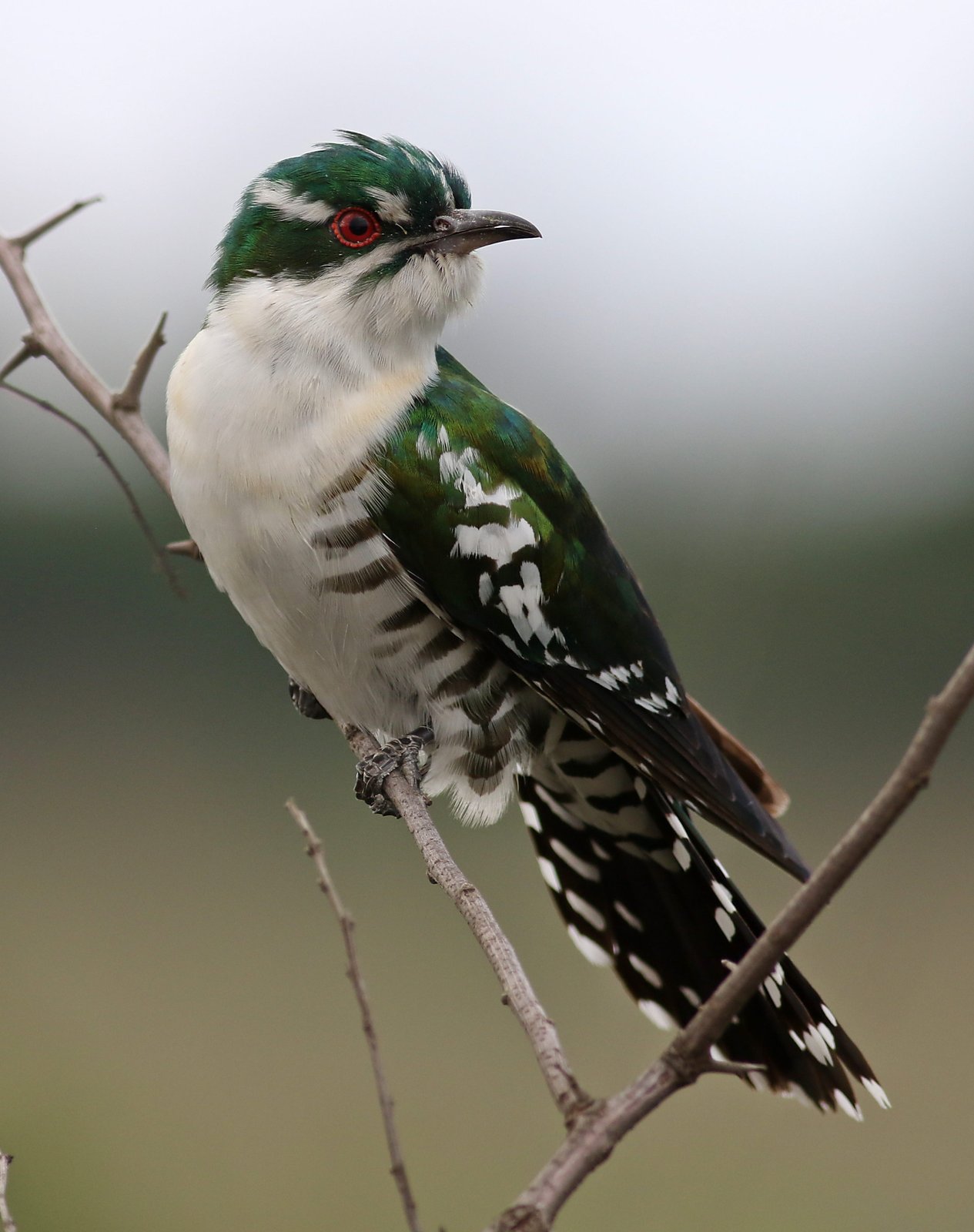
The Diederik Cuckoo is a small, metallic-glossed cuckoo named after its call: a clear, rising dee-dee-dee-deederik heard almost everywhere in the region in summer. It parasitises mainly weavers, bishops and sparrows and so is found from reedbed colonies to town gardens. Of the region's three glossy cuckoos it is by far the most widespread.
Voice
A clear, rising and loud series, dee-dee-dee-deederik, often repeated many times and given by the male both from a lookout and in flight. The female gives a soft, plaintive deea-deea. One of the most frequently heard summer sounds of the region, even in the midday heat.
Recording: Jaap van der Waarde — CC BY-NC-SA 4.0 · converted to mono · xeno-canto
Identification
18–20 cm. The male is glossy metallic green above with a bronze or coppery sheen, with conspicuous white spots on the wing coverts and inner webs of the flight feathers and white tips to the outer tail feathers. A white stripe runs before and behind the eye, broken by a green eye-stripe; the iris and eye-ring are red. The underparts are white with green barring on the flanks. The female is more bronzy, with a buff-tinged throat and breast and more barring on the flanks. Juveniles have a striking coral-red bill, rufous-barred upperparts and spotted underparts. It flies fast and straight, often in chases.
Confusion species
Klaas's Cuckoo Chrysococcyx klaas is slightly smaller, lacks the white spots in the wing and has only a small white patch behind the eye, and a dark eye. The male African Emerald Cuckoo Chrysococcyx cupreus is bright emerald green with a yellow belly; females are barred green over the entire underparts. When in doubt the call settles it.
Habitat
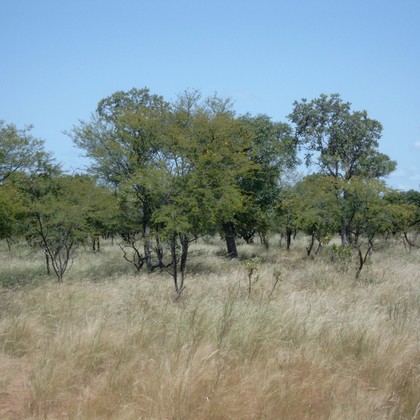
Almost all open and semi-open country with weavers and bishops: acacia savanna, bushveld, reedbeds and riverside scrub along dams and rivers, farmland, parks and gardens, to the edges of the Karoo. It eats mainly hairy caterpillars, also other insects. Important hosts include Southern Masked Weaver Ploceus velatus, Village Weaver Ploceus cucullatus, Southern Red Bishop Euplectes orix and Cape Sparrow Passer melanurus.
Where the bird is most at home, classified by the vegetation units of southern Africa.


Range and movements
A summer visitor throughout the region, from Angola, Zambia, Malawi and Mozambique through Zimbabwe, Botswana and Namibia to all of South Africa, Lesotho and Eswatini; scarce only in the barren Namib and the highest parts of Lesotho. In the north of the region some birds stay all year. Beyond the region it is widespread in almost all of sub-Saharan Africa and in south-western Arabia.
- Summer visitor (c. Oct–Mar)
- Passage (Mar–Apr, Oct–Nov)
- dark = core range, pale = thinly spread
How and when to look
October to February at a weaver colony in reeds or a tree over water: males call from a bare branch and the weavers alarm loudly when a cuckoo comes too close to the nests. Later in summer look for young cuckoos with red bills begging behind a weaver or bishop.
Conservation status
Not threatened and common over a very large range. In the region it benefits from the abundant weavers and bishops on farmland, around dams and in gardens; there is no evidence of declines.
Scientific name
Chrysococcyx caprius | (Boddaert, 1783)
Boddaert described the species in 1783 as Cuculus caprius; because it was later moved to another genus, the author and year stand in brackets. The genus Chrysococcyx was introduced in 1826 by Boie. Chrysococcyx comes from the Greek chrysos, 'gold', and kokkyx, 'cuckoo' — for the metallic green-and-gold upperparts. According to Jobling, caprius derives from the Latin cupreus, 'coppery' — for the metallic sheen of the plumage. The specimen the first description was based on came from Cape of Good Hope.