All species › Passerines › Reed warblers › African Yellow Warbler
African Yellow Warbler | Iduna natalensis
Gele rietzanger | Zarcero de Natal
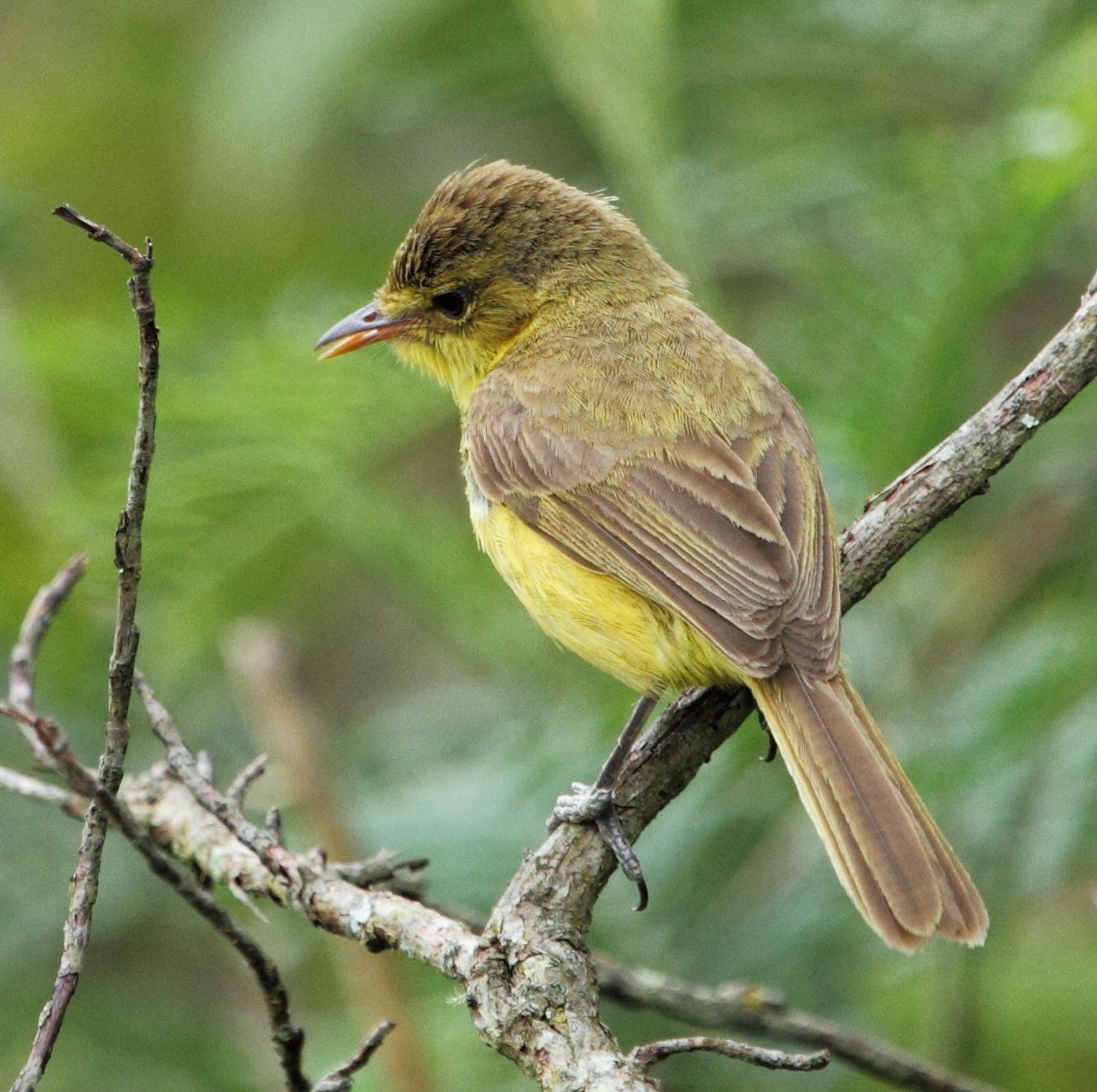
The African Yellow Warbler is a yellow-brown and bright yellow warbler of rank, damp vegetation in the east and north of the region, from the Eastern Cape to Angola. Despite its reed-warbler relatives it does not live in reeds but in tangles of tall herbs, bracken and shrubs along streams and forest edges, and with its broad, flat bill it suggests a flycatcher rather than a reed warbler.
Voice
The song is a short, forceful and rather jerky series of clear whistles and chattering notes, chip-chip-cheeree-cheeree, often repeated from a projecting stem. The call is a hard chak, with a rasping, rattling chrrr when alarmed.
Recording: Faansie Peacock — CC BY-NC-SA 4.0 · converted to mono · xeno-canto
Identification
14–15 cm, with a round head, a broad, flat bill with a dark upper and paler lower mandible, and a long, rounded tail. The upperparts are warm olive-brown with a yellowish tone, the underparts bright yellow, washed brownish on the flanks. The lores are yellow, a true supercilium is lacking and the eyes look large in the plain face. The wings are short and rounded, without a panel; the legs are grey. The male is slightly brighter yellow than the female; juveniles are browner above and duller below. It often perches upright on a stem and catches insects in short sallies, also in the air.
Confusion species
Icterine Warbler Hippolais icterina is greener above, has long wings with a pale panel, an orange-pink lower mandible and a flat crown, and is a summer visitor to dry savanna, not damp tangles. Mountain Yellow Warbler Iduna similis is dark olive-green above, lives higher in the mountains of northern Malawi and Zambia and has a richer song. Willow Warbler Phylloscopus trochilus is smaller and slimmer, with a fine bill, a clear supercilium and restless leaf-warbler behaviour. Yellow-Throated Woodland Warbler Phylloscopus ruficapilla is smaller and lives in the canopy of montane forest. Female weavers are bulkier, with a conical bill.
Habitat
Dense tangles of tall herbs, bracken, shrubs and creepers along streams, vleis and marsh edges, at the edges of montane and riverine forest and in neglected corners of plantations, from sea level to over 2,000 m, but mainly in hilly and mountainous country. It feeds on insects taken low in the vegetation or caught in short sallies.
Where the bird is most at home, classified by the vegetation units of southern Africa.


Range and movements
Within the region in eastern South Africa (Eastern Cape eastwards, KwaZulu-Natal, Mpumalanga and the mountains of Limpopo), Eswatini, locally in western Lesotho, in the Eastern Highlands of Zimbabwe and the mountain areas of Mozambique, fairly common in Malawi and northern and eastern Zambia, and in the central and northern highlands of Angola; absent from the arid west. Beyond the region from the highlands of Nigeria and Cameroon to Ethiopia and south through East Africa.
- Resident
- Summer visitor (c. Oct–Mar)
- Winter visitor (c. Apr–Sep)
- Passage (Mar–Apr, Oct–Nov)
- dark = core range, pale = thinly spread
How and when to look
All year, but easiest to find in summer (October–February), when males sing. Look for bracken and herb tangles along forest streams, for example in the Drakensberg foothills of KwaZulu-Natal, Magoebaskloof in Limpopo or the Bvumba in Zimbabwe. Watch for a yellow bird perched upright on a stem that suddenly snatches an insect from the air.
Conservation status
Not threatened and widespread over a large range. Suitable habitat disappears locally through the draining of vleis, overgrazing, frequent fires and the conversion of rank growth to plantations or fields.
Scientific name
Iduna natalensis | (Smith, 1847)
Smith described the species in 1847 as Chloropeta natalensis; because it was later moved to another genus, the author and year stand in brackets. The genus Iduna was introduced in 1840 by Keyserling & Blasius. Iduna refers to Iðunn (Iduna) of Norse mythology, goddess of spring and fertility and keeper of the magic apples of rejuvenation. She was changed into a sparrow so that Loki, in falcon form, could rescue her from the giant Þjazi. natalensis means 'of Natal', the old name of present-day KwaZulu-Natal, where the first specimen came from. The specimen the first description was based on came from Durban, South Africa.