All species › Woodpeckers and allies › African barbets › Anchieta's Barbet
Anchieta's Barbet | Stactolaema anchietae
Geelkopbaardvogel | Barbudo de Anchieta
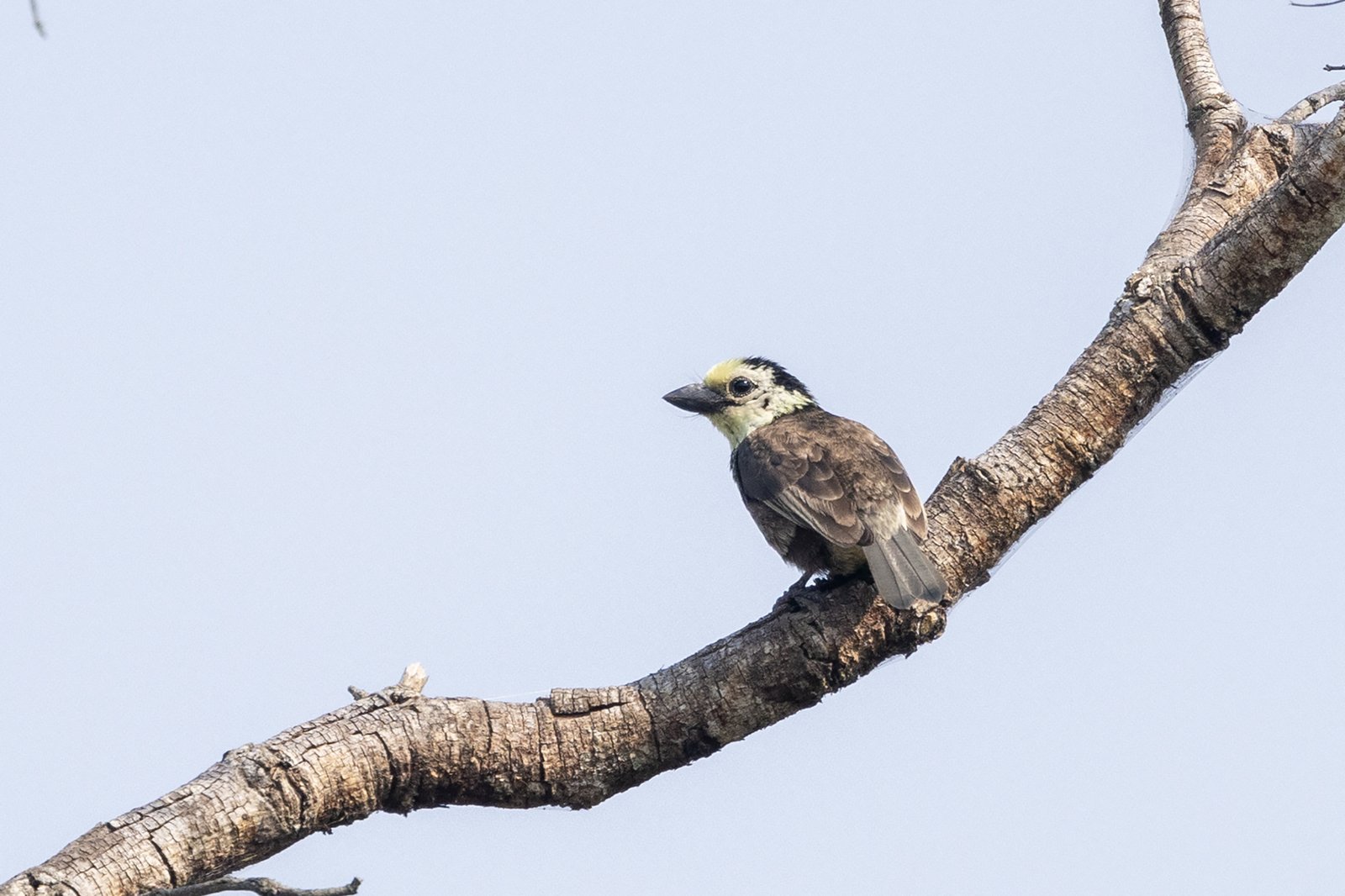
Anchieta's Barbet is a medium-sized, dark brown barbet with a pale yellow head, confined to the miombo plateau of Angola, Zambia and southern DR Congo. It lives in small family groups that visit fig trees together and share a breeding cavity.
Voice
A series of soft, hollow, owl-like hoots, hoo-hoo-hoo-hoo, often sustained from a hidden perch, plus a hoarse squeaky chatter and dry chrrr notes as group members keep in contact.
Recording: Dries Van de Loock — CC BY-NC-SA 4.0 · converted to mono · xeno-canto
Identification
About 18 cm, compact, with a short tail and a heavy blackish bill fringed with bristles at the base. Forehead, crown and cheeks are pale yellow to yellowish-white, sharply demarcated from the dark brown nape and back. The underparts are dark brown with pale yellowish streaks and spots on throat and breast; the flight feathers have narrow yellow edges. The subspecies differ in the intensity of the yellow: birds in western Angola have a whiter head, those in Zambia and Katanga a deeper yellow face. The sexes are alike; juveniles have a duller, browner-mottled head.
Confusion species
Whyte's Barbet (Stactolaema whytii), of north-eastern Zambia and Malawi, has only a yellow forehead and eyebrow, a white wing patch and a plainer, browner head. White-Eared Barbet (Stactolaema leucotis) is black with a white stripe behind the eye and a white belly, and within the region occurs only in eastern Mozambique. The pale yellow head on an otherwise dark body is diagnostic.
Habitat
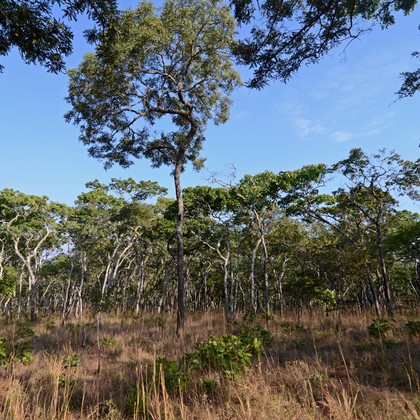
Miombo and other broadleaved plateau woodland, especially where large figs, Uapaca and other fruiting trees grow, also riparian forest and wooded dambo margins. It eats mainly fruit, supplemented with insects. It excavates a cavity in dead wood; a breeding pair is often assisted by earlier offspring, and the group roosts together in a hole.
Where the bird is most at home, classified by the vegetation units of southern Africa.

Range and movements
The central and eastern plateau of Angola and northern and western Zambia, east to about the Copperbelt and the north of Northern Province; local and scarce. Beyond the region only in south-eastern DR Congo (Katanga).
- Resident
- dark = core range, pale = thinly spread
How and when to look
In miombo look for fruiting figs, where the group feeds alongside other barbets and turacos. The hollow call gives it away, but the bird often sits quietly and unobtrusively in the canopy. North-western Zambia (around Mwinilunga) and the Angolan plateau offer the best chances.
Conservation status
Not threatened. The range is restricted but fairly large, and the species is locally common. Clearing of miombo for charcoal and farming reduces habitat locally, above all through the loss of large fruiting trees and standing dead wood.
Scientific name
Stactolaema anchietae | (Bocage, 1869)
Bocage described the species in 1869 as Buccanodon anchietae; because it was later moved to another genus, the author and year stand in brackets. The genus Stactolaema was introduced in 1870 by Marshall & Marshall. Stactolaema comes from the Greek staktos, 'dripping', and laimos, 'throat' — for the streaked, as if tear-stained throat and breast of the type species. anchietae honours the Portuguese naturalist José Alberto de Oliveira Anchieta (1832–1897), who collected in Angola. The specimen the first description was based on came from Caconda, Angola.