All species › Woodpeckers and allies › African barbets › White-Headed Barbet
White-Headed Barbet | Lybius leucocephalus
Witkopbaardvogel | Barbudo Cabeciblanco
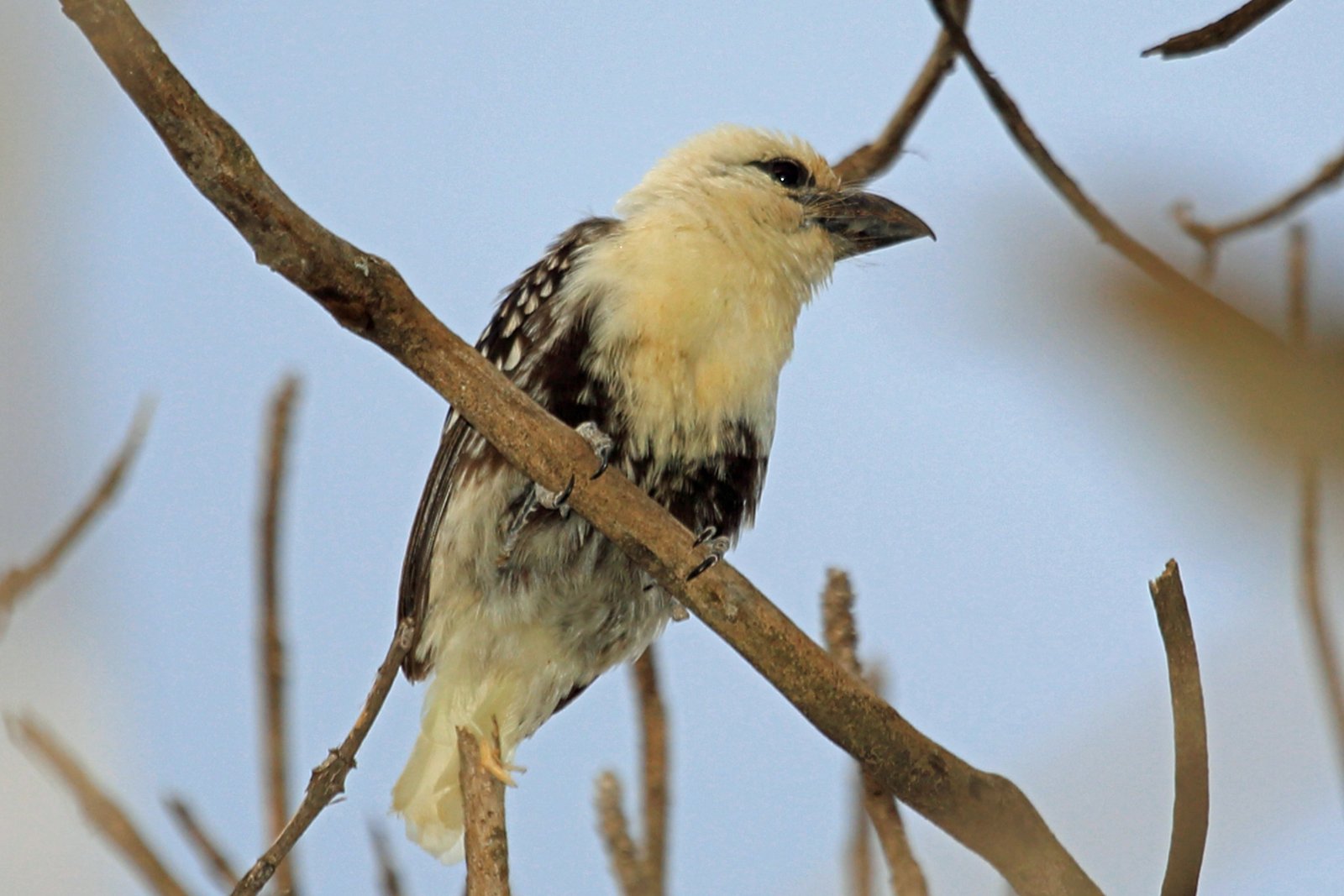
The White-Headed Barbet is a sturdy black-and-white barbet with an entirely white head. In the region only the Angolan subspecies leucogaster occurs, which went unrecorded for decades after 1971 and was only rediscovered in 2017 on the escarpment near Lubango.
Voice
Harsh, hoarse cackling and grating kek notes, often from two or more birds together, with bill-snapping; poorly documented for the Angolan form.
Recording: Rory Nefdt — CC BY-NC-SA 4.0 · converted to mono · xeno-canto
Identification
About 18–19 cm, with a heavy black bill. In the subspecies leucogaster the head, neck and underparts are pure white, the back, wings and tail dark blackish-brown, with a white wing patch and pale edges to the coverts. The tail is dark. The sexes are alike; juveniles are duller, with a brownish wash to the head. Other subspecies in East Africa have a brown belly or a white tail.
Confusion species
Not confusable with any other barbet in the region. Chaplin's Barbet (Lybius chaplini) in Zambia is also largely white, but has red bare skin around the eye and yellow-edged flight feathers, and does not overlap in range. At distance a pied shrike might catch the eye, but the thick bill and stocky build are distinctive.
Habitat
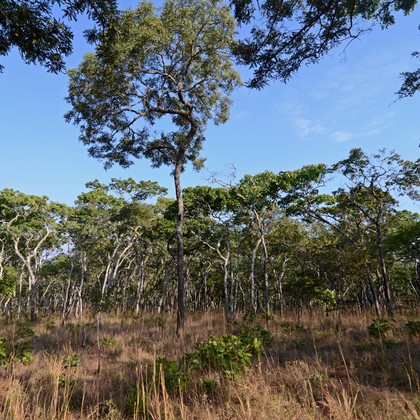
In Angola closed woodland, riverine woodland and copses on the western escarpment, with a preference for large trees and especially figs; at Tundavala also in low miombo scrub between taller tree clumps, to over 2000 m. It feeds mainly on fruit, supplemented with insects.
Where the bird is most at home, classified by the vegetation units of southern Africa.

Range and movements
Within the region only in south-western Angola, on and around the Huíla escarpment near Lubango; possibly further along the western escarpment. Beyond the region other subspecies range from southern Sudan, Uganda and Kenya to Tanzania, and in eastern DR Congo.
- Resident
- dark = core range, pale = thinly spread
How and when to look
Tundavala near Lubango is where the Angolan form was rediscovered in 2017. Check fruiting figs on the slopes and the tree clumps in the scrub, early in the morning when the birds move about actively.
Conservation status
The species as a whole is not threatened. The Angolan subspecies leucogaster, however, is highly localised, small in number and poorly known; clearing and burning on the escarpment are potential threats.
Scientific name
Lybius leucocephalus | (de Filippi, 1853)
De Filippi described the species in 1853 as Laimodon leucocephalus; because it was later moved to another genus, the author and year stand in brackets. The genus Lybius was introduced in 1783 by Hermann. Lybius derives from the Greek libyos, an unidentified bird mentioned by Aristotle, possibly allied to woodpeckers; Libya, the classical name for Africa, may also play a part. leucocephalus comes from the Greek leukos, 'white', and kephalē, 'head' — for the white head. The specimen the first description was based on came from White Nile between 3° and 4° N, South Sudan.