All species › Woodpeckers and allies › African barbets › Chaplin's Barbet
Chaplin's Barbet | Lybius chaplini
Chaplins baardvogel | Barbudo de Chaplin
Chaplin's Barbet is Zambia's only endemic bird species: a white barbet with black wings and back and a red patch around the eye. It is closely tied to old sycamore figs in open woodland in the south of the country.

Voice
A noisy chorus of buzzing, grating notes accelerating into a hoarse cackle, often from the whole group at once, accompanied by loud bill-snapping. In greeting, birds bob up and down and flap their wings.
Recording: Dries Van de Loock — CC BY-NC-SA 4.0 · converted to mono · xeno-canto
Identification
About 19 cm, with a heavy black bill. Head, neck and underparts are white, sometimes with a yellowish or dingy wash; back, wings and tail are black, with the flight feathers and coverts narrowly edged yellow. A bright red patch of bare skin surrounds the eye. The sexes are alike; juveniles are duller with less red around the eye.
Confusion species
Black-Collared Barbet (Lybius torquatus), which occurs in the same area, has an entirely red face with a black collar and a grey-brown back. White-Headed Barbet (Lybius leucocephalus) is also largely white, but lacks the red around the eye and the yellow wing edges and does not occur in Zambia. The white body with a red eye patch is unmistakable within the range.
Habitat
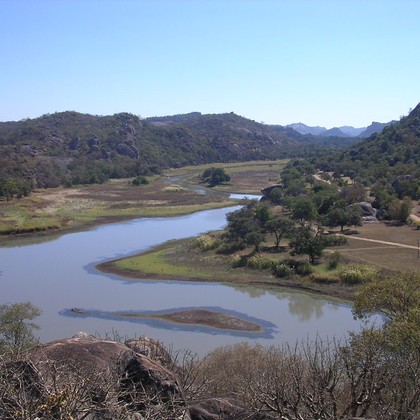
Open woodland with large, old sycamore figs (Ficus sycomorus), often along seasonal streams, dambo margins and on farmland where the figs have been left standing. It feeds mainly on figs, supplemented with other fruit and insects. It lives in groups of two to six birds that defend a territory fiercely and nests in a cavity in a dead branch of an old fig.
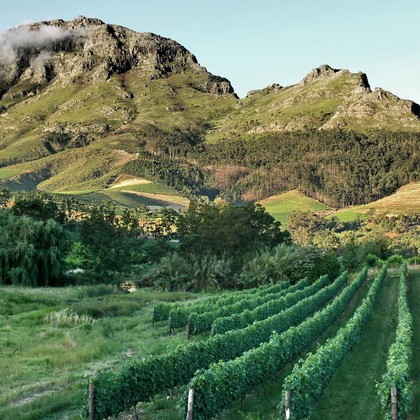
Where the bird is most at home, classified by the vegetation units of southern Africa.
Range and movements
Endemic to southern and central Zambia: from the upper Kafue and the margins of the Kafue Flats to Kalomo District in Southern Province, including the areas around Choma, Monze and Namwala. Found nowhere else in the world.
- Resident
- Winter visitor (c. Apr–Sep)
- dark = core range, pale = thinly spread
How and when to look
A well-known site is the Nkanga River Conservation Area near Choma, where groups frequent large figs. Search for old sycamore figs in farmland and listen for the cackling chorus; the birds often sit together on a high branch.
Conservation status
Vulnerable. The population is estimated at about 5,200 adult birds and is declining. Felling of old figs for agriculture and firewood, and the lack of young figs that could one day serve as nest trees, are the main threats; the species depends on fig trees several decades old.
Scientific name
Lybius chaplini | Clarke, 1920
Clarke described the species in 1920 and placed it straight away in the genus where it still stands. The genus Lybius was introduced in 1783 by Hermann. Lybius derives from the Greek libyos, an unidentified bird mentioned by Aristotle, possibly allied to woodpeckers; Libya, the classical name for Africa, may also play a part. chaplini honours Sir Francis Drummond Percy Chaplin (1866–1933), British colonial administrator in Northern and Southern Rhodesia. The specimen the first description was based on came from Kafue River, Zambia.