All species › Woodpeckers and allies › African barbets › Black-Collared Barbet
Black-Collared Barbet | Lybius torquatus
Zwarthalsbaardvogel | Barbudo Acollarado
The Black-Collared Barbet is a stocky barbet with a bright red face and a broad black collar. Pairs sing in perfect duet, timed so closely that it sounds like a single bird, with a bowing, wing-quivering display.

Voice
A rhythmic, flowing duet, too-puddly too-puddly too-puddly, one bird giving the too and the other the puddly, often repeated many times with bowing heads and half-spread wings. Also a rasping krrr and a dry bill-snapping when excited.
Recording: African Bioacoustics Community — CC BY-NC-SA 4.0 · converted to mono · xeno-canto
Identification
About 20 cm, with a heavy black bill fringed with bristles at the base. Forehead, face, throat and upper breast are scarlet, bordered below by a broad black band that continues around the nape. Upperparts and wings are grey-brown with fine yellow edges to the flight feathers; the underparts below the band are dirty white to pale yellow. The sexes are alike. Juveniles have a brown face speckled with red. A rare form has the red replaced by yellow.
Confusion species
Crested Barbet (Trachyphonus vaillantii) has a yellow, red-speckled face, a black crest and a spotted breast band. Black-Backed Barbet (Pogonornis minor) in the north has a pale bill, red only on the forehead and forecrown and a pinkish-red belly patch. Acacia Pied Barbet (Tricholaema leucomelas) and Miombo Pied Barbet (Tricholaema frontata) are smaller, with black-and-white striped heads and only a small red forehead spot.
Habitat
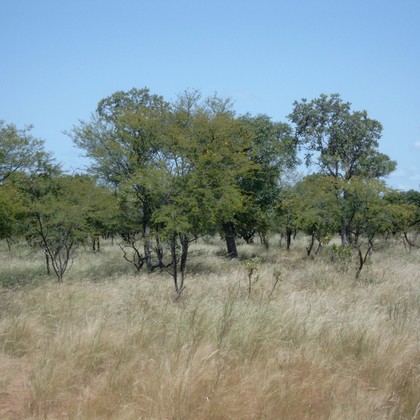
Open woodland, thornveld with tall trees, riverine woodland, forest edges, plantations and gardens in villages and suburbs. It feeds mainly on fruit, especially figs, supplemented with insects. The pair excavates a cavity in dead wood and also roosts there outside the breeding season; young from earlier broods sometimes help.
Where the bird is most at home, classified by the vegetation units of southern Africa.


Range and movements
Widespread in the east and north of the region: eastern South Africa from the Eastern Cape northwards, Eswatini, Mozambique, Zimbabwe, Malawi, Zambia, northern and eastern Botswana, north-eastern Namibia and southern and eastern Angola. Absent from Lesotho, the Karoo and the arid west. Beyond the region it reaches southern DR Congo, Tanzania and Kenya.
- Resident
- Summer visitor (c. Oct–Mar)
- Winter visitor (c. Apr–Sep)
- Passage (Mar–Apr, Oct–Nov)
- dark = core range, pale = thinly spread
How and when to look
The duet is the best clue and is most frequent in the breeding season, from September to January. Search gardens and fruiting fig trees; the bird often sits inconspicuously in the canopy and only draws attention when the pair begins to sing.
Conservation status
Not threatened and common. The species thrives in gardens and plantations and has spread locally with the planting of fruiting trees. Removal of dead trees reduces the supply of nest sites.
Scientific name
Lybius torquatus | (Dumont, 1805)
Dumont described the species in 1805 as Bucco torquatus; because it was later moved to another genus, the author and year stand in brackets. The genus Lybius was introduced in 1783 by Hermann. Lybius derives from the Greek libyos, an unidentified bird mentioned by Aristotle, possibly allied to woodpeckers; Libya, the classical name for Africa, may also play a part. torquatus is Latin for 'collared' — for the broad black band below the red throat. The specimen the first description was based on came from 'Brazil' (erroneous).