All species › Passerines › Sunbirds › Anchieta's Sunbird
Anchieta's Sunbird | Anthreptes anchietae
Anchieta's honingzuiger | Suimanga de Anchieta
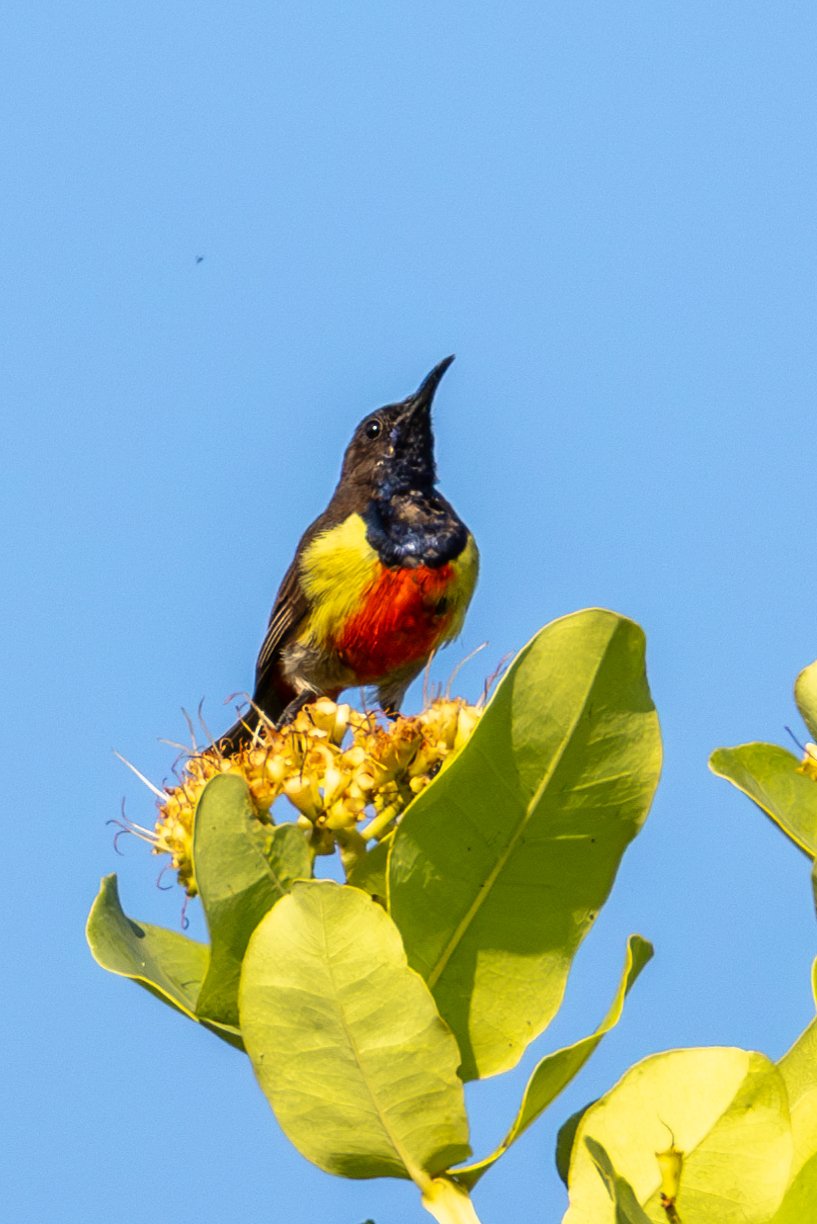
Anchieta's Sunbird is a colourful, short-billed sunbird of miombo woodland, in both sexes with a glossy blue head and throat and an orange-red breast with yellow flanks. It is tied to Brachystegia woodland and its flowering trees and mistletoes.
Voice
A very active caller, with a range of short, clear phrases such as tseu-werr, tsoo-wit and chip-choo-chip, often repeated several times. The song is a fast series of rising, chipping notes.
Recording: Dries Van de Loock — CC BY-NC-SA 4.0 · converted to mono · xeno-canto
Identification
About 11 cm, with a short, almost straight bill. The male has a glossy dark blue forehead, crown, chin and upper breast; nape, back, wings and tail are grey-brown. The centre of the breast has a vivid orange-red patch, flanked by bright yellow breast sides; the belly is pale yellow to greyish. The female is duller: the blue is limited to the forehead and a wash on the throat, and the breast is yellowish with less red. Juveniles are grey-brown above and yellow below with no blue.
Confusion species
No other miombo sunbird combines a blue head with an orange-red breast and yellow sides. Scarlet-Chested Sunbird (Chalcomitra senegalensis) has a scarlet breast but is larger and otherwise blackish-brown, with a long curved bill. Western Miombo Sunbird (Cinnyris gertrudis) has a metallic green head and a red breast band on a grey belly. Females may recall a female Collared Sunbird (Hedydipna collaris), which is green above and lacks blue on the forehead.
Habitat
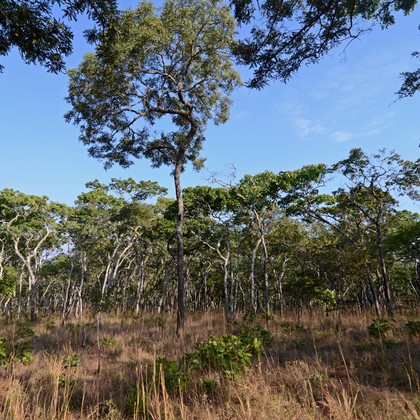
Miombo and other Brachystegia woodland, including degraded woodland, often on rocky slopes. It forages mainly in the canopy at flowering trees, mistletoes (Loranthaceae) and aloes, and gleans insects from foliage. Outside the breeding season it wanders with the flowering.
Where the bird is most at home, classified by the vegetation units of southern Africa.
Range and movements
Within the region in central and northern Angola, over most of the miombo in the northern half of Zambia, in central and northern Malawi and in northern Mozambique. Seasonal: in parts of Zambia it is absent during the rains, from November to April. Beyond the region in southern Congo-Kinshasa (Katanga) and south-western Tanzania.
- Resident
- dark = core range, pale = thinly spread
How and when to look
Best in the dry season, from May to October, when mistletoes and miombo trees flower and sunbirds gather at them. Well-known sites are Dzalanyama Forest in Malawi and the miombo of north-western Zambia. Listen for the busy, varied calls from the canopy, then look for the blue head.
Conservation status
Not threatened. The species is locally common, but depends on miombo woodland, which is being cleared on a large scale for farming and charcoal.
Scientific name
Anthreptes anchietae | (Bocage, 1878)
Bocage described the species in 1878 as Nectarinia anchietae; because it was later moved to another genus, the author and year stand in brackets. The genus Anthreptes was introduced in 1832 by Swainson. Anthreptes comes from the Greek anthos, 'flower', and threptēs, 'feeder' — for the habit of taking nectar from flowers. anchietae honours the Portuguese naturalist José Alberto de Oliveira Anchieta (1832–1897), who collected birds in Angola for decades. The specimen the first description was based on came from Caconda, Huíla, Angola.