All species › Passerines › Sunbirds › Plain-Backed Sunbird
Plain-Backed Sunbird | Anthreptes reichenowi
Blauwkeelhoningzuiger | Suimanga de Reichenow
The Plain-Backed Sunbird is a small, unobtrusive sunbird of lowland forest, with a plain olive-green back lacking any metallic gloss. Only the male has a glossy blue-violet forehead and throat. It lives mainly in the canopy and draws attention only once the call is known.
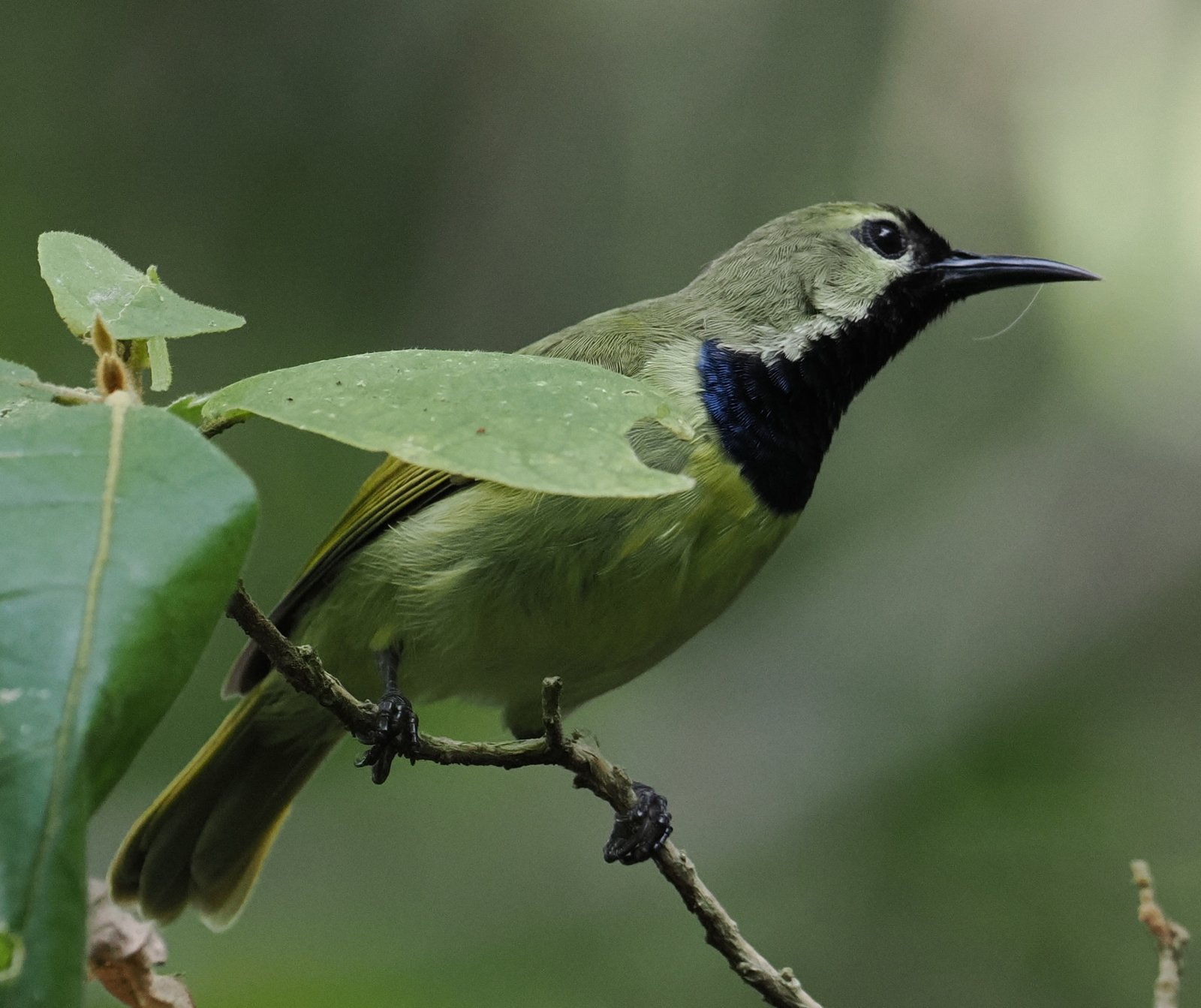
Click a thumbnail to switch the photo above.
Voice
A high, thin tsip or tseep contact call, often repeated from the canopy. The song is a rapid, high and rather high twitter lasting a few seconds, sometimes ending in a falling trill.
Recording: Louis A. Hansen — CC BY-NC-SA 4.0 · shortened to the first 60 s, mono · xeno-canto
Identification
About 10 cm, with a short, almost straight bill and a rather short tail. The male has a glossy blue-violet forehead, chin and throat; the rest of the upperparts is plain olive-green, the tail darker. The underparts are yellowish-olive, yellower on the belly, with yellow pectoral tufts shown in display. The female lacks all blue: olive-green above, pale yellow below with a greyish-white throat and a faint pale supercilium. Juveniles resemble the female.
Confusion species
Collared Sunbird (Hedydipna collaris) shares the same forests, but the male is metallic green above and on the throat with a narrow purple breast band, and even the female has a green gloss on the back. Olive Sunbird (Cyanomitra olivacea) is much larger, with a long curved bill and no blue. Neergaard's Sunbird (Cinnyris neergaardi) has a decurved bill and a metallic green male with a red breast band. With females, look for the short straight bill and the unglossed back.
Habitat
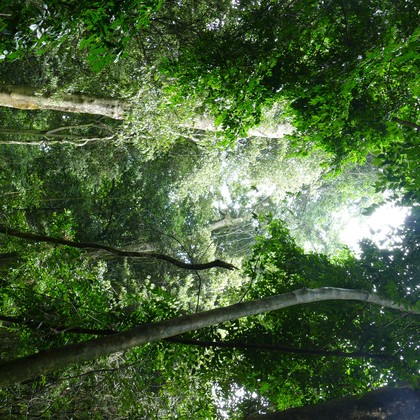
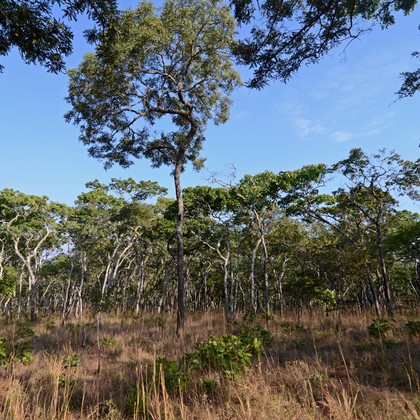
Near-coastal lowland forest, riverine forest, forest edge and dense tall thicket, locally also moist miombo next to forest, from sea level to about 1,000 m. It forages in the canopy and at flowering trees and creepers, often in small mixed parties, and gleans many small insects from leaves.
Where the bird is most at home, classified by the vegetation units of southern Africa.

Range and movements
Within the region on the coastal plain and in the lowland forests of Mozambique, from the north southward to the south of the country, and in eastern Zimbabwe, including Haroni-Rusitu and the Honde Valley. Whether it occurs regularly into the extreme north-east of KwaZulu-Natal is uncertain. Beyond the region a separate population lives in the coastal lowlands of Kenya and north-eastern Tanzania.
- Resident
- Summer visitor (c. Oct–Mar)
- Winter visitor (c. Apr–Sep)
- Passage (Mar–Apr, Oct–Nov)
- dark = core range, pale = thinly spread
How and when to look
Search Haroni-Rusitu or the coastal forests around Beira and Inhambane for small parties of sunbirds in the canopy, and listen for the high tsip. A sunbird with no gloss on the back but a blue throat is almost always this species; females can be named with certainty only in the company of a male.
Conservation status
Not threatened, but local in the region and dependent on lowland forest, which is steadily cleared for farming and charcoal. In Zimbabwe its small habitat at Haroni-Rusitu is seriously threatened.
Scientific name
Anthreptes reichenowi | Gunning, 1909
Gunning described the species in 1909 and placed it straight away in the genus where it still stands. The genus Anthreptes was introduced in 1832 by Swainson. Anthreptes comes from the Greek anthos, 'flower', and threptēs, 'feeder' — for the habit of taking nectar from flowers. reichenowi honours the German ornithologist Anton Reichenow (1847–1941), curator at the natural history museum in Berlin. The specimen the first description was based on came from Mzimbiti near Beira, Mozambique.