All species › Passerines › Weavers › Bar-Winged Weaver
Bar-Winged Weaver | Ploceus angolensis
Miombowever | Tejedor Alibarrado
The Bar-Winged Weaver is a dark, nuthatch-like weaver with white wing-bars and a yellow back, found in the region only in the lichen-rich woodland of Zambia and Angola. Like the Olive-Headed Weaver it does not nest in colonies, but lives in pairs among the old man's beard lichen in the tree crowns.

Voice
Not very vocal. A series of fast notes building to a loud, sizzling swizz-swizz-zizzzz; also high squeaks, buzzes and a rattling churr.
Recording: Dries Van de Loock — CC BY-NC-SA 4.0 · converted to mono · xeno-canto
Identification
About 13 cm, with a pointed black bill. Head, wings and tail are dark blackish-brown; the wing shows two bold white wing-bars and white edges and tips to the flight feathers. The back and rump are yellow, conspicuous as the bird creeps along branches and in flight. The underparts are pale, washed lemon-yellow on belly and flanks. The sexes are similar; the female has more white in the wing and is whiter below. Juveniles have a paler crown and a pale bill. There is no separate breeding and non-breeding plumage.
Confusion species
The combination of dark head, white wing-bars and yellow back makes confusion with other weavers unlikely. Dark-Backed Weaver (Ploceus bicolor) is also dark above, but has a dark back, no white wing-bars and deep yellow underparts, and lives in denser forest. Olive-Headed Weaver (Ploceus olivaceiceps) creeps through lichen-rich woodland in the same way, but is olive above, golden-yellow below and has a chestnut breast patch. At distance the foraging along branches suggests a tit or a creeper; the conical bill and yellow back make the difference.
Habitat
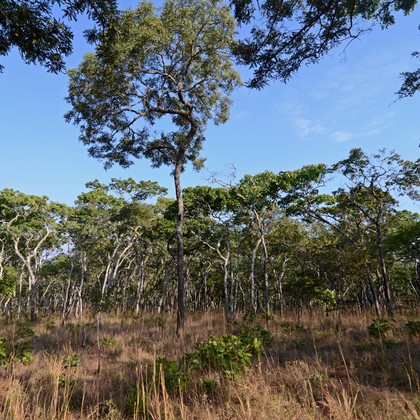
Mature miombo and dry evergreen Cryptosepalum forest (mavunda) where old man's beard lichen (Usnea) hangs abundantly in the canopy. It forages singly or in pairs for insects such as beetles, mantids and midge larvae, creeping nuthatch-like along branches and through the lichen, and joins mixed foraging flocks. The nest is a round ball with a downward-hanging entrance tube 3 to 21 cm long, hidden among the lichen. The clutch is two or three turquoise eggs with dark flecks.
Where the bird is most at home, classified by the vegetation units of southern Africa.
Range and movements
Within the region only in north-western and northern Zambia (including the Mwinilunga area and the mavunda forest of West Lunga) and in central and eastern Angola. Beyond the region only in south-eastern DR Congo (Katanga): a species almost confined to the miombo belt south of the Congo Basin.
- Resident
- dark = core range, pale = thinly spread
How and when to look
Search the tall, lichen-rich woodland of north-western Zambia, such as around Mwinilunga and in the Cryptosepalum forest of West Lunga, for mixed flocks in the canopy. The yellow back flashes as a bird creeps along a branch or flies off; the white wing-bars confirm the identification. In the breeding season the nest with its long hanging tube is a useful lead.
Conservation status
Not threatened, but closely tied to undisturbed, lichen-rich woodland. Logging, charcoal production, shifting cultivation and fire reduce that woodland locally. Much of the range lies in little-visited and poorly surveyed country.
Scientific name
Ploceus angolensis | (Bocage, 1878)
Bocage described the species in 1878 as Sharpia angolensis; because it was later moved to another genus, the author and year stand in brackets. The genus Ploceus was introduced in 1816 by Cuvier, GLCFD. Ploceus comes from the Greek plokeus, 'plaiter, weaver', for the tightly woven, ball-shaped nest that gives weavers their name. angolensis means 'of Angola' — for the country where the type was collected. The specimen the first description was based on came from Caconda, Angola.