All species › Passerines › Weavers › Olive-Headed Weaver
Olive-Headed Weaver | Ploceus olivaceiceps
Olijfkopwever | Tejedor Cabeciverde
The Olive-Headed Weaver is a scarce, unobtrusive weaver of mature miombo woodland. It does not nest in colonies but lives in pairs in the canopy, creeping along branches like a nuthatch. The nest is woven from old man's beard lichen (Usnea), and where that lichen disappears from the woodland, the bird disappears too.

Voice
Not very vocal. Soft, high, buzzing notes, roughly tsizz or zee-zee, and thin squeaks between the pair, easily lost in the chatter of a mixed foraging flock.
Recording: Niall Perrins — CC BY-NC-SA 4.0 · converted to mono · xeno-canto
Identification
About 14 cm, with a fairly long, pointed black bill. Head, neck and upperparts are dull olive-green, wings and tail olive-brown with greenish-yellow feather edges. The underparts are golden-yellow with a rufous to chestnut patch on the breast. The male has a golden-yellow crown and a larger, warmer breast patch; in the female the crown is olive like the rest of the head and the breast patch is smaller and fainter. Juveniles are paler and duller, with barely any breast patch. There is no separate breeding and non-breeding plumage.
Confusion species
Spectacled Weaver (Ploceus ocularis) also has an olive back and yellow underparts, but a yellow head with a narrow black eye-stripe, a pale eye and, in the male, a black bib; it lives in dense thickets and riverine forest, not in open miombo. Dark-Backed Weaver (Ploceus bicolor) is dark slate to blackish on head and back. Bar-Winged Weaver (Ploceus angolensis) shares the creeping behaviour in lichen-rich woodland but is dark on head and wings with white wing-bars and a yellow back; the ranges barely overlap. Other yellow weavers lack the chestnut breast patch and do not forage nuthatch-like along the bark.
Habitat
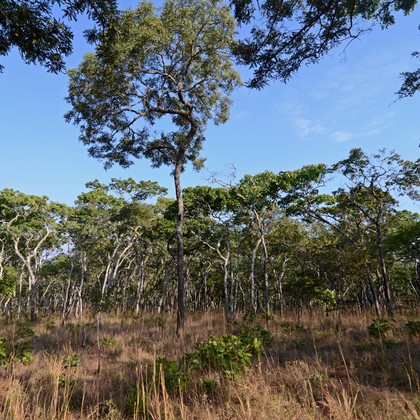
Tall, mature miombo woodland with Brachystegia trees and abundant old man's beard in the canopy; in southern Mozambique the dry, isolated woodland around Panda. It forages singly or in pairs in the canopy for insects and spiders, creeping along branches and among the lichen strands, and often joins mixed foraging flocks. The nest hangs high in the crown, is woven largely from lichen and is therefore hard to spot.
Where the bird is most at home, classified by the vegetation units of southern Africa.
Range and movements
Very local within the region: an isolated population in southern Mozambique around Panda (Inhambane Province), and further in northern Mozambique, parts of Malawi and very locally in north-eastern Zambia. Beyond the region only in southern Tanzania. The Panda population is the southernmost and best known.
- Resident
- Summer visitor (c. Oct–Mar)
- Passage (Mar–Apr, Oct–Nov)
- dark = core range, pale = thinly spread
How and when to look
Panda in Inhambane Province is the classic site in the region. Walk slowly through the tall woodland and watch for movement among the lichen strands in the canopy: the bird gives itself away by its creeping more than by its voice. Mixed foraging flocks are the best lead; follow one and check every yellow bird that works along a branch like a nuthatch. A local guide greatly improves the chances.
Conservation status
Near Threatened. The species depends on undisturbed, lichen-rich miombo and is declining through logging, charcoal production, cultivation and frequent fires, which also strip the lichen. The small Panda population in southern Mozambique is therefore particularly vulnerable.
Scientific name
Ploceus olivaceiceps | (Reichenow, 1899)
Reichenow described the species in 1899 as Symplectes olivaceiceps; because it was later moved to another genus, the author and year stand in brackets. The genus Ploceus was introduced in 1816 by Cuvier, GLCFD. Ploceus comes from the Greek plokeus, 'plaiter, weaver', for the tightly woven, ball-shaped nest that gives weavers their name. olivaceiceps is Latin for 'olive-headed', from olivaceus, 'olive-coloured', and -ceps, 'headed'. The specimen the first description was based on came from Songea, near the source of the Rovuma (Tanzania).